UK Blueberry Breeders Strive for Consistent Taste Appeal

Member News
The views expressed in this Member News article are the author's own and do not necessarily represent those of Agri-TechE.

James Hutton Limited, on behalf of the blueberry breeding consortium, contracted Delytics Ltd in 2020 to help them select new varieties that will be consistently liked by consumers.

Delytics is assisted the consortium to pinpoint blueberry varieties that will appeal to multiple consumer groups with distinct taste preferences. The aim was to track how each variety matures over time to determine its taste development and expected acceptance by specific target markets.

Dr Susan McCallum (pictured), who runs James Hutton’s blueberry breeding programme, says Delytics’ recognised expertise in crop taste optimisation is crucial for their consumer-focused breeding programme.
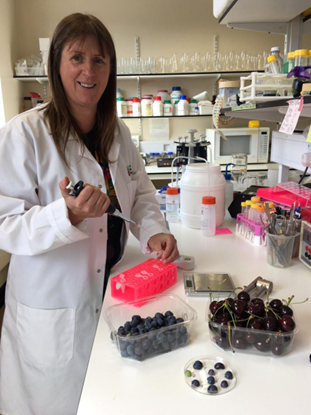
Dr McCallum says, “We are looking to breed blueberries for consistent high quality taste. It’s really important for us to understand the science behind the taste so we know which varieties will appeal to consumers. Delytics is helping us achieve that by analysing how the Brix and acid changes over time in each variety, how much consumers will like them, and the best time to pick for optimum taste.”

Previous sensory research conducted by the James Hutton Institute highlighted variations in taste preferences for blueberries in different consumer groups. The most notable of these was between male and female consumers, with males tending to prefer eating small tart tasting blueberries in their porridge or yoghurt and females preferring to snack on larger, sweeter blueberries.

Dr McCallum says the work the breeding consortium is doing with Delytics has the potential to allow them to intentionally breed blueberry varieties that meet the taste expectations of specific consumers.

The monitoring framework being used for this project was initially designed by Delytics to help The James Hutton Institute raspberry breeding programme develop a new consumer-centric breeding protocol in 2018. Delytics’ monitoring protocols are now also being used to help ensure the majority of James Hutton bred blueberries and cherries will be liked by consumers.

Dr McCallum says, “Delytics is playing a really important role in helping us understand the role that Brix and acid plays in providing the flavour in our berries so we can ensure the ones we select will be consistently liked by consumers. The data analysis they are doing will also tell us the best time to pick the berries to make sure the flavour comes through every time.”

“We want growers to be confident that when they invest in our cultivars and follow our growing and picking instructions, they will get an ongoing good return.”

  • *I have permission from the copyright holder to publish this content and images.

Breeding Raspberries for Optimum Taste

Member News
The views expressed in this Member News article are the author's own and do not necessarily represent those of Agri-TechE.

Delytics has helped the globally recognised James Hutton Institute create a new breeding protocol to ensure the majority of their raspberries are liked by consumers.

In 2018, the James Hutton Institute contracted Delytics to assist in the study: `Feasibility of developing a Novel Breeding Methodology to Improve Berry Flavour’. Supported through funding from Innovate UK, the project was commissioned to improve raspberry flavour by developing new breeding models and decision support tools. Prior to working with Delytics, the James Hutton research team was unable to validate how the sensory data they were collecting from taste panels matched consumer taste preferences. Delytics assisted them by providing a customised consumer liking measurement protocol, which enabled them to identify the genetic regions for liking in raspberries and better understand what the consumer response would be to various raspberry breeds.

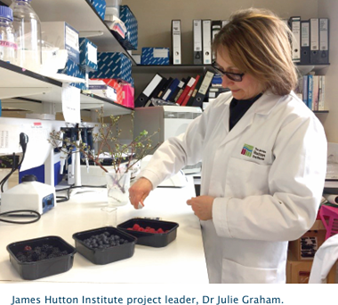
James Hutton Institute project leader, Dr Julie Graham, says Delytics’ helped the research team `take a big step forward’ by understanding how to select raspberry seedlings from the breeding plots that will meet the taste expectations of UK consumers.

Dr Graham says, “Being able to combine Delytics’ understanding of consumer liking with our understanding of genetics has allowed us to tailor our breeding programme to produce raspberries that consistently meet the taste profile that consumers want. We can now analyse the taste data alongside the genetic markers in the raspberries and we have identified the key regions that are really important for flavour.”

Delytics’ ability to measure the Brix, acid and liking of individual berries from only 0.3 ml of juice was a key factor in helping the research team understand the full range of flavours and maturity variability for selected raspberry varieties. This information will now allow breeders to predict consumer response before harvest and develop science-based maturity standards to ensure a consistently good eating experience.

One of the key focuses of the feasibility study was to understand how to effectively breed soft fruit in the UK for consistently great flavour. Consistent berry flavour has been a key consumer attribute that has challenged UK breeders and growers, resulting in low consumer acceptance.

Dr Graham says, “Only about a third of raspberries tested in UK supermarkets last year were liked by consumers, so that’s two thirds of consumers not enjoying the taste experience. The understanding Delytics has given us about taste and consumer liking is massively valuable when it comes to breed selection. Raspberries can yield well, pick well and withstand pests and diseases – but if they don’t taste good, we just won’t get the consumer uplift.”

“For us as a breeding organisation, being able to breed raspberries that we know are going to be liked by the majority of consumers is massive for us.”

Delytics assisted James Hutton Institute to validate the consumer liking of one of their own varieties that they already suspected would be well received by consumers. Being able to verify that variety will meet the taste expectations of most consumers has given them the confidence to run with that variety and use similar quantification methods for other varieties.

Dr Graham says, “Integrating Delytics’ consumer liking tools into our breeding program was really, really useful for us. The easy to implement step-by-step process they gave us is highly effective and transferrable to other crops. It will be used in our blueberry breeding programme next season, and we can see many opportunities for it to add value to other fresh processed crops.”

“Breeders can now base their breed selections on hard science rather than their own preferences, which will ensure the breeds selected will have the broadest possible taste appeal.”

  • *I have permission from the copyright holder to publish this content and images.

Agri-TechE Recruitment

Member News
The views expressed in this Member News article are the author's own and do not necessarily represent those of Agri-TechE.

As part of our “Back to the Future” project, we’re asking Agri-TechE members to reflect on how the agri-tech industry has evolved over the past decade and to share their vision for the next ten years. By compiling these insights, we aim to create a powerful outlook on the future of agriculture, a compelling call to arms for the industry driven by the diverse perspectives of our community.

This submission is part of the collection of reflections and predictions from our members, offering unique perspectives on the industry’s past milestones and future directions. Each contribution adds to a broader dialogue about the innovations and challenges that will shape the next decade in agri-tech.

Eden Search goes Back to the Future…

Increased Demand and Prices for Australian Table Grapes

Member News
The views expressed in this Member News article are the author's own and do not necessarily represent those of Agri-TechE.

Consumer acceptability hit a five-year high for Australian table grapes in 2020 with increased demand and prices – just one year after Delytics helped the industry put new maturity standards in place.

A three-year project led by Delytics on behalf of the Australian Table grape Association (ATGA) increased the demand and value of table grapes by ensuring they are liked by the majority of consumers. The project Table grape supply chain quality (TG17002) was a strategic levy investment in the Hort Innovation Table Grape Fund. It was funded using the table grape research and development levy and contributions from the Australian Government.

Retail monitoring carried out over the 2019/20 season recorded the highest consumer acceptability in five years with an overall consumer acceptability of 79%. This was a 20 percentage point increase from the 2016/17 season, the year before the project started.

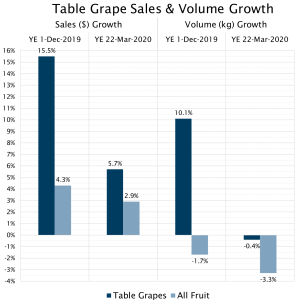
The retail monitoring was supported by Nielsen Homescan data, which showed increased consumer demand and prices over the same period. The Nielsen Harvest to Home report for the 52 weeks to 1 December 2019 recorded an average 10.1% increase in volume for Australian table grapes and an associated 5% increase in price. Following Covid-19, table grape sales volume dropped by only 0.4%, compared to an all fruit volume drop of 3.3%. Over the same period, dollar sales increased by 5.7%, despite a slight drop in sales volume, marking a 6% increase in price.

The increased demand and prices delivered by this project achieved a key outcome in the Hort Innovation Australia Table Grape Strategic Investment Plan.

Horticulture Innovation Australia General Manager, Data and Extension, Dr Anthony Kachenko says, “Delytics’ very adaptive and inclusive approach resulted in a quality outcome, and helped industry pivot their thinking. Their work certainly made a difference and was very well received.”

Delytics’ analysis of the maturity monitoring data collected during the first two seasons of the project helped the industry agree on a minimum retail acceptability of 80% and the minimum maturity standards required to deliver that.

The new standards were formally announced by the ATGA in October 2019, with full supply chain adoption set for the 2020/21 season.

ATGA CEO Jeff Scott says, “Delytics added huge value to our industry by transforming the raw monitoring data into easy-to-read graphics that highlighted immaturity over a four-month period of harvest. Their analytical skills gave us the tangible evidence we’d been looking for, for 10 years, to help us decide the evidence-based minimum standards needed for growers to harvest their fruit at the optimum maturity. We want our grapes to provide a consistently good eating experience, throughout the whole season. The increased consumer demand already achieved by this project supports previous research showing that consumers will buy more fruit when they are confident it will taste good.”

Jeff adds, “From an export point of view, importers will always pay a high price for good quality mature fruit. Table grapes are now the largest exporter by value of all fresh fruit out of Australia. Over the past 12 months our export sales have gone from $555 million to a record $623 million.”

Jeff views the new maturity standards as a win-win for the entire industry and grower, Glenn Pearmine agrees. Glenn owns Gleniecy table grape vineyard in Emerald, Central Queensland.

Prior to using the Delytics system included in the project, Glenn harvested his fruit over three or four picks, with much of it immature. This was evidenced by prices dropping within a week after the initial new season surge. After adopting the new standards in late 2019, Glenn picked 90% of his crop in the first pick followed by a small clean up pick – and prices stayed strong the whole season.

Glenn says, “It gave me a tool to manage my vineyard based on maturity levels. Last year [before the new standards] we picked over an eight-week period and this year we picked over a two-week period. That’s a huge big difference. By just holding off for an extra week before we picked we got a more consistent pick and the best prices we’ve had in nine years.”

You can hear Glenn talk about the benefits he received here.

IAgrE Conference 2024, Rothamsted 6th Nov – What do we want out of agricultural Engineering?

Member News
The views expressed in this Member News article are the author's own and do not necessarily represent those of Agri-TechE.

  • *I have permission from the copyright holder to publish this content and images.

Consumer Acceptance of Navel Oranges Significantly Improved

Member News
The views expressed in this Member News article are the author's own and do not necessarily represent those of Agri-TechE.

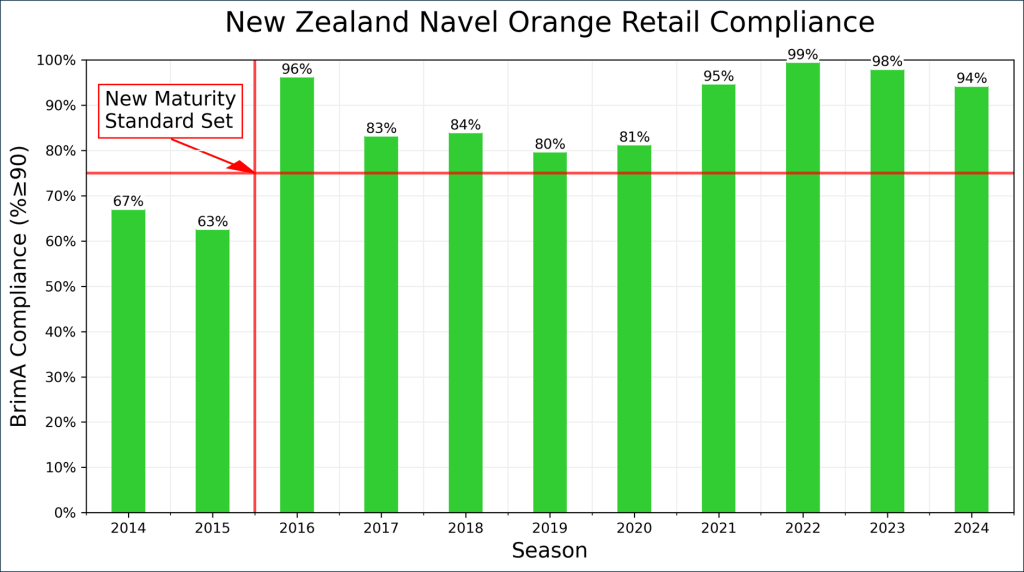
Minimum maturity standards recommended by Delytics have improved the consumer acceptability of New Zealand navel oranges for nine seasons in a row, with an immediate lift from 67% to 96% in the first season.

The retail monitoring data Delytics analyses for Citrus New Zealand has shown a consistently high consumer acceptance for navel oranges since the industry adopted the new standards in 2016. The navel orange maturity standards are an integral part of the independent clearance process that Delytics designed for Citrus New Zealand in 2015.

This graph shows that the retail compliance of New Zealand navel oranges has never dropped below 80% since the new standards were adopted, despite some very challenging growing seasons. Even though the 2024 results only cover the first four weeks, it indicates the expected fruit quality for the rest of the season.

Citrus New Zealand Research Manager, Sally Anderson says, “These results are a really great outcome for New Zealand citrus growers. It shows the investment that we’ve put into developing, organising and managing our quality programme is paying off for growers by having a positive affect at the retail level. Delytics’ analysis of the retail monitoring data we collect has given the sector insight into how maturity functions every season and shown that there is real value in harvesting when the fruit is ready.”

Delytics Managing Director, Mark Loeffen says, “This is a great example of the long-term value gained from putting processes in place to make sure fruit is harvested and sent to market at the right maturity. We’ve seen many examples where the investment made to set and adopt maturity standards has provided continuous benefits in each successive season the standards are followed. These benefits flow through the whole supply chain to the end consumer and the return on investment is typically very high.”

Delytics specialises in designing maturity standards and clearance processes that match consumer taste preferences in specific markets. They are currently focusing on helping marketing companies with licensed growers in multiple growing regions make sure their branded fruit delivers a consistent high quality eating experience, no matter where it is grown or bought.

Mark says, “Ensuring fruit consistently provides the taste experience that consumers want is definitely worth the investment. Putting processes in place to prevent immature fruit from entering the supply chain will help drive demand, increase repeat purchases, and enable branded fruit to be marketed as premium.”

  • *I have permission from the copyright holder to publish this content and images.

The 25% Solution: Defra’s Approach to Harmonizing Agriculture and Environment

Member News
The views expressed in this Member News article are the author's own and do not necessarily represent those of Agri-TechE.

The Sustainable Farming Incentive (SFI) scheme was introduced in 2021 by The Department for Environment, Food & Rural Affairs (Defra) and began being rolled out in September 2023. The SFI pays farmers and land managers to take up and maintain sustainable farming and land management practices that protect the environment and support food production whilst also improving productivity.

Less than a year since its implementation on 26 March 2024, Defra announced a restriction on SFI. Under the new rules only a maximum of 25% of a farm’s land can be taken out of food production and placed into the SFI scheme. This is a concerted effort from Defra to try and strike a balance between environmental sustainability and the need for greater food production.

This decision is a response to concerns from the farming community that too much land was being diverted away from food production and into environmental schemes. While the SFI scheme is designed to encourage sustainable farming practices, there is also a recognition of the primary objective, that of course being food production. Hence the need to put in place some target restrictions. The six SFI actions affected by this cap are those that take land out of direct food production. Evidence showed that a small percentage of farmers applying for SFI in 2023, entered 80% or more of their farm into actions that involved taking land out of food production. This cap will now safeguard against this.

This change underscores the delicate balance that must be struck between environmental stewardship and food production. It highlights the ongoing challenge of ensuring that sustainability initiatives like the SFI scheme contribute positively to both the environment and the agricultural sector.

This comes at a time when our Welsh neighbours have recently announced the Sustainable Farming Scheme which will be introduced in 2026. The stated aims are to secure food production systems whilst safeguarding the environment simultaneously. Requirements to apply to the scheme requires farmers to have at least 10% tree cover on their farmland and to manage at least 10% of land as semi-natural habitats. This has been contentious and no doubt marks a significant shift in agricultural policy in Wales.

I highlight this as it will be an ongoing challenge to simultaneously safeguard the environment, whilst also ensuring that food production is secure and rural life and farmers’ ability to be profitable is also protected. The difficulty of this is almost tangible and will require flexibility and adaptability from both Defra and the rural community in order to strike the perfect balance.

KISS AI Survey – AI in business and marketing operations – your insight is needed

Member News
The views expressed in this Member News article are the author's own and do not necessarily represent those of Agri-TechE.

We are gathering valuable insights from our stakeholders and the wider industry on the integration and usage of Artificial Intelligence (AI) in business and marketing operations.

Your participation in this survey will help identify areas where support is needed, uncover industry trends and guide innovation.

We will share the anonymised results with everyone who completes the survey and provides an email address.

Please fill out the survey on our website here.

  • *I have permission from the copyright holder to publish this content and images.

How resilient are global agri-food supply chains?

Member News
The views expressed in this Member News article are the author's own and do not necessarily represent those of Agri-TechE.

The global population is projected to increase by more than a third, or 2.3 billion individuals, between 2009 and 2050. This surge in population will significantly impact food demand, particularly for income-sensitive food crops such as meat, dairy products, and vegetable oils.

The agri-food supply chain (AFSC) is a critical component of global food security, encompassing the entire process from production to consumption.

However, unbeknownst to many, AFSCs are increasingly complex and challenging and require innovation through the advent of sustainable practices, technological advancements and strategic planning to ensure food safety, quality and availability.

A new book – Frontiers in agri-food supply chains: Frameworks and case studies – takes a considered approach to detailing the recent developments across the sector which support the changing demands placed upon agri-food supply chains.

“This volume – edited by a trio of agri-food supply chain experts – delivers a very useful overview of how agri-food supply chains can help tackle current challenges related to climate change, sustainability requirements and the need for sufficient healthy food,” says Professor Jack van der Vorst, Wageningen University & Research in The Netherlands.

Technological advancements play a crucial role in enhancing AFSC efficiency. The integration of digital technologies such as the Internet of Things (IoT), blockchain, big data, and sensor technologies has shown promise in optimizing supply chain operations, ensuring data transparency, and improving traceability.

But not all AFSCs are the same and different regions bring forth different challenges and benefit from different innovations.

For example, the diversity of consumption patterns and the significant contributions of different activities across the supply chain highlight the complexity of Asia’s AFSCs. Challenges such as food safety, climate change, and geopolitical conflicts necessitate state-led interventions and the adoption of agri-food tech ecosystems to enhance supply chain resilience.

Whereas, improving AFSCs in Africa involves addressing challenges related to infrastructure, climate change, and market access. Implementing fair investment policies to attract green infrastructure investments and integrating global value chains are essential for enhancing food security and economic growth in the region.

One element that doesn’t fluctuate between regional AFSCs is the fundamental need for effective planning and control. Demand planning, forecasting, production planning, inventory management, and distribution are critical components that ensure efficiency and effectiveness.

The status of agri-food supply chains is marked by significant challenges and opportunities. Addressing these challenges through technological advancements, sustainable practices, and strategic planning is essential for ensuring food security and resilience in the face of global disruptions. Collaborative efforts and continuous innovation – as demonstrated in this new book – will be key drivers in shaping the future of AFSCs.

“We probably live in one of the most interesting times to study agri-food supply chains,” says Professor Sander de Leeuw, Chair in Operations Research and Logistics at Wageningen University and Research, The Netherlands and co-editor of this new book.

“This book aims to provide a foundation for understanding these complex systems and inspire further exploration into making agri-food supply chains more efficient, resilient and sustainable,” he adds.

  • *I have permission from the copyright holder to publish this content and images.

Agritech Thymes: A brief look at public prior use of plants in the US

Member News
The views expressed in this Member News article are the author's own and do not necessarily represent those of Agri-TechE.

In the US, plants can be protected by utility patents, plant patents and/or plant variety rights. Both types of patent are subject to the same novelty rules of USC §102, which states that public prior use counts as a disclosure which can destroy the novelty of an invention.

In a decision from the Federal Circuit in the US in 2023 relating to a utility patent application on a particular plant variety, it was held that merely having a new plant variety on display to the public and labelled with its variety name before the filing date is a citeable public prior use of the plant.

This case1 related to the US utility patent for a variety of Calibrachoa plant named ‘Cherry Star’ having a distinctive star pattern on the petals. Claim 1 defined the variety by said pattern as follows:

A Calibrachoa plant comprising at least one inflorescence with a radially symmetric pattern along the center of the fused petal margins wherein said pattern extends from the center of the inflorescence and does not fade during the life of the inflorescences, and wherein the Calibrachoa plant comprises a single half-dominant gene, as found in Calibrachoa variety ‘Cherry Star,’ representative seed having been deposited under ATCC Accession No. PTA-13363’.

The applicant sought a reissue of the patent, and during the examination process of said reissue application, they disclosed that the variety had been had displayed at a Home Depot store event, where the public were able to view it. The applicant argued that the novelty was not destroyed by displaying the plant because the public did not have possession of the genetics of the plant to enable it to be bred, and were not aware that Cherry Star was the result of a “single half-dominant gene” as claimed. The PTAB examined “whether the purposed use: (1) was accessible to the public; or (2) was commercially exploited”, and held that although the variety wasn’t sold or analysed by the public, because the intended use of the plant variety is ornamental and its petal pattern was seen, that this was a citeable disclosure.

The federal circuit have only once before considered prior use in the context of plants, back in 2015. This earlier US decision2 related to two plant patents for ‘Scarlet Royal’ and ‘Autumn King’ table grapes in which the variety was grown in public before filing, but in this case, the variety was not identified and the intended use of the plant was for consumption rather than ornamental. The court confirmed that the “grape varieties cannot be reliably identified simply by viewing the growing vines alone.” As such in that case, the disclosure was not deemed to be novelty-destroying. It seems that perhaps if the cherry star was not identified as such by the labelling, their case may have been stronger. Furthermore, it seems that arguments could have been presented around the feature of the claim that the pattern ‘does not fade’ which would not have been made available to the public at the short event.

This case somewhat surprisingly shows that in situations where the use of the invention, even under a utility patent, is one of an aesthetic or visual nature then displaying it can be enough to destroy novelty by prior use in the US. A reminder that patent applications should always be filed before disclosure, and relying on technical genetic features of plant claims may not be enough to ensure novelty over prior use.


This article was prepared by Partners Punita Shah and Ellie Purnell.
  • *I have permission from the copyright holder to publish this content and images.

Rootwave CEO: ‘Autonomous tech breeds reliability and farmer confidence’

Member News
The views expressed in this Member News article are the author's own and do not necessarily represent those of Agri-TechE.

Rootwave have been interviewed for an article on AgTechNavigator


UK-based RootWave has developed an eco-friendly weed control system that uses electricity instead of harmful chemicals to kill weeds. We spoke to its CEO Andrew Diprose to learn about how combining best-in-class power electronics, imaging and artificial intelligence can create ‘unrivalled’ weed control solutions.

Read the full article here.

Pheromone-Based Integrated Pest Management

Member News
The views expressed in this Member News article are the author's own and do not necessarily represent those of Agri-TechE.

As part of our “Back to the Future” project, we’re asking Agri-TechE members to reflect on how the agri-tech industry has evolved over the past decade and to share their vision for the next ten years. By compiling these insights, we aim to create a powerful outlook on the future of agriculture, a compelling call to arms for the industry driven by the diverse perspectives of our community.

This submission is part of the collection of reflections and predictions from our members, offering unique perspectives on the industry’s past milestones and future directions. Each contribution adds to a broader dialogue about the innovations and challenges that will shape the next decade in agri-tech.