Patenting, Trademarks, Copyright, Trade Secrets...
In the next installment of our micro-learning series, we’ll explore potential legal solutions to help you keep your ideas safe and sound.

PheroSyn Secures Funding from Tall Grass Ventures to Advance Sustainable Pest Management Solutions

Member News
The views expressed in this Member News article are the author's own and do not necessarily represent those of Agri-TechE.

PheroSyn, an innovative agricultural technology company specializing in the development of insect pheromones for sustainable crop protection, announced today that it has secured investment from Tall Grass Ventures (TGV), a leading Canadian venture capital firm focused on early-stage agri-food tech startups. This funding will accelerate PheroSyn’s mission to replace harmful chemical pesticides with more sustainable alternatives.

A spin-out from the renowned chemical ecology research group at Rothamsted Research in the UK, PheroSyn is committed to providing farmers and growers with effective and sustainable pest management solutions. The company’s groundbreaking pheromone-based products offer a safer and more targeted approach to pest management, minimizing the environmental impact of traditional pesticides.

“We are delighted to partner with a firm that shares our vision for a more sustainable future in agriculture,” said Dr. Mary Ellis, Co-founder and CEO of PheroSyn. “This investment is a significant step towards advancing the growth of our company, and will enable us to expand our product portfolio, accelerate research and development, and reach a wider market with our innovative solutions. Ultimately, farmers and growers across the world are facing renewed pressures with fewer products in their toolbox, and this support will allow us to scale and expand our solutions to help protect crops while also preserving the earth’s biodiversity.”

PheroSyn’s proprietary pheromone production methods allow for the creation of cost-effective and environmentally friendly pest management products. By harnessing the power of natural insect communication systems, the company’s novel products offer a targeted and effective way to manage pests, while preserving biodiversity and minimizing the risk of resistance development.

“Quality of founders is at the top of the list in the venture world, and we found Mary and Daniel excellent to work with, very down to earth, and extremely motivated to succeed in this endeavour.”  said Chris Edwards, Managing Partner at Tall Grass Ventures. “Insect pheromones are not easy to synthesize accurately, and so PheroSyn’s unique technological approach coupled with a market waiting for a solution, really made us stop and take notice.”

About Tall Grass Ventures

Tall Grass Ventures is a venture capital firm investing in early-stage companies that are reimagining the future of agriculture and food. With a team of experienced investors and operators, TGV partners with visionary entrepreneurs to build category-defining businesses. To learn more visit www.tallgrass.vc

Not so simple: mosses and ferns offer new hope for crop protection

Member News
The views expressed in this Member News article are the author's own and do not necessarily represent those of Agri-TechE.

Mosses, liverworts, ferns and algae may offer an exciting new research frontier in the global challenge of protecting crops from the threat of disease. 

These non-flowering plants are often regarded as unsophisticated compared to their flowering relatives – which include major crops.  

However, new research carried out by the John Innes Centre has found that non-flowering bryophytes, and mosses in particular, contain sophisticated immune receptor repertoires. 

“The non-vascular and non-flowering bryophytes are often thought of as simple predecessors of flowering plants, but we find that mosses in particular have an expanded set of immune receptors that are perhaps the most complex amongst plants,” said Dr Phil Carella, a group leader at the John Innes Centre and author of the study. 

Biotechnological techniques revealed that NLR immune receptor domains which protect plants against pathogens are transferable between flowering and non-flowering plants. 

Dr Carella added, “The exciting part of this study is that the diverse immunity found in non-flowering plants like mosses are transferable, so they offer us a source of new resistance genes against pathogens.”  

The discovery opens exciting new possibilities for engineering immunity in major crops which are facing a growing threat from emerging and rapidly evolving pathogens exacerbated by climate change. 

Plants have developed leucine-rich-repeat (NLR) immune receptors to detect pathogens over millions of years. The NLRs of flowering plants is a well-studied subject, but much less is known about the form and function of receptors from divergent lineages of non-flowering, non-vascular bryophytes. 

Bryophytes diverged from flowering plants over 500 million years ago, and knowledge of their immune systems is limited. Using a combination of genetic and computational tools, the team focused on the N-terminal domain of NLR immune receptors that encode the biochemical basis of plant immunity. 

They found that there was remarkable structural and functional similarity between immune receptor domains across diverse plant lineages, even though the genetic sequences of these domains was highly variable. 

By using transient expression techniques, they transferred immune receptor genes obtained from non-flowering plants like the liverwort Marchantia polymorpha into a flowering plant Nicotiana benthamiana, a type of dwarf tobacco.  

Diverse immune receptor domains activated strong immune responses when transiently expressed in flowering plants. The reverse was also true, as researchers found they could functionally transfer an immune domain from flowering plants into to non-flowering plants.  

The fact that these domains are transferable and function across plant lineages is a breakthrough in understanding and offers practical applications for crop protection. 

“This means that we can use non-flowering plants like mosses or liverworts as a source of new resistance genes against crop pathogens,” explained Dr Carella, “We show that we can indeed leverage the vast evolutionary diversity of immune receptors from across the entirety of the plant kingdom. So, our scope to engineer immunity is therefore a lot larger than we originally thought.” 

The team is also exploring the evolutionary novelties encoded in bryophytes as a source of gene discovery that can be used to protect crops against diseases. 

Future experiments will seek to identify pathogen molecules that trigger immunity across diverse plants.  

The researchers will also try to understand how the components of the immune receptor come together to activate an immune response.  

The research also offers biological insight, said Dr Carella, “It is often considered that flowering plants are the pinnacle of evolution. But our study shows that there is likely a complexity of immune receptor biochemistries in non-flowering plants, which could offer a new reservoir for immunity if we can transfer these into crops.” 

The N-terminal domains of NLR immune receptors exhibit structural and functional similarities across plant lineages, appears in the July issue of The Plant Cell. 

Image Caption – Marchantia polymorpha liverwort colony growing in an urban environment. Here both male and female umbrella-like reproductive structures can be seen

Finding the Right People

Member News
The views expressed in this Member News article are the author's own and do not necessarily represent those of Agri-TechE.

As part of our “Back to the Future” project, we’re asking Agri-TechE members to reflect on how the agri-tech industry has evolved over the past decade and to share their vision for the next ten years. By compiling these insights, we aim to create a powerful outlook on the future of agriculture, a compelling call to arms for the industry driven by the diverse perspectives of our community.

This submission is part of the collection of reflections and predictions from our members, offering unique perspectives on the industry’s past milestones and future directions. Each contribution adds to a broader dialogue about the innovations and challenges that will shape the next decade in agri-tech.

AgRecruit goes Back to the Future

Genetics, Agronomy and Data with National Institute of Agricultural Botany (Niab)

Member News
The views expressed in this Member News article are the author's own and do not necessarily represent those of Agri-TechE.

As part of our “Back to the Future” project, we’re asking Agri-TechE members to reflect on how the agri-tech industry has evolved over the past decade and to share their vision for the next ten years. By compiling these insights, we aim to create a powerful outlook on the future of agriculture, a compelling call to arms for the industry driven by the diverse perspectives of our community.

This submission is part of the collection of reflections and predictions from our members, offering unique perspectives on the industry’s past milestones and future directions. Each contribution adds to a broader dialogue about the innovations and challenges that will shape the next decade in agri-tech.

Niab goes Back to the Future…

Environmental Sensing for Agriculture with Delta – T Devices

Member News
The views expressed in this Member News article are the author's own and do not necessarily represent those of Agri-TechE.

As part of our “Back to the Future” project, we’re asking Agri-TechE members to reflect on how the agri-tech industry has evolved over the past decade and to share their vision for the next ten years. By compiling these insights, we aim to create a powerful outlook on the future of agriculture, a compelling call to arms for the industry driven by the diverse perspectives of our community.

This submission is part of the collection of reflections and predictions from our members, offering unique perspectives on the industry’s past milestones and future directions. Each contribution adds to a broader dialogue about the innovations and challenges that will shape the next decade in agri-tech.

Back to the Future with Delta – T Devices

Achieving the Potential of Insect Rearing

Member News
The views expressed in this Member News article are the author's own and do not necessarily represent those of Agri-TechE.

As part of our “Back to the Future” project, we’re asking Agri-TechE members to reflect on how the agri-tech industry has evolved over the past decade and to share their vision for the next ten years. By compiling these insights, we aim to create a powerful outlook on the future of agriculture, a compelling call to arms for the industry driven by the diverse perspectives of our community.

This submission is part of the collection of reflections and predictions from our members, offering unique perspectives on the industry’s past milestones and future directions. Each contribution adds to a broader dialogue about the innovations and challenges that will shape the next decade in agri-tech.

UK Blueberry Breeders Strive for Consistent Taste Appeal

Member News
The views expressed in this Member News article are the author's own and do not necessarily represent those of Agri-TechE.

James Hutton Limited, on behalf of the blueberry breeding consortium, contracted Delytics Ltd in 2020 to help them select new varieties that will be consistently liked by consumers.

Delytics is assisted the consortium to pinpoint blueberry varieties that will appeal to multiple consumer groups with distinct taste preferences. The aim was to track how each variety matures over time to determine its taste development and expected acceptance by specific target markets.

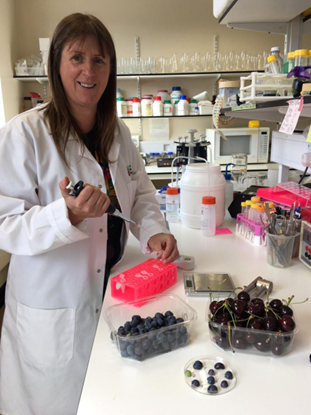
Dr Susan McCallum (pictured), who runs James Hutton’s blueberry breeding programme, says Delytics’ recognised expertise in crop taste optimisation is crucial for their consumer-focused breeding programme.

Dr McCallum says, “We are looking to breed blueberries for consistent high quality taste. It’s really important for us to understand the science behind the taste so we know which varieties will appeal to consumers. Delytics is helping us achieve that by analysing how the Brix and acid changes over time in each variety, how much consumers will like them, and the best time to pick for optimum taste.”

Previous sensory research conducted by the James Hutton Institute highlighted variations in taste preferences for blueberries in different consumer groups. The most notable of these was between male and female consumers, with males tending to prefer eating small tart tasting blueberries in their porridge or yoghurt and females preferring to snack on larger, sweeter blueberries.

Dr McCallum says the work the breeding consortium is doing with Delytics has the potential to allow them to intentionally breed blueberry varieties that meet the taste expectations of specific consumers.

The monitoring framework being used for this project was initially designed by Delytics to help The James Hutton Institute raspberry breeding programme develop a new consumer-centric breeding protocol in 2018. Delytics’ monitoring protocols are now also being used to help ensure the majority of James Hutton bred blueberries and cherries will be liked by consumers.

Dr McCallum says, “Delytics is playing a really important role in helping us understand the role that Brix and acid plays in providing the flavour in our berries so we can ensure the ones we select will be consistently liked by consumers. The data analysis they are doing will also tell us the best time to pick the berries to make sure the flavour comes through every time.”

“We want growers to be confident that when they invest in our cultivars and follow our growing and picking instructions, they will get an ongoing good return.”

  • *I have permission from the copyright holder to publish this content and images.

Breeding Raspberries for Optimum Taste

Member News
The views expressed in this Member News article are the author's own and do not necessarily represent those of Agri-TechE.

Delytics has helped the globally recognised James Hutton Institute create a new breeding protocol to ensure the majority of their raspberries are liked by consumers.

In 2018, the James Hutton Institute contracted Delytics to assist in the study: `Feasibility of developing a Novel Breeding Methodology to Improve Berry Flavour’. Supported through funding from Innovate UK, the project was commissioned to improve raspberry flavour by developing new breeding models and decision support tools. Prior to working with Delytics, the James Hutton research team was unable to validate how the sensory data they were collecting from taste panels matched consumer taste preferences. Delytics assisted them by providing a customised consumer liking measurement protocol, which enabled them to identify the genetic regions for liking in raspberries and better understand what the consumer response would be to various raspberry breeds.

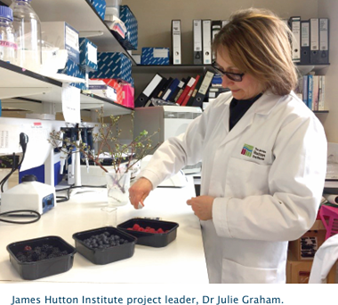
James Hutton Institute project leader, Dr Julie Graham, says Delytics’ helped the research team `take a big step forward’ by understanding how to select raspberry seedlings from the breeding plots that will meet the taste expectations of UK consumers.

Dr Graham says, “Being able to combine Delytics’ understanding of consumer liking with our understanding of genetics has allowed us to tailor our breeding programme to produce raspberries that consistently meet the taste profile that consumers want. We can now analyse the taste data alongside the genetic markers in the raspberries and we have identified the key regions that are really important for flavour.”

Delytics’ ability to measure the Brix, acid and liking of individual berries from only 0.3 ml of juice was a key factor in helping the research team understand the full range of flavours and maturity variability for selected raspberry varieties. This information will now allow breeders to predict consumer response before harvest and develop science-based maturity standards to ensure a consistently good eating experience.

One of the key focuses of the feasibility study was to understand how to effectively breed soft fruit in the UK for consistently great flavour. Consistent berry flavour has been a key consumer attribute that has challenged UK breeders and growers, resulting in low consumer acceptance.

Dr Graham says, “Only about a third of raspberries tested in UK supermarkets last year were liked by consumers, so that’s two thirds of consumers not enjoying the taste experience. The understanding Delytics has given us about taste and consumer liking is massively valuable when it comes to breed selection. Raspberries can yield well, pick well and withstand pests and diseases – but if they don’t taste good, we just won’t get the consumer uplift.”

“For us as a breeding organisation, being able to breed raspberries that we know are going to be liked by the majority of consumers is massive for us.”

Delytics assisted James Hutton Institute to validate the consumer liking of one of their own varieties that they already suspected would be well received by consumers. Being able to verify that variety will meet the taste expectations of most consumers has given them the confidence to run with that variety and use similar quantification methods for other varieties.

Dr Graham says, “Integrating Delytics’ consumer liking tools into our breeding program was really, really useful for us. The easy to implement step-by-step process they gave us is highly effective and transferrable to other crops. It will be used in our blueberry breeding programme next season, and we can see many opportunities for it to add value to other fresh processed crops.”

“Breeders can now base their breed selections on hard science rather than their own preferences, which will ensure the breeds selected will have the broadest possible taste appeal.”

  • *I have permission from the copyright holder to publish this content and images.

Agri-TechE Recruitment

Member News
The views expressed in this Member News article are the author's own and do not necessarily represent those of Agri-TechE.

As part of our “Back to the Future” project, we’re asking Agri-TechE members to reflect on how the agri-tech industry has evolved over the past decade and to share their vision for the next ten years. By compiling these insights, we aim to create a powerful outlook on the future of agriculture, a compelling call to arms for the industry driven by the diverse perspectives of our community.

This submission is part of the collection of reflections and predictions from our members, offering unique perspectives on the industry’s past milestones and future directions. Each contribution adds to a broader dialogue about the innovations and challenges that will shape the next decade in agri-tech.

Eden Search goes Back to the Future…

Increased Demand and Prices for Australian Table Grapes

Member News
The views expressed in this Member News article are the author's own and do not necessarily represent those of Agri-TechE.

Consumer acceptability hit a five-year high for Australian table grapes in 2020 with increased demand and prices – just one year after Delytics helped the industry put new maturity standards in place.

A three-year project led by Delytics on behalf of the Australian Table grape Association (ATGA) increased the demand and value of table grapes by ensuring they are liked by the majority of consumers. The project Table grape supply chain quality (TG17002) was a strategic levy investment in the Hort Innovation Table Grape Fund. It was funded using the table grape research and development levy and contributions from the Australian Government.

Retail monitoring carried out over the 2019/20 season recorded the highest consumer acceptability in five years with an overall consumer acceptability of 79%. This was a 20 percentage point increase from the 2016/17 season, the year before the project started.

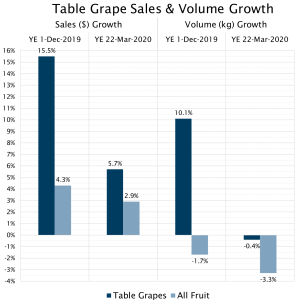
The retail monitoring was supported by Nielsen Homescan data, which showed increased consumer demand and prices over the same period. The Nielsen Harvest to Home report for the 52 weeks to 1 December 2019 recorded an average 10.1% increase in volume for Australian table grapes and an associated 5% increase in price. Following Covid-19, table grape sales volume dropped by only 0.4%, compared to an all fruit volume drop of 3.3%. Over the same period, dollar sales increased by 5.7%, despite a slight drop in sales volume, marking a 6% increase in price.

The increased demand and prices delivered by this project achieved a key outcome in the Hort Innovation Australia Table Grape Strategic Investment Plan.

Horticulture Innovation Australia General Manager, Data and Extension, Dr Anthony Kachenko says, “Delytics’ very adaptive and inclusive approach resulted in a quality outcome, and helped industry pivot their thinking. Their work certainly made a difference and was very well received.”

Delytics’ analysis of the maturity monitoring data collected during the first two seasons of the project helped the industry agree on a minimum retail acceptability of 80% and the minimum maturity standards required to deliver that.

The new standards were formally announced by the ATGA in October 2019, with full supply chain adoption set for the 2020/21 season.

ATGA CEO Jeff Scott says, “Delytics added huge value to our industry by transforming the raw monitoring data into easy-to-read graphics that highlighted immaturity over a four-month period of harvest. Their analytical skills gave us the tangible evidence we’d been looking for, for 10 years, to help us decide the evidence-based minimum standards needed for growers to harvest their fruit at the optimum maturity. We want our grapes to provide a consistently good eating experience, throughout the whole season. The increased consumer demand already achieved by this project supports previous research showing that consumers will buy more fruit when they are confident it will taste good.”

Jeff adds, “From an export point of view, importers will always pay a high price for good quality mature fruit. Table grapes are now the largest exporter by value of all fresh fruit out of Australia. Over the past 12 months our export sales have gone from $555 million to a record $623 million.”

Jeff views the new maturity standards as a win-win for the entire industry and grower, Glenn Pearmine agrees. Glenn owns Gleniecy table grape vineyard in Emerald, Central Queensland.

Prior to using the Delytics system included in the project, Glenn harvested his fruit over three or four picks, with much of it immature. This was evidenced by prices dropping within a week after the initial new season surge. After adopting the new standards in late 2019, Glenn picked 90% of his crop in the first pick followed by a small clean up pick – and prices stayed strong the whole season.

Glenn says, “It gave me a tool to manage my vineyard based on maturity levels. Last year [before the new standards] we picked over an eight-week period and this year we picked over a two-week period. That’s a huge big difference. By just holding off for an extra week before we picked we got a more consistent pick and the best prices we’ve had in nine years.”

You can hear Glenn talk about the benefits he received here.

IAgrE Conference 2024, Rothamsted 6th Nov – What do we want out of agricultural Engineering?

Member News
The views expressed in this Member News article are the author's own and do not necessarily represent those of Agri-TechE.

  • *I have permission from the copyright holder to publish this content and images.

Consumer Acceptance of Navel Oranges Significantly Improved

Member News
The views expressed in this Member News article are the author's own and do not necessarily represent those of Agri-TechE.

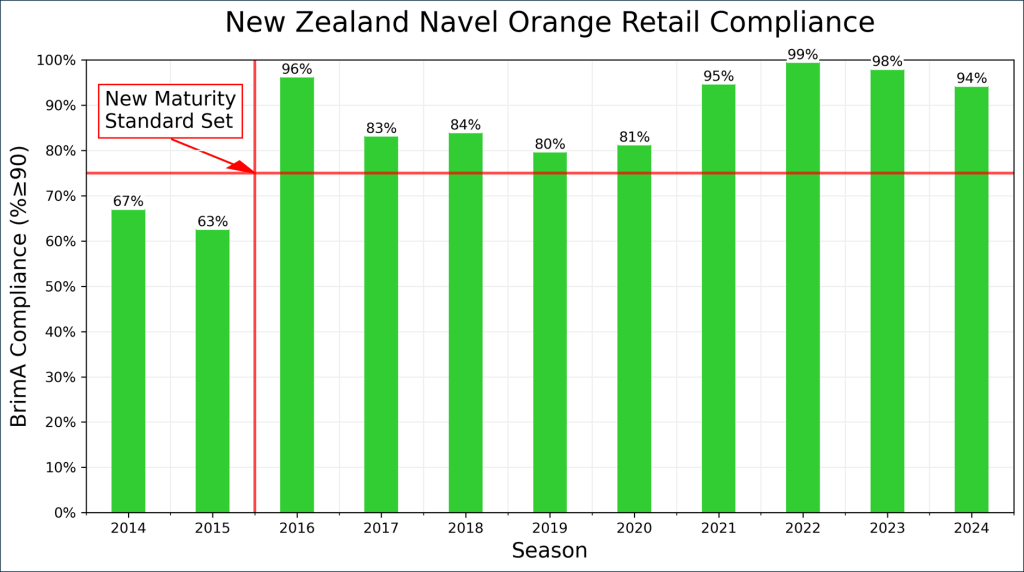
Minimum maturity standards recommended by Delytics have improved the consumer acceptability of New Zealand navel oranges for nine seasons in a row, with an immediate lift from 67% to 96% in the first season.

The retail monitoring data Delytics analyses for Citrus New Zealand has shown a consistently high consumer acceptance for navel oranges since the industry adopted the new standards in 2016. The navel orange maturity standards are an integral part of the independent clearance process that Delytics designed for Citrus New Zealand in 2015.

This graph shows that the retail compliance of New Zealand navel oranges has never dropped below 80% since the new standards were adopted, despite some very challenging growing seasons. Even though the 2024 results only cover the first four weeks, it indicates the expected fruit quality for the rest of the season.

Citrus New Zealand Research Manager, Sally Anderson says, “These results are a really great outcome for New Zealand citrus growers. It shows the investment that we’ve put into developing, organising and managing our quality programme is paying off for growers by having a positive affect at the retail level. Delytics’ analysis of the retail monitoring data we collect has given the sector insight into how maturity functions every season and shown that there is real value in harvesting when the fruit is ready.”

Delytics Managing Director, Mark Loeffen says, “This is a great example of the long-term value gained from putting processes in place to make sure fruit is harvested and sent to market at the right maturity. We’ve seen many examples where the investment made to set and adopt maturity standards has provided continuous benefits in each successive season the standards are followed. These benefits flow through the whole supply chain to the end consumer and the return on investment is typically very high.”

Delytics specialises in designing maturity standards and clearance processes that match consumer taste preferences in specific markets. They are currently focusing on helping marketing companies with licensed growers in multiple growing regions make sure their branded fruit delivers a consistent high quality eating experience, no matter where it is grown or bought.

Mark says, “Ensuring fruit consistently provides the taste experience that consumers want is definitely worth the investment. Putting processes in place to prevent immature fruit from entering the supply chain will help drive demand, increase repeat purchases, and enable branded fruit to be marketed as premium.”

  • *I have permission from the copyright holder to publish this content and images.