The Productive Landscape: NatureTech for Profit and Planet
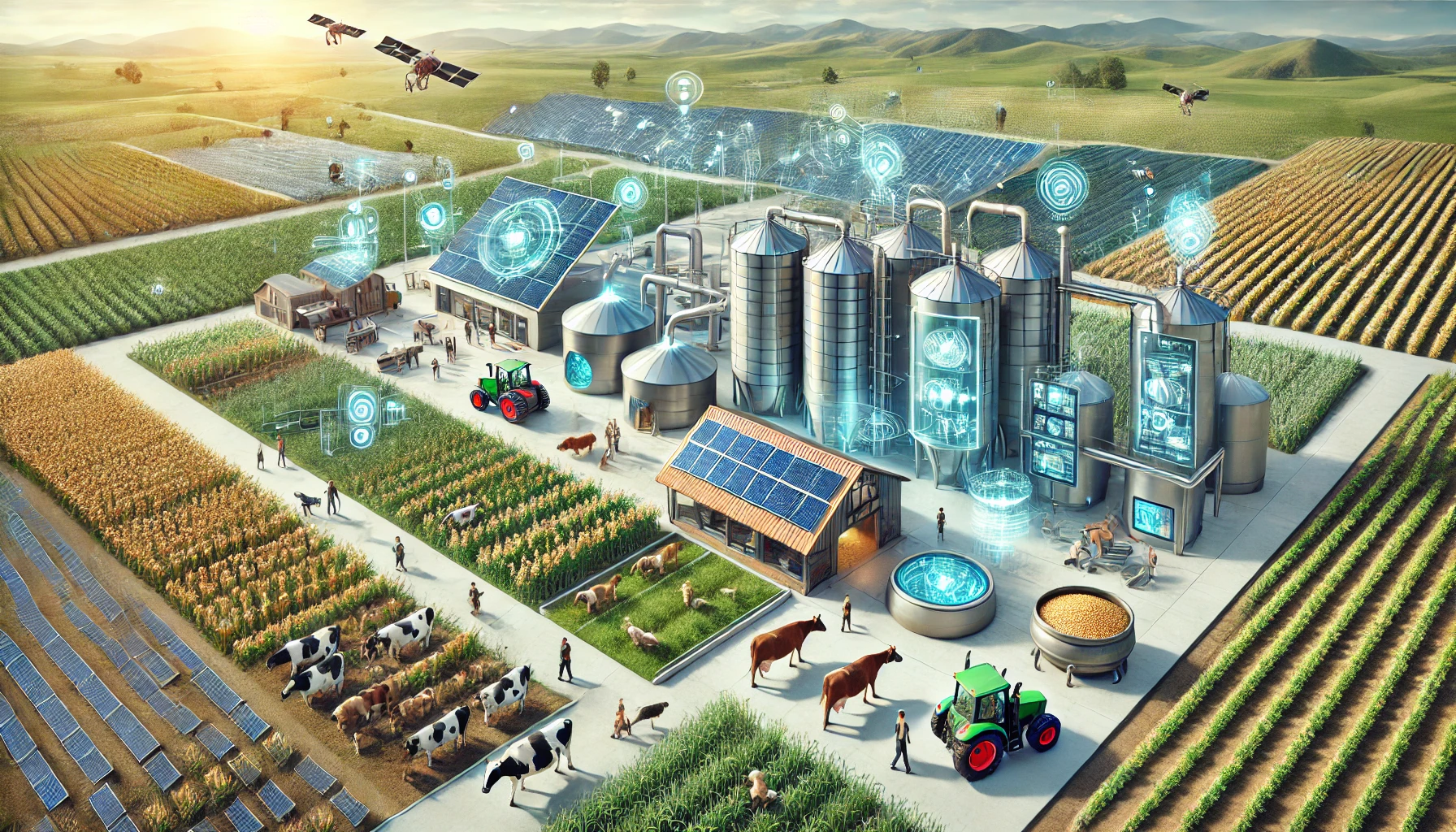
How can technology enable delivery of food, nature recovery, and climate resilience - all at once? The Head of the Environment Agency is asked: what's the national plan for dealing with land use pressures, plus you’ll hear from technologists and land managers working on nature-based and tech-enabled solutions for water, soils and climate adaptation.

Nurturing agri-tech start-ups

Agri-TechE Blog
Agri-TechE

A strong and growing start-up community is important for the success of the UK agri-tech sector.  Although funding is vital so equally is access to the end-user community, particularly as in most cases the founder or innovator doesn’t have an agri-tech background but is someone who can see the market potential in the sector.

Niab
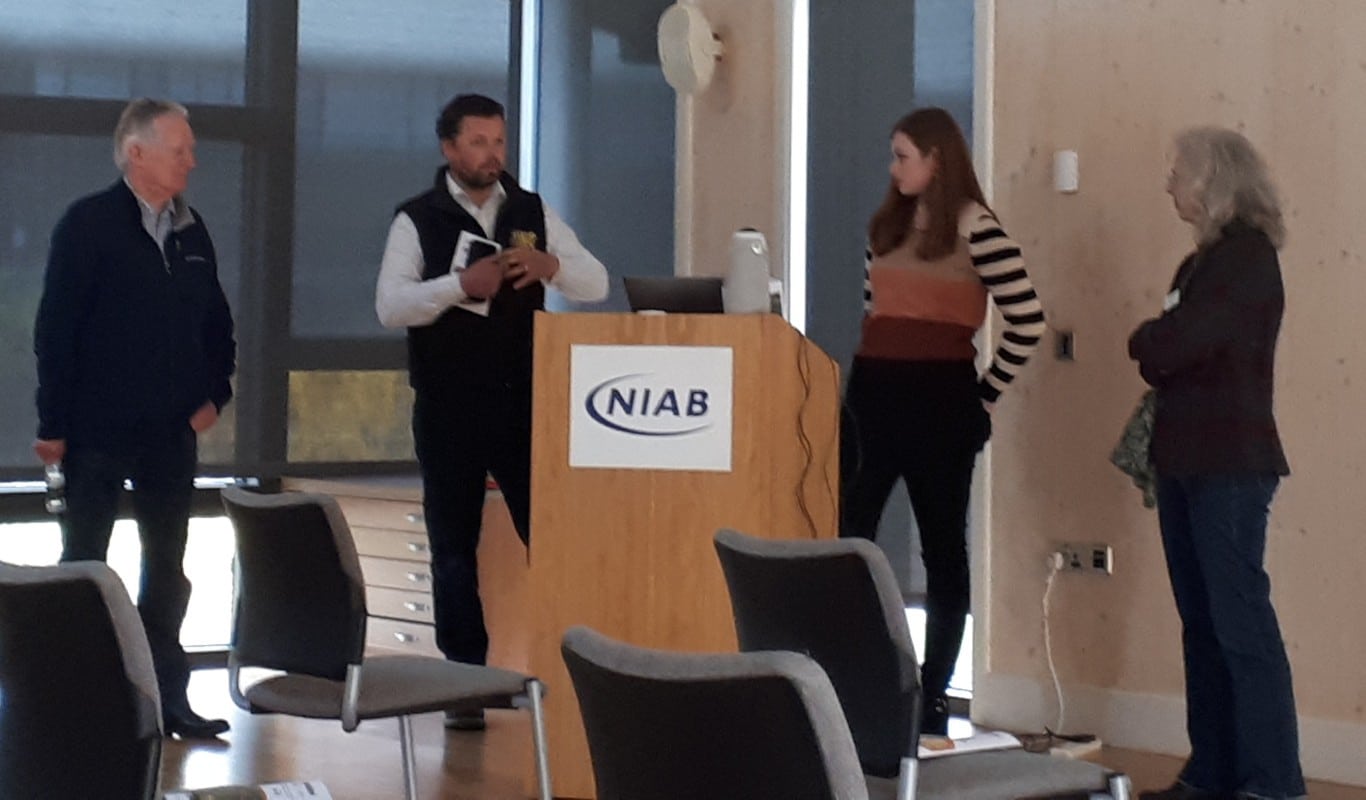
Niab sign at Cereals 2014: Farming in 2020 – are you ready?

End-user engagement via the Agri-TechE cluster network can help ensure the innovation journey and route to market  has the greatest chance of success.

Over the last few months we have seen some really interesting early stage activity.

We have met start-ups developing technology-based platforms to help with on-farm decision making, which has included tools to predict crop yield potential in different fields and calculators to establish the financial impact of the CAP greening policies. There are online platforms for global agri-tech value chain mapping and tracking, and we are also seeing a range of ideas designed to help protect crops against pests and diseases.

Although agri-tech is in its infancy, compared to the established high-tech or biomedical sectors, the signs are that it is set to follow. The benefit that agri-tech entrepreneurs have is that the infrastructure designed to support start-ups is already in place.

We are fortunate in the east of England to have access to a vibrant and energetic early stage investment community, as well as other public/private investment tools to encourage commercialisation of agri-tech related ideas.

Angels or dragons – call them what you will – early stage investors are a vital element of a successful cluster ecosystem. Not only do they contribute financially, but the right investors can provide mentoring, advice, guidance and access to networks to help make the difference between success and failure.

Sources of finance include:

What all these investors have in common is the desire for high quality deal flow, at the right scale, and with a team and technology ready for investment.

The business plan and model, the innovation itself and, importantly, the exit strategy also have to be right. Again, we are fortunate to have a range of support mechanisms in place locally to help maximise the chance of success.

Support programmes include:

All of these offer support programmes to help innovators refine their business plan and become investment-ready – most are free of charge or have a small fee associated with them.

The so-called “open innovation” model adopted by the high-tech and pharma industries has potential also for agri-tech.  Over time the number of small businesses in the sector will increase, creating opportunities for  large agri-business to partner, collaborate and, potentially, acquire (that famous exit strategy again) these companies and ensuring a flow of capital through the industry.

Agri-TechE is focussing strongly on connecting the start-up and investment communities, with the inclusion of end-user growers and farmers to help inform and accelerate the journey of a new innovation to market.

We believe this is an important foundation for a successful sustainable agri-tech cluster making a real contribution to the UK economy.

KisanHub looking for input from farmers

Meet the Network
Agri-TechE

KisanHub, a specialist in the development of quantitative and data analytics tools, gained a boost in June when it became one of the first companies to be awarded a grant from the new Eastern Agri-TechE Growth Initiative.

The funding will be used to develop and trial a model that uses satellite data and meteorological information to make irrigation and fertiliser recommendations and crop yield predictions.

Kisanhub
Giles Barker of KisanHub

KisanHub’s Giles Barker welcomed the grant saying that it could not have come at a better time: “The grant will fast-track our R&D satellite project and put KisanHub firmly on track to becoming a leading player in innovative software solutions in agriculture.”

KisanHub intends to release their dashboard in the Autumn and is currently looking for farmers, producers and agri-sector partners keen to influence development of this next generation of precision-farming decision-support tools.

KisanHub will be speaking at an Agri-TechE event on the 17th September 2014 more details coming shortly.

British Business House showcase for agri-tech

Agri-TechE Blog
Agri-TechE

As Glasgow prepares for the Commonwealth Games, so too will there be an opportunity to showcase Britain’s knowledge-based industries.

British Business house

The British Business House is a one-day event that is encouraging an ideas exchange between industry leaders, experts and ministers in key areas of UK expertise such as digital health, space and satellite communication, oil and gas and agri-tech. To be part of this line-up of economically important industries, gives a clear signal of the importance that the government is giving to agri-tech.

This is underpinned by the appointment of a UK Business Ambassador for Agri-Tech, James Townshend, who will be moderating the session in Glasgow, and by the creation of a dedicated agri-tech group within UKTI.

The government’s commitment to the East of England was seen recently through an injection of £1.55M of new funding into the Eastern Agri-TechE Initiative fund, which aims to encourage SMEs to create business opportunities and explore collaborative R&D with the region’s research base.

Such visible and tangible support for business growth and training in agri-tech by government is important in consolidating the excellence and capabilities we have in the region. This is a key message to communicate outside the region particularly to those who would considering investing here.

We had an opportunity to do so recently when Agri-TechE hosted a briefing visit of the UK’s Agri-TechE Organisation, which is responsible for promoting overseas trade and inward investment.

This team is an international “sales team” travelling the world to promote the national capabilities and so provide a good opportunity to profile the East of England’s strength as an agri-tech cluster.

A further opportunity  to promote the cluster will be in Glasgow later this month to delegates from global agri-businesses attending the British Business House.

British Business House

There will be a ministerial welcome to the agri-tech session which will explore how technology can be used to assist Commonwealth countries with their food security issues.

I am delighted to participate within the panel along with Professor Simon Blacker from Harper Adams, Professor David Hume of the Roslin Institute and Professor James Turnbull of Stirling University.

Judith Batchelar, Director of Brand at Sainsbury’s, will also contribute to the session, and will provide delegates with an overview of the agri-tech industrial strategy.

Attracting the agri-best to come and work with us, and invest in the cluster partners is a key priority for Agri-Tech, I will be telling anyone with an interest in the sector that if  you are seeking new research partners, validation of your new technology, finding more customers, or setting up a sales office, you are guaranteed a warm welcome in the East of England.

Cereals speakers stress urgency of sustainable intensification

Agri-TechE Blog
Agri-TechE

Cereals 2014 came to Cambridgeshire and saw 25,000 farmers, technical and commercial service providers, machinery distributors, researchers and training institutions come together for 2 days to network, learn and do deals.

Agri-TechE used Cereals as the platform to unveil our new logo and brand identity, as well as host a technical seminar to discuss how new innovations to increase yield and productivity will sit alongside the sustainability agenda.

Cristobal
Dr Cristobal Uauy, wheat geneticist at the John Innes Centre and National Institute of Agricultural Botany.

At the seminar the real urgency to deliver new solutions was a theme from all speakers and questions from the floor. Dr Cristobal Uauy, wheat geneticist at the John Innes Centre (JIC) and National Institute of Agricultural Botany (Niab) and Dr Pete Werner (KWS-UK) were agreed on the importance of academic-industry partnerships to develop new crop varieties.

Dr Uauy explained that the need for food security was driving the demand for greater productivity, but that this yield also needs to be sustainable and stable. The boom bust cycles of the present must change to provide more predictable yields.

He commented that the DNA revolution is enabling us to understand more about the tiny differences both within and between varieties of cereal, this will allow the creation of varieties that are more resilient in field conditions. Total eradication policies of the past lead to resistance, as this puts pressure on the pathogen to evolve. Current thinking, for example in yellow rust, is that it is better to tolerate some pathogen in the crop and increase the resilience of the crop. Also management strategies, such as rotation, have a role in the control of persistent weeds such a black grass.

What is needed is more information back from farmers and growers about the field conditions and performance so this can be feedback into the research and also the development of  improved ‘farmer centric’ tools that can help capture the data and improve its interpretation.

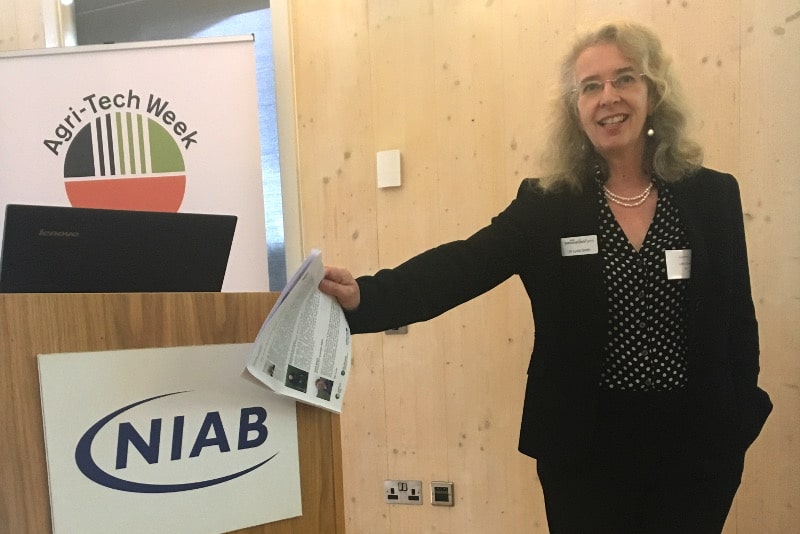
Dr Lynn Dicks from Cambridge University emphasised the importance of farmer input into the research agenda, particularly in the development of new on-farm decision-support tools. She said that although farmers were under pressure to increase yield sustainably it was still unclear exactly how you ‘measure’ the environment. There is a need for more benchmarking tools where farmers can compare how they are doing with other farms of similar size, operating under similar conditions.

She commented that many of the organisations developing tools were global operations and there is a need to tailor these tools for local conditions. This is where interaction with growers is vital to ensure that the next generation of tools are relevant and user-friendly.

agri-tech
Speakers at the Agri-TechE Technical Seminar at Cereals 2014, accompanied by the HexCam drone. From left to right: Peter Werner (KWS UK), Dr Cristobal Uauy (JIC & Niab), Dr Belinda Clarke (Agri-Tech), Peter Lee (Taylor Vinters LLP) and Dr Lynn Dicks (University of Cambridge).

All the panellists were excited by the potential of imaging taken by unmanned vehicles to provide an aerial view of land use.Peter Lee of Taylor Vinters, who runs the law firm’s specialist unmanned systems division said that 80% of future drone use is predicted to be in agriculture. Spectral imaging will allow a much more detailed understanding of performance of varieties in the real field conditions, for example, with infra-red it is able to measure the chlorophyll production, which is an indication  of health.

Overall it was agreed the East of England is in a prime position to be world-leading in agri-tech and that the creation of the Agri-TechE to facilitate the development of the cluster will provide benefit at all levels.

The speakers were joined by one of the drones developed by Norwich-based company HexCam, which flew over the Cereals trial plots and featured on the BBC Look East programme that evening. Judging by the number of interested farmers who came by our stand to meet the drone, we will be seeing a lot more of them on farms.

Agri-TechE shared its Cereals stand with the Local Enterprise Partnership which was promoting the grants programme aimed at regional agri-based businesses looking to grow or undertake new research and development. There was lots of interest in the funding scheme over the two days, which will hopefully convert into a strong pipeline of project proposals for assessment. The funds have to be committed by March 2015 (or sooner if the funds run out) and the local authorities can even help you fill in the application form.

In other Cereals news, congratulations are due to the John Innes Centre, Rothamsted Research and the BBSRC, who were awarded second prize for best large stand for their shared presence. Overall winner for best stand was Bayer, it played host to Secretary of State Owen Patterson for a joint announcement that Bayer is investing in wheat breeding in the UK again.

A great testimony to the UK’s research capabilities and one on which we should capitalise.

Business media interest in agri-tech

Agri-TechE Blog
Agri-TechE

Cereals 2014 was a highly successful event for us this month with an opportunity to meet a good cross-section of the community.

Among the media interviews that I have given over the last few weeks is this one on the Cambridge community radio station 105, which provides a useful short overview of Agri-Tech.

Cambridge 105
Click on the image above to listen to the Cambridge 105 interview.

You can listen again to the interview by clicking here. 

The interview gave me an opportunity to discuss how the concept for Agri-TechE came about, its current focus and plans for the future.

As more strands come together it is increasingly apparent that now is the right time for agri-tech. We are particularly keen to attract innovative thinking from entrepreneurial organisations that hadn’t previously considered working in the sector.

The next step is to put in place some events that will bring parties with mutual interests together. Details of this will be appearing shortly.

Cool farm tool

Agri-TechE Article
Agri-TechE

The Cool Farm Tool is a new greenhouse gas calculator for farming. It’s easy to use and gives instant results that invite users to try out alternatives and ask ‘what if’ questions.

The tool was commissioned by Unilever from the University of Aberdeen. The tool is ideal for farmers, supply chain managers and companies interested in quantifying their agricultural carbon footprint and finding practical ways of reducing it.

It calculates the greenhouse gas balance of farming, including emissions from fields, inputs, livestock, land use and land use change and primary processing. It uses ‘Tier2-type’ methods, offering users simple menu choices for parameters that farmers can influence to reduce their carbon footprint. Reporting greenhouse gas emissions is part of the Metric Reporting requirements of Unilevers Sustainable Agriculture Code.

The Cool Farm Tool calculator will be used in a multi-company project on agricultural climate mitigation co-ordinated by the Sustainable Food Laboratory, which includes Unilever, PepsiCo, Marks & Spencer, Pulse Canada, Yara, Sysco and others. If this is something that would be of interest to you, please visit The Sustainable Food Lab  to find out more. This Cool Farm Tool calculator is free and open source. It is provided under an Attribution-Non-Commercial-Share Alike 2.0 (UK: England & Wales).

Drones offer helicopter view of field trials

Meet the Network
Agri-TechE

HexCam aerial photography, based in Norwich, Norfolk provides unique aerial photography solutions and has seen growing demand from farmers and breeders for visualising field trials.

Elliott Corke says​: “With our radio-controlled multirotor aircraft we can access areas that traditional photography just can’t reach. We can work safely anywhere from floor level to 120 metres altitude using our GPS assisted hexacopter or octocopter UAVs.

“Our hexacopter (official title: G-UAV0054) was built in Ireland and finished in Norwich. She contains some of the most up-to-date radio-controlled multirotor UAV technology, including autohover, GPS and failsafe return to base. Our octocopter, G-UAV0055 uses the same flight controller but can carry a higher quality camera.

​”We have added some cutting edge imaging hardware to give us excellent HD video, still images and, soon, 3D imaging. Despite the small size we do not compromise on image quality. Both our multirotors can record continuously whilst on an operation to allow us to provide you with either unedited footage and stills or, for an additional fee, edited video”

This is an evolving technology area and Elliott is keen to talk to all parties in the industry to understand the requirements.

More information www.hexcam.co.uk

Weatherquest advises growers

Member News
Agri-TechE

Weatherquest, based at Norwich Research Park provides detailed and application-specific weather forecasts, which allow business and the travelling public to manage the risks presented by the worst of the weather.

Its data is also being used in research to help find cold resilient brassicas, such as cauliflowers, to extend the cropping season. Jim Bacon, Managing Director of Weatherquest explains, “We give accurate and detailed weather information which is simply not available elsewhere. Most industrial practices are weather dependent, and often the weather forecasts on the TV are not detailed enough to make business decisions, so we fine-tune this service based on our individual client’s needs”.

The company was established by locally-based experienced forecasters when the Norwich Weather Centre closed in 2000. The team saw an opportunity for a consultancy service and with their links to the University of East Anglia (UEA) Environmental Sciences department they have incorporated the latest research into their weather prediction service.

Jim recalls, “One of my colleagues, Steve Dorling, was himself based at UEA on the Norwich Research Park. So setting up business on the research park seemed a natural location, it is well known for its ground breaking research and expertise, so we felt it was a good environment to be a part of. More recently we have started working with the John Innes Centre in support of their work on plant research.”

Prolonged cold weather can also create shortages of winter vegetables. Data from Weatherquest is currently being used by Judith Irwin, researcher in Crop Genetics at the John Innes Centre, in a research project aimed at improving resilience within the horticultural industry.

The main focus of the research is helping crops adapt to climate change, but the science can help build resistance to temperature variations too. “For brassicas such as cauliflower and broccoli we eat the flower buds of the plant and they require a period of cold known as vernalization to trigger the flowering mechanism. This varies between species and by examining the temperatures required by different varieties to vernalize, you can select those that need different periods of cold to flower.” Additionally by comparing mean winter temperatures from 1961 – 2006 the researchers have found that Cornwall on average enjoys winter temperatures 2°C higher than Lincolnshire, and that this influences how varieties mature in these areas.

This information can be used to prolong the flowering period by selecting varieties that vernalize at different temperatures. This would be desirable for supermarkets and also for farmers who would see an increase in the crop’s profitability, as they would crop for longer.

Jim explains that at some stage all food is dependent on a weather forecast. “This doesn’t just mean in terms of growing a crop, but also the shipping, transportation and freshness of that crop,” he says. “For example, one of our clients is the Port of Felixstowe. For them, wind and visibility information is vital. Ships are unable to enter or leave the docks if the wind is too high or visibility too low. Likewise, cranes are unable to unload cargo, such as food, off the ships if the weather conditions are not just right.” Jim concludes, “Winter is usually a busy period for us as people worry about travelling up and down the country to visit friends and family.

For the companies we work with, busy periods usually come when the weather is significantly different from the ‘norm’. We are able to predict when this is going to happen and communicate how it will affect our clients, before it has a detrimental result on their business.” For a personal weather forecast call Weatherquest on 09065 77 76 75 (nb.calls charged at £1.50 per min-network charges)

Controlling pesticide resistant black-grass

Agri-TechE Article
Agri-TechE

Pangaea Agrochemicals, based in Norwich and Cambridge has gained a grant from the Eastern Agri-TechE Growth Initiative to develop a product to tackle pesticide resistant black-grass.

Pangaea Agrochemicals concentrates on finding solutions to pests and weeds that have become resilient to existing pesticides. The grant will be used for a reformulation project that will use active ingredients that have had efficacy in the past to overcome resistance.

The funding will accelerate the development of this technology and allow the team to run further trials in the local area.

Michael Gifford from Pangaea Agrochemicals, said: “Pangaea Agrochemicals are delighted to have been awarded this grant. We have a really exciting technology that will prove vital in the battle against resistant black-grass.

“The support from the Eastern Agri-TechE Growth Initiative will allow us to develop our solution to this national problem using the world-class facilities and expertise available in East Anglia.”

Sustainable intensification research

Research Digest
Agri-TechE

Three interlinked research projects that will investigate ways to increase farm productivity while reducing environmental impacts and enhancing ecosystem services launched on 1st May 2014.

The projects have been commissioned by Defra as part of the Sustainable Intensification Research Platform (SIP), which aims to develop more integrated and collaborative ways of funding, conducting and applying agricultural research. Defra is investing £4.5m in the SIP over the next three years.

The interlinked SIP research projects involve agricultural, environmental & social scientists, economists, stakeholders and policymakers from over 30 organisations (universities, charities, consultancies & government agencies).

Researchers and stakeholders working on projects linked to the SIP will establish a shared network of research sites and form an expert community of practice to coordinate translational research on farming systems and to engage in knowledge exchange activities. These will form a platform to host future research on farming systems and land management.


More information

Agri-Gate testing facilities open for business

Agri-TechE Blog
Agri-TechE

The big news from the Cluster this month is the award of funding for  Agri-Gate, a new innovation facility in Cambridgeshire  for applied research to reduce waste in the food chain and improve production efficiency.

Agri-Gate will include testing facilities and allow the demonstration of new technologies.  The different soil types around the Fens offer great opportunities to really test our innovations in the field and it has been heartening to hear how many local farmers are keen to offer their land up as test beds for new technologies. This really is the region for innovation.

Funding of £500,000 from the Eastern Agri-TechE Initiative has been agreed to support the initiative,  which is a result of the  long-standing collaboration between Niab and growers group G’s, Agri-Gate is open for business for growers and processors looking to develop new projects. Anyone interested in discussing potential new projects should get in touch here.

Other funding success

Early stage feasibility studies are usually done on an idea or concept that is a long way from market. Although the risk of failure is high if they do succeed then the next step is to demonstrate the concept works by developing a prototype. In the case of a crop this means moving it from small scale in the lab to growing under controlled conditions in a glasshouse or even in the field.

National and local public funding is available to help move through these stages.  In particular, the Agri-TechE Catalyst fund, available from the Technology Strategy Board, offers funding from early stage feasibility to experimental development. (Funding for collaborative projects is also available from the European Commission, but that’s not for the faint-hearted!).

There have been notable success stories within the Cluster at winning national funding, for example,Kings Lynn based seed company Germains and Cambridge company Cambivac have both won early stage feasibility awards from the Agri-TechE Catalyst fund. More information about their projects and the other winners is here.

Grants available

Local grants for businesses are also available for from the Eastern Agri-TechE Iniitative for businesses within Norfolk, Suffolk and Cambridgeshire. Grants ranging from £10k to £150k, depending on the project, funding is available for R&D and prototyping, as well as business growth. Activities which are in and out of scope are described here. The fund is only open until March 2015 but you will get an answer within 45 days of submitting your proposal.

We need to be smarter at accessing and leveraging public funding. Agri-TechE can help signpost you to the different funding opportunities, and people who can advise you on the relevance of your idea. We can also help you connect with like-minded people to build collaborations to apply for the funds which need one or more partners.

Do get in touch on info@ukagritech.co.uk to discuss your interest in collaborations.

Creating opportunities for a growing industry sector

Agri-TechE Blog
Agri-TechE

Norfolk has a fine tradition of innovation in agriculture. From ‘Turnip’ Townshend’s Norfolk Four Crop Rotation system through to the new Beneforte Broccoli, a superfood that has put the focus firmly on the value of quality food.

The East of England has a rich blend of farmers, growers, researchers and technologists across a range of disciplines. This expertise and practical knowledge is being brought together under the umbrella of agri-tech, which has at its core sustainable and improved food production.

Agri-tech also encompasses non-food uses of plants such as the production of high-value chemicals, food, feed, fibre and fuels. It is now widely recognised that one industry’s waste product can form the raw material for another, so a key focus is to look at how value can be extracted from everything that agriculture can produce.

Additionally, new types of crops, perhaps grown on land unsuitable for food production, can also produce valuable organic compounds. This is creating new markets for agricultural production and potentially different supply chains.

But what does this mean on the ground? To help define and grow the opportunities presented by agri-tech, a new membership organisation called Agri-TechE has been established. It aims to develop a cluster of interested organisations and individuals to pool knowledge and facilitate partnerships.
As the newly appointed director of Agri-Tech, it’s been a hectic few weeks talking to as many potential stakeholders as possible.

Over recent weeks I have met with growers, processors and agricultural organisations to gain their insights and understand their expectations. It has been a pleasure to revisit many former colleagues and friends in the Norfolk producer and research communities.

The next stage is to pull this together into an action plan, which will underpin future activities, including the first one which is a strong presence at Cereals in June. As the leading technical event for the UK arable industry, it is a very appropriate platform from which to promote agri-tech and showcase the innovation that is happening across the region.

What makes Agri-TechE distinctive is that we aim also to bring in entrepreneurial ideas from outside of the industry. Agri-Tech, which is funded by the Gatsby Charitable Foundation, is being initially hosted by the Cambridge Network which has significant experience of growing successful knowledge-based clusters.

Already we are seeing the benefit of new technologies, with the emergence of companies such as Food Forensics, based on the Norwich Research Park. This analysis company can determine the origin of a food or beverage from its unique “fingerprint. Work on authenticating products will mean that it will be easier to protect British grown products and Norfolk brands.

My intention over the coming months is to map out the sector and identify the players. This will include researchers, farmers, producers, technologists, entrepreneurs and also includes organisations more “near market”, such as retailers and the wider ecosystem of government, associations and support networks.

There has been a proliferation of funding opportunities emerging in this space but they often require collaborations between different parties. We will be in a good position to showcase the opportunities that are available. There will be a key role here for growers to support trials of new approaches and technologies and to share in the outcomes.

I believe that there is also a role to create wider awareness of the contribution that agri-tech can make to the UK economy. In 2012, the UK exported £18bn of food, drink and animal feed making it one of the world’s top 12 exporters.

The UK is also a world leader in science and technology in this sector, and this attracts a significant amount of inward investment.

One of the challenges for Agri-TechE will be to increase the profile of the sector both within the UK and with the international community and add value to all its players.