A scaleup’s guide to Australia’s agritech and foodtech ecosystem
Member News
The views expressed in this Member News article are the author's own and do not necessarily represent those of Agri-TechE.

With a bold vision to reach $100 billion in production by 2030, and as one of the five key pillars of the Australian economy, Australian agriculture is well-positioned to be an exceptional launchpad for scaling agricultural and food technologies. For startups looking to scale their agricultural or food technology solutions, Australia’s innovation ecosystem offers a unique combination of advantages that few other countries can match.

Australia’s distinctive advantages for agritech and foodtech innovators

Australia is uniquely positioned within the global agricultural innovation ecosystem, with world-class research capabilities, a supportive policy environment, diverse natural resources, and a collaborative environment that fosters rapid development and commercialisation of agritech and foodtech solutions.

While Australia’s diverse ecosystem can be challenging to navigate, the scale-up guide, published by growAG. provides international and Australian-based startups with insights into how to operate within the landscape for sustainable growth and market expansion.

For agritech innovators, Australia offers diverse testing environments across six climate zones, and a fast-growing network of accelerators and incubators. Its counter-seasonality to US and EU markets enables quicker development cycles, while strong leadership in sustainability provides a supportive environment for climate-resilient technologies.

Foodtech innovators also benefit from a strong scientific talent pool, access to high-quality raw materials, and alignment with global consumer demands for clean, sustainable food. Combined with opportunities for global collaboration and the Australian Research and Development Corporation’s cross-industry research model, Australia offers fertile ground for growth, innovation and market success.

Navigating the growAG. Scale-Up Guide

With a focus on facilitating growth and innovation in the agritech and foodtech sectors, the growAG. Scale-Up Guide provides in-depth insights into key industry players, support programs and strategic pathways to scale. It also highlights success stories through real-world case studies, offering valuable lessons and inspiration for innovators at every stage of their journey.

One of the key strengths of the guide is its extensive collection of practical resources. These include detailed maps of the Australian agritech and agrifood ecosystems, showcasing innovation hubs, research institutions, and investment hotspots. The guide also presents a comprehensive overview of Australia’s agricultural sector, breaking down top commodities, production values by state, market drivers and emerging trends – equipping businesses with the knowledge to make informed decisions.

The guide also explores how startups can validate their solutions in the Australian market and outlines the investment landscape, which, over the past five years has seen startups raise more than $1.2 billion USD and agricultural R&D receive over $8 billion USD.

Success stories from the field

CropX is an AI-powered farm management system originally from New Zealand. After securing $30 million in Series C funding in early 2023, CropX strategically expanded into Australia by acquiring Adelaide-based Green Brain in December 2023. This acquisition significantly strengthened CropX’s Australian presence, tripling its local sales team and leveraging Green Brain’s nearly 40-year reputation for technical expertise and customer support in irrigation optimisation.

By combining CropX’s advanced agronomic system (which provides insights on irrigation, fungal diseases, soil health, and nitrogen leaching) with Green Brain’s established customer base in a market where recurring droughts and high irrigation costs create demand for precision agriculture, the move demonstrated smart market entry. It also now offers a blueprint for how international agtech innovators can successfully scale in Australia through strategic partnerships that address local agricultural challenges.

Navigating market entry, securing funding and achieving commercial success can be complex and challenging in today’s global landscape. However, success stories like these demonstrate what is possible within Australia’s innovation ecosystem, highlighting the unique support and opportunities available for agritech and foodtech innovators.

For scale-ups interested in exploring these opportunities further, the complete guide is available to download at growag.com.

  • *I have permission from the copyright holder to publish this content and images.

Could a land-use framework support a ‘just transition’ to Net Zero?

Member News
The views expressed in this Member News article are the author's own and do not necessarily represent those of Agri-TechE.

UK’s Net Zero economy has grown by 10% in the past year, and the UK is positioning itself to become a global hub for transitional finance*. This ambition could also be used to fund a move to regenerative agriculture, changing the mindset that sustainable food production comes at a cost to society, observes Rachel Holdsworth.

Increasingly banks and investors are offering preferential finance to companies that have reduced their climate risks and have high ratings on voluntary disclosure platforms. To achieve this, companies need to further reduce their carbon footprints – and the solutions could come from agriculture.

Farmers are in a unique position as not only can they reduce their emissions, but they can also actively remove carbon from the atmosphere into habitats – through improving soil, regenerative agriculture, and planting hedgerows and trees.

However, agriculture is often considered a separate entity to the wider business community. This means that farmers are not part of the conversation when green finance is being discussed.

Changing the mindset

Farmer Doug Wanstall has trialled a range of restorative systems on his farm in Kent and is also co-founder of Beyond Zero (beyondzero.ag), an organisation that is helping farmers and landowners transition to regenerative systems. He says: “We’ve always believed that the same land can deliver not just food, but also wider environmental benefits. We need to think about land differently and how it can solve multiple problems.

“We drastically underestimate how much opportunity there is in soil. With interventions they become deeper and more fertile. Our projects are getting some amazing numbers, year after year. Some farmers have increased their soil organic matter by about half a percent per year.”

Doug’s own farm, Bank Farm, in Kent is used as a model farm to show what is possible. He has experimented with growing sterile variants of Paulownia, a fast-growing tree from South-East Asia that produces hardwood. The UK currently imports 80% of its timber and Paulownia can grow to the size of a 40-year-old oak in just ten years – and can then regenerate.

Independent verification creating trust

Demand for high integrity carbon projects is increasing, driven by the need for businesses to be more transparent with their stakeholders.

Melanie Blackmore, co-founder of Carbonology (carbonologyhub.com), specialists in carbon standards verification, explains: “Sustainability is becoming integral to company performance. Increasingly we are seeing banks and investment institutes asking for evidence that a company has a credible carbon reduction plan.

“In some cases, they give preferential terms for loans, but in other cases they will refuse finance as the company is considered a high climate risk.

“Independently verified carbon reporting can also improve ranking on voluntary disclosure platforms such as EcoVadis and CDP, indexes increasingly being used by investors for valuations.”

Farmer-led initiative

Beyond Zero has taken a science-based approach to develop its framework, which aims to both build resilience in farm businesses and deliver high quality carbon projects for offsetting that are trusted by investors and the markets. It has about 15 approved projects, covering 300,000 hectares and a further 90 in the pipeline.

Doug continues: “The first obligation for all businesses is to have a credible carbon reduction plan and reduce their own emissions,” he says. “For many it won’t be possible to get completely carbon neutral so they will need to buy credits to offset their residual emissions.”

Each project is monitored through an intensive soil sampling protocol and remote satellite imaging. There is still much debate about the accuracy of testing and the techniques to use, but Doug says the key is to be consistent with the technology and process.

Beyond Zero has worked with Cranfield University to develop its soil analysis protocol. Its UK Carbon Code, used to verify projects, is gaining traction with farm clusters.

For each farm project, Beyond Zero creates baselines to work out the emissions and opportunities for carbon removal, with the aim to get the farm business to beyond zero as quickly as possible.

Once this has been achieved and the project audited, and approved, it is registered with the UK Carbon Code Registry. The project can then issue credits annually based on the net balance between their emissions and carbon removals – one credit for each one tonne of CO2 removed from the atmosphere above net zero.

Doug estimates that the current projects are generating about 450,000 credits a year.

“Once beyond net zero a farm can sell the additional carbon credits created from this positive action to large corporations.

“This could form a long-term supply and offtake arrangement that delivers constantly, improving how land is managed and delivering the co-benefits that follow a regenerative transition.”

Bank Farm will be opening on 1st May 2025 as part of an event with Carbonology and Nature Broking, a company that matches corporates with sustainability projects. Find out more at: naturebroking.com/events/bank-farm-may

* eciu.net/media/press-releases/2025/uk-net-zero-economy-grows-10-in-a-year-finds-new-report

  • *I have permission from the copyright holder to publish this content and images.

Webinar: Politics, pesticides & precision breeding

Member News
The views expressed in this Member News article are the author's own and do not necessarily represent those of Agri-TechE.

Politics, pesticides & precision breeding: In Conversation with George Eustice

Join the British On-Farm Innovation Network (BOFIN) for an exclusive webinar on Wednesday 21st May, offering insight from former Defra secretary George Eustice.

In a discussion with BOFIN managing director Tom Allen-Stevens hear George Eustice’s views on the legislation that has challenged and shaped farming including the ban on neonicotinoids and metaldehyde, and why he believes the rules around biopesticides should be changed.

They will also explore the background to the Genetic Technologies Act (2023), why it was prioritised and what government hoped it would enable.

Tom will also raise questions on the Farming Innovation Programme which Mr Eustice put in motion, and his thoughts on the ADOPT programme and how farmers can benefit from the new scheme.

Participants will have the opportunity to put forward their own questions on policy, innovation, and the future of farming.

Date: Wednesday 21st May
Platform: Zoom (link provided on registration)
Registration: https://tinyurl.com/BOFINwebinar

Register now and join us for an enlightening discussion!

About George Eustice 

George Eustice was Secretary of State for Environment, Food and Rural Affairs from 13 February 2020 to 6 September 2022. He was previously Minister of State at the Department for Environment, Food and Rural Affairs (Defra) from 11 May 2015 to 13 February 2020.

He was elected as the Conservative MP for Camborne and Redruth in 2010 and served on the EFRA Select Committee from 2010.

George is from a farming background, and his family still run a fruit farm, restaurant and farm shop in Cornwall where they also have a herd of South Devon cattle and the country’s oldest herd of British Lop pigs.

  • *I have permission from the copyright holder to publish this content and images.

Funding Alert: New DEFRA grant competitions now open for Agri-TechE innovators

Member News
The views expressed in this Member News article are the author's own and do not necessarily represent those of Agri-TechE.

Funding Alert: New DEFRA grant competitions now open for Agri-TechE innovators

DEFRA has just launched two significant new funding opportunities under its Farming Innovation Programme, offering a chance for UK agri-tech innovators to access £1 million to £2.5 million in collaborative R&D grants. With up to 70% funding available, these schemes present a timely opportunity for those working on cutting-edge solutions in sustainable agriculture.

🧬 Precision Breeding for Crops – Farming Futures R&D Fund: Precision Breeding Competition

This competition supports projects that use advanced breeding techniques to improve crop outcomes. Focus areas include:

  • Higher yield and improved quality
  • Resistance to pests, diseases, and climate stress
  • Enhanced nutritional value and shelf life
  • Reduction of allergens and toxins
  • Improved harvesting, growth cycles, and storage

🌍 Low Emissions Farming – Farming Futures R&D Fund: low emissions farming

This call seeks innovative, collaborative projects that reduce on-farm or near-farm emissions. Key areas include:

  • Regenerative farming systems
  • On-farm energy efficiency and innovation
  • Methanisation and biogas utilisation
  • Livestock methane reduction
  • Agroforestry, biochar, and land management innovations

Deadline for both competitions: Wednesday 25 June 2025 at 11:00am


Project scoping and application preparation

At Tatton Consulting, we’ve helped secure over £100m in non-dilutive grant funding, including £15m+ for agriculture, food, and agri-tech. With a 70%+ success rate and a strong track record across Innovate UK, DEFRA and more, we bring strategic insight and hands-on bid expertise that can make all the difference.

🔍 Agri-TechE Member Perks
To support the Agri-TechE network, we’re offering:

  • Free 30-minute project scoping & assessment session
  • 10% discount on all grant support fees

Our team provides honest, upfront advice, no boilerplate bids, and bespoke project design to maximise your competitiveness. And with a ‘No-Win, No-Fee’ option, there’s no risk in exploring your eligibility.

📧 Book your session: funding@tattonconsulting.co.uk
🌐 Learn more: ukgrantfunding.co.uk

  • *I have permission from the copyright holder to publish this content and images.

Let’s talk about ADOPT (Webinar 1st May)

Member News
The views expressed in this Member News article are the author's own and do not necessarily represent those of Agri-TechE.

Farmers and innovators are invited to register for a webinar exploring the opportunities created by the Accelerating Development of Practices and Technologies (ADOPT) Fund, which launches on 28th April.

The funding is part of Defra’s Farming Innovation Programme which is delivered by Innovate. It aims to accelerate the adoption of cutting-edge practices, from sustainable techniques to agri-tech solutions by providing grants of up to £100,000. Support grants of £2,500 are also available to kickstart applications.

The British On-Farm Innovation Network (BOFIN) is one of the programme’s approved project facilitators and is ready to encourage farmers to explore the opportunities through a free one-hour webinar on 1st May 2025, starting at 8.30am. It follows the official Innovate UK launch webinar the previous day.

The BOFIN webinar will include a panel discussion chaired by managing director Tom Allen-Stevens. Experts taking part are Kate Pressland of CEIA, Belinda Clarke of Agri-TechE , Becky Swinn of Innovative Farmers, Siwan Howatson of Farming Connect and Holly Shearman of Innovation for Agriculture.

They will discuss the details of the programme, opportunities for farmers and innovators, and give advice on how to develop ideas into projects.

“The long-awaited ADOPT Fund puts farmers in the driving seat of innovation, enabling them to harness the new technologies or innovations they believe could bring productivity gains,” said BOFIN’s Tom Allen-Stevens. “We want to make sure all farmers are aware of the opportunities this fund creates, which is why we are hosting this webinar. I encourage anyone interested to register to learn more and start developing their ideas.

“Going forward, our role as facilitators will be firstly to help farmers build collaborations with scientists and innovators, and apply for grants. Then, for those that are successful, to ensure farmers can focus on what matters – running trials that boost productivity and sustainability for their own businesses and the wider industry – while we handle the paperwork, partnerships and project management.”

Register for the webinar at www.tinyurl.com/ADOPTwebinar or for information on working with BOFIN visit www.bofin.org.uk/adopt

Further information:

The ADOPT Fund is part of Defra’s Farming Innovation Programme, with £20.6m allocated. For further information click HERE.

The ADOPT Support Hub is delivered by ADAS, UK Agri-TechE Centre and the Soil Association. Visit FarmPEP for more information.

  • *I have permission from the copyright holder to publish this content and images.

Which cultivation method holds the most water?

Member News
The views expressed in this Member News article are the author's own and do not necessarily represent those of Agri-TechE.
Paul-Tech’s soil stations monitored the impact of different cultivation methods on the plant growing environment in a trial organised by eAgronom. Field peas were in the crop rotation in 2024, preceded by a diverse cover crop. Three different cultivation methods were compared: plough-based, minimised tillage and direct drilling. Ploughing was carried out on 25 April, minimised tillage was carried out with a disc harrow on 4 May, and sowing for all variants took place on 6 May, which was immediately followed by rolling.

Soil stations were placed in the fields after the crop was sown. The sensors of the stations were located at depths of 8 and 20 cm in the soil in all variants to monitor daily soilwater and nutrient levels and movement in the soil. In addition, the sensors also recorded soil temperature. The data measured from the soil are presented as daily averages for two layers.

Soilwater

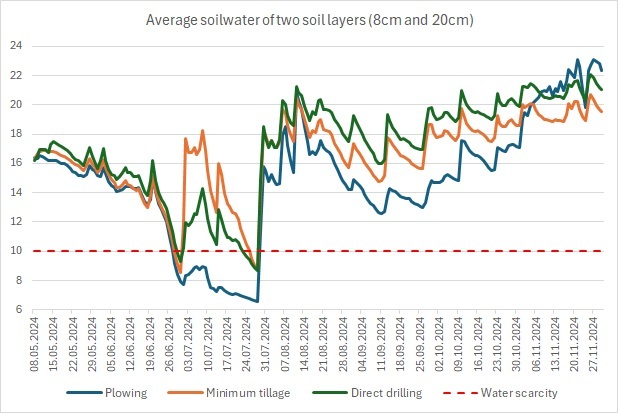
The 2024 sowing period had a larger reserve of soilwater left over from the winter compared to previous years. As the days warmed up and due to low rainfall, there was a steady decline in soilwater (Figure 1), which gained momentum on 20 June and lasted until the end of the same month. July rains raised the soilwater level highest in the minimised tillage variant, followed by the direct drilling variant. July rains had the least impact on soilwater in the ploughing variant. In the ploughing variant, soilwater was lower throughout the season than in the other variants, which indicates the lowest water retention capacity.

Figure 1. Average soilwater in two soil layers (8 and 20 cm), field peas 2024.

The largest amount of soilwater during the vegetation period was in the direct drilling variant, closely followed by the minimised tillage variant.

Days with water deficit occurred during the pea growing season in the ploughing variant 31 (28/06…28/07), in the minimised tillage variant 6 (28/06…30/06 and 26/07…28/07) and in direct drilling 8 (29/06…30/06 and 23/07…28/07).

The rainfall that started in the last days of July considerably raised the soilwater level in all variants, but still left the ploughing readings lower. Subsequent rains kept the soilwater level consistently high until winter set in.

In the ploughing variant, the amount of soilwater only rose higher compared to the other variants after the autumn ploughing done at the beginning of November, when the ploughed layer filled with more water than the other variants. This may be due to the formation of a plough pan under the ploughing.

Nutrients

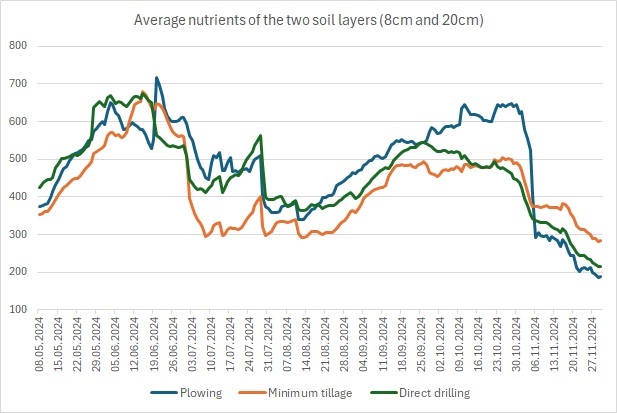
The fertilisation background was the same for all variants. With sowing, mineral fertiliser MAP 12-52 – N 4.8 kg/ha and P 9.15 kg/ha was applied. On 16 May, Potassium chloride – K 32.37 kg/ha was added as top dressing. Nutrients were also provided to the soil by the cover crop and field peas, which also resulted in an increase in nutrients from August to the end of October (Figure 2). However, in November there was a decrease in nutrient levels due to leaching. Nutrients that appeared after the peas matured were wasted due to soil leaching.

Figure 2. Average nutrients in two soil layers (8 and 20 cm), field peas 2024.

In the second half of May and the first half of June, there were the most nutrients in direct drilling, which was based on a higher soilwater level. Overall, ploughing had the highest nutrient level. On the one hand, the water deficit period in July hindered nutrient uptake, on the other hand, biological processes took place faster in the aerated soil with ploughing in the second half of the summer and autumn. As a result, more nitrate nitrogen was released into the soil than with other tillage methods. In addition, the above-ground residues of the cover crop were turned into the soil with spring ploughing. After the autumn ploughing done at the beginning of November, nutrients were quickly washed out of the ploughed layer by the rain.

The nutrient level was lowest in the minimised tillage variant. But by the end of November, fewer nutrients had been leached from there than in the other variants.

Soil Temperature

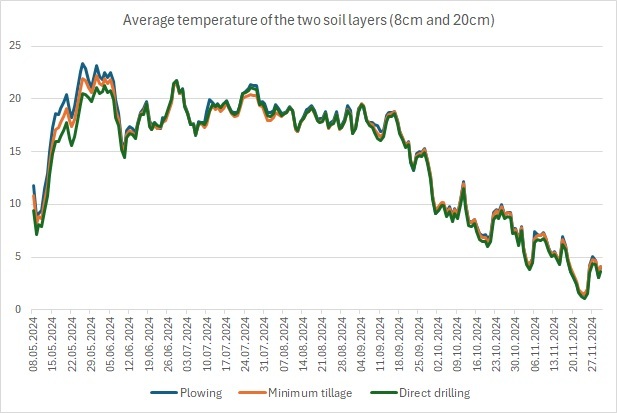
In spring, the soil warmed up fastest in the ploughing variant (Figure 3). Soil temperatures were also higher there until the vegetation shaded the soil surface. Ploughing was most exposed to heat stress during the heatwave in late May and early June. The lowest soil temperature in spring was in direct drilling. In direct drilling, the average daily soil temperature of the two soil layers was up to 3 degrees lower than ploughing on the hottest days, so the risk of soil heat stress was significantly lower. Soil with minimised tillage fell in between the others. Soil temperatures evened out when the vegetation shaded the soil surface. There were no clear differences in soil temperatures in the autumn.

Figure 3. Average soil temperature in two soil layers (8 and 20 cm), field peas 2024.

Conclusion

Water retention capacity was lowest with ploughing, but highest with direct drilling. There were significantly more days with water deficit with ploughing than with minimised tillage or direct drilling.

During periods of rainfall, biological processes were faster in the aerated soil with ploughing, and more nitrate nitrogen was released into the soil compared to the other variants. A large amount of nitrogen that appeared in the soil after the peas matured leached out in late autumn.

Ploughing warmed up fastest in spring but was most susceptible to soil heat stress. Soil with direct drilling was most protected from the heat, but the soil warmed up more slowly in spring than with other cultivation methods. Reducing soil temperature by using direct drilling is beneficial for enhancing root growth and water and nutrient uptake during heatwave periods.

  • *I have permission from the copyright holder to publish this content and images.

The 2025 Innes Lecture – Following the Pepper: Black berries, Asian trade and European empires

Member News
The views expressed in this Member News article are the author's own and do not necessarily represent those of Agri-TechE.


This year’s Innes Lecture is being delivered by Prof Sujit Sivasundaram, Professor of World History at the University of Cambridge, who will look at the history of pepper and the role it plays in the world.

It will be held on Tuesday 29 April in the John Innes Conference Centre at Norwich Research Park. The event is free to attend and open to all. Please book your tickets here.

Doors open at 6pm with the lecture starting at 6.30pm.

Pepper is the most widely used spice in the world, but its widespread use was not always certain or predictable.

This lecture follows pepper’s journey from its origins in South India, across the Indian Ocean, and through many different hands, before the Portuguese sought to take control of it.

The way pepper was harvested and traded to meet growing demand helped shape the plantation economy. The combination of the plantation economy and European colonisation played a huge role in shaping the modern world. Looking at how pepper was cultivated and traded, reveals different ecologies, trade networks, labour systems and cultural influences.

Prof Sivasundaram’s last book, Waves Across the South: A New History of Revolution and Empire, won both the British Academy Book Prize and the Jerry Bentley Prize for World History. He is a Fellow of the British Academy.

  • *I have permission from the copyright holder to publish this content and images.

Land Use for Net Zero Footprint: Greenhouse Gas Accounting Living Lab

Member News
The views expressed in this Member News article are the author's own and do not necessarily represent those of Agri-TechE.

Land use can be the cause as well as the solution to the biodiversity and climate crises that we currently face. However, our ability to better predict the implications of our land use decisions will determine whether we can achieve desired changes that support diverse needs, on a finite area, whilst reducing environmental impact.

Land Use for Net Zero (LUNZ) Footprint is one of five research projects that run alongside the LUNZ Hub. Collectively these projects aim to help drive the transformation of UK land use needed to achieve net zero by 2025. The LUNZ Footprint project specifically aims to make it simpler for farmers to measure and reduce their carbon footprint, recognising that as we approach 2050, farm businesses will increasingly need to demonstrate net zero credentials to processors and retailers who have Scope 3 net zero targets.

LUNZ Footprint uses a ‘Living Lab’ approach to enable integration of research and innovation through co-creation in the real-world, ensuring research matches industry needs. Key to the success of these Living Labs is building communities who can share best practices and help compare greenhouse gas calculations.  The project is engaging with policy and value chain stakeholders and 100 farm businesses to raise awareness around the tools available to understand greenhouse gas footprint and to help place farm businesses at the centre of decision making.

 There are currently opportunities to engage with this project through a series of regional workshops. The Eastern England workshop to describe the project and provide opportunities to engage further will take place on Thursday 8th May 2025 at Cranfield University in Bedfordshire. Details and registration for this event can be found here.

  • *I have permission from the copyright holder to publish this content and images.

How Integrated Power, Wireless, and SMART Solutions Are Revolutionising Business and Farming Operations

Member News
The views expressed in this Member News article are the author's own and do not necessarily represent those of Agri-TechE.

In today’s rapidly evolving business landscape, the integration of sustainable power, reliable connectivity, and intelligent technology isn’t just a luxury – it’s a necessity for survival and growth. As businesses face increasing pressure to reduce costs, improve efficiency, and meet sustainability goals, the convergence of these three critical technologies is creating unprecedented opportunities for operational excellence.

The Current Business Challenge

Modern businesses face a triple challenge:

  1. Rising energy costs and unreliable power supply
  2. Growing demand for seamless connectivity
  3. The need for intelligent, automated systems

These challenges are particularly acute in industrial settings, agricultural operations, and remote facilities where traditional infrastructure may be limited or unreliable.

The Power of Integration

The real magic happens when off-grid renewable power, private wireless networks, and SMART technology work in harmony. This integration creates a robust ecosystem that delivers:

  1. Energy Independence and Sustainability
  • Reliable off-grid power solutions
  • Reduced operational costs
  • Minimized environmental impact
  • Consistent power supply for critical operations
  1. Secure and Reliable Connectivity
  • Private 5G networks for enhanced security
  • Custom wireless design for optimal coverage
  • Multi-bearer radio technologies for redundancy
  • Seamless communication across operations
  1. Intelligent Operations
  • SMART building management systems
  • Automated security solutions
  • Agricultural technology integration
  • Real-time monitoring and control

Real-World Applications

Let’s explore how this integrated approach transforms different sectors:

Industrial Sector:

  • Automated production lines powered by renewable energy
  • Real-time monitoring through private wireless networks
  • SMART systems optimising energy usage and maintenance schedules

Agricultural Operations:

  • Sustainable power for irrigation systems
  • Wireless connectivity for precision farming
  • SMART technology for crop monitoring and optimization

Defence and Security:

  • Reliable power for critical operations
  • Secure private networks for sensitive communications
  • Intelligent surveillance and monitoring systems

The Implementation Journey

A successful integration typically follows these steps:

  1. Assessment of current infrastructure and needs
  2. Custom solution design
  3. Phased implementation (typically 6 weeks)
  4. System optimisation and monitoring
  5. Ongoing support and maintenance

Return on Investment

The benefits of this integrated approach are substantial:

  • Reduced energy costs through renewable power
  • Improved operational efficiency via SMART systems
  • Enhanced security through private networks
  • Increased productivity through automation
  • Future-proofed infrastructure

Looking Ahead

As technology continues to evolve, the integration of power, wireless, and SMART solutions will become increasingly sophisticated. Businesses that embrace this convergence now will be better positioned to:

  • Adapt to changing market conditions
  • Meet sustainability goals
  • Maintain competitive advantage
  • Scale operations efficiently

Conclusion

The future of business operations lies in the seamless integration of sustainable power, reliable connectivity, and intelligent systems. By adopting this holistic approach, organisations can not only address current challenges but also position themselves for future success in an increasingly competitive and sustainability-focused world.

Phone: 0333 0386878

Email: hello@c3rtechnologies.com

Website: www.c3rtechnologies.com

Follow Us on LinkedIn, Facebook and X

  • *I have permission from the copyright holder to publish this content and images.

FLYTHRIVE uses AI to drive natural defences and deliver value to growers

Member News
The views expressed in this Member News article are the author's own and do not necessarily represent those of Agri-TechE.

New research aims to tackle rising insect pest infestations in common berry crops using advanced AI, natural lures and selected species of aphid-feeding hoverflies to continuously monitor the crop and trigger earlier intervention. 

UK berry growers are threatened by increasing pest infestations which drive down yields and increase costs; aphids can reduce berry crop yields by more than 30%. Growers are urgently searching for new ways to deal with pests at a predictable cost and with better environmentally sound results.

A consortium of commercial growers, leading applied researchers, and an innovative agritech solutions business including the crop research organisation Niab, The Natural Resources Institute, University of Greenwich, Asplins Producer Organisation Ltd, The Summer Berry Company Ltd, and agritech start-up Olombria, have already developed a system to deliver innovative natural pest management solutions in soft fruit.

FLYTHRIVE (Fly-Led Yield Thriving in Horticulture with Integrated Vision and Ecology) is the next step and the £1.3 million match-funded project, supported by InnovateUK, will enable the system to be trialled and optimised in full-scale commercial environments. The unique hoverfly-led control system is expected to be commercially effective in all commonly used berry-growing environments and has broad application across other fruits.

Dr Sarah Arnold, research lead in applied entomology at Niab commented, “There is an urgent need for integrated pest management solutions in commercial horticulture that do not depend on new pesticide approvals. Beneficial insects such as predators and parasitoids are an increasingly important part of growers’ toolkit to manage priority pests like aphids.”

The goal is early automated detection through active monitoring and highly efficient rapid targeting of aphids with select hoverfly species at a much lower cost and without negative environmental impact. FLYTHRIVE aims to reduce aphids by over 70%  within two weeks of deployment. New Machine-Learning Vision Systems and active lures will be developed to monitor and direct hoverflies at a much earlier stage of aphid infestation, reporting their performance directly to growers and providing AI training data for future optimisation. The project will prove the viability at scale for the system.

Tashia Tucker, founder and CEO of Olombria explained, “This project is tackling one of the toughest challenges berry growers face, and we’re confident it will deliver real solutions. Building on our success with pollination systems, we’re excited to collaborate with our incredible partners, whose expertise and dedication are vital to developing a natural, effective way to protect crops from pests like aphids and support growers in achieving healthier, more sustainable harvests.”

Dr Steven Harte, senior lecturer in chemical ecology at NRI, commented, “This project combines chemical ecology techniques commonly used in IPM with new technologies such as machine learning to do something novel in biocontrol research and offers fruit growers a sustainable pest control solution.”

Chris Rose, chief operating officer of Asplins, added, “The UK soft fruit sector has been a great success story providing delicious, healthy fruit to a high standard; yet growers are struggling to remain profitable with rising costs, increasing pest and disease challenges and customer lead need for pesticide reduction.  This exciting and innovative project has the potential to significantly ameliorate all these challenges.”

Camilla Langmead, senior production coordinator at The Summer Berry Company, said, “This project is exciting for us as it will help us reduce our pesticide use, and it will create an additional pollination route which can increase our fruit size and reduce wastage. We have natural biologicals on the farm, but this will increase the biodiversity further, complimenting the direction we want to be heading in.”

A researcher’s guide to Australia’s agriculture and food ecosystem

Member News
The views expressed in this Member News article are the author's own and do not necessarily represent those of Agri-TechE.

When it comes to making meaningful impacts in agriculture and food innovation, Australia’s research ecosystem is brimming with opportunities for local and international researchers. growAG.’s research guide to Australia’s agriculture and food ecosystem serves as an essential resource for international researchers and organisations looking to navigate Australia’s research landscape and forge meaningful collaborations.

Australia’s research ecosystem

Australia’s agricultural research landscape represents a substantial economic commitment, with combined public and private investment reaching US$1.59 billion in 2022-23. This investment includes US$906 million in public funding from federal and state governments and universities, complemented by US$686 million in private funding. Studies have consistently demonstrated the significant return on this investment, estimating that every $1 spent on agricultural R&D yields almost $8 in returns for farmers over a 10-year period.

At the heart of this ecosystem are the Rural Research and Development Corporations (RDCs), which have been driving agricultural advancements since 1989. These organisations facilitate co-investment between the Australian government and primary producers, creating benefits that extend to industry stakeholders and regional communities alike. The Australian research landscape includes 15 RDCs – 5 Commonwealth statutory bodies and 10 industry-owned companies – collectively investing approximately US$550 million annually.

However, Australia’s research ecosystem doesn’t stop at RDCs. It also encompasses numerous Cooperative Research Centres (CRCs), federal government agencies like the CSIRO, state-based agricultural departments, university research hubs, private sector R&D programs, and technology incubators.

While such a diverse and extensive research environment offers tremendous opportunities, it can be tricky to navigate the maze of funding options, partnership structures, regulations, and paths to commercialisation in Australia’s agricultural innovation space.

The solution: The growAG. Research Guide

The growAG. research guide simplifies the pathway for local and international researchers by providing comprehensive insights into Australia’s unique research landscape. The guide is designed to help researchers identify opportunities, establish partnerships, and access programs to foster collaboration and growth.

The guide offers several valuable resources including detailed profiles of each RDC, a map illustrating the Australian agriculture and food research landscapes, five distinct pathways for engaging with research entities and intellectual property considerations.

The RDC profiles summarise their industry focus areas, strategic research priorities, and preferred investment models. These profiles help researchers identify which RDCs align with their research areas and expertise.

The Australian agriculture and food research maps serve as navigational tools, helping researchers pinpoint potential collaborators and understand the complex relationships between various public and private institutions in the Australian research environment.

To grow research in Australia, an outline of five distinct pathways are provided highlighting actionable steps for researchers to take to begin building meaningful collaborations. These included collaborating with RDCs, Cooperative Research Centres, partnering with universities, or accessing government grants, incentives & assistance.

Intellectual property considerations are an essential consideration for international researchers looking to enter the Australian market. The benefits of establishing IP in Australia, the types of IP researchers should consider and specific considerations for research collaboration with universities and businesses are all outlined in the guide.

Success stories from the field

FutureFeed, a partnership between CSIRO, Meat and Livestock Australia, and James Cook University, is one example of collaboration featured in the research guide.

This collaboration created a livestock feed ingredient from native Australian Asparagopsis seaweed that reduces cattle methane emissions by over 80%. Launched as a company in 2020 with US$9.34 million in investment from Woolworths, GrainCorp, Harvest Road, and AGP Sustainable Real Assets- SparkLabs Cultiv8, FutureFeed now licenses seaweed growers across the globe.

FutureFeed, a partnership between CSIRO, Meat and Livestock Australia, and James Cook University, is one example of collaboration featured in the research guide.

This collaboration created a livestock feed ingredient from native Australian Asparagopsis seaweed that reduces cattle methane emissions by over 80%. Launched as a company in 2020 with US$9.34 million in investment from Woolworths, GrainCorp, Harvest Road, and AGP Sustainable Real Assets-SparkLabs Cultiv8, FutureFeed now licenses seaweed growers across the globe.

The innovation was recognised with the Food Planet Prize and demonstrated commercial viability by producing the world’s first lower-emission steaks in 2021. If adopted by just 10% of global producers, it would equal removing 100 million cars from roads while potentially feeding an additional 23 million people – showcasing how Australia’s research ecosystem can transform scientific breakthroughs into global solutions.

As global agricultural challenges intensify due to climate change, population growth, and resource constraints, successful research collaboration examples like these demonstrate what can be achieved. By providing a clear roadmap to Australia’s research ecosystem, the guide empowers Australian and international researchers to contribute to and benefit from one of the world’s most innovative agricultural sectors.

To explore these opportunities further, the complete guide is available to download from growag.com.

  • *I have permission from the copyright holder to publish this content and images.

Brewing a sustainable future: Morrow’s innovative approach to eco-friendly coffee

Member News
The views expressed in this Member News article are the author's own and do not necessarily represent those of Agri-TechE.

Legend has it that the first coffee consumers were goats – and that the energetic properties of coffee were discovered by Ethiopian farmers who noticed their goats were far more animated after consuming coffee cherries. Since then, consumption of coffee has spread to the human population – and if we are going to make a competition out of it – Finland wins, with each adult on average consuming 27.5 pounds of coffee a year…

Despite record-breaking coffee prices, the consumption of coffee worldwide is soaring, and with this soaring coffee consumption comes an environmental debt. Large-scale coffee farming leads to deforestation and the subsequent loss of natural habitats, soil damage, and water pollution, all of which contribute to climate change.

For these reasons, when We are Morrow presented an environmentally friendly solution at Agri-TechE ’s REAP Conference in Newmarket in November, it is fair to say that everyone in the room was intrigued. Their solution? Coffee made from locally grown and up-cycled ingredients, such as fruit pips, peels and seeds, but crucially, not coffee beans. As We are Morrow explained during their presentation, they first identify the compounds that give coffee its unique flavour, aroma and colour, select ingredients that contain those compounds and then ferment, roast and malt these ingredients until a product is achieved with the right flavour compounds. This is impressive given that coffee is actually incredibly complex. The list of chemical compounds present in coffee runs to over 1000 with over 800 aromatic compounds. For this reason recreating coffee without the coffee bean is quite a scientific achievement. However, We are Morrow’s technology is not only scientifically remarkable. As the coffee can be made from locally sourced waste or by-products, the environmental impact of producing coffee is significantly lessened.

The example set by We are Morrow is fortunately being reflected in the food market. As we – as consumers – become increasingly aware of the environmental impact of our food, the popularity of up-cycled food products is increasing at a significant rate. According to a recent market report, the up-cycled food products market was valued at $54.5 billion in 2022, and is forecasted to reach an impressive $94.6 billion by 2032. Examples of other up-cycled food products include snack bars made from spent grain, over ripe bananas and the pulp from pre-juiced vegetables and fruit. As such, we hope to see more and more of our food coming from up-cycled ingredients in the years to come. For now, however, we look forward to welcoming We are Morrow coffee into the coffee shops of Cambridge!

Andrea Williams

Partner, M&C Cambridge

  • *I have permission from the copyright holder to publish this content and images.