Patenting, Trademarks, Copyright, Trade Secrets...
In the next installment of our micro-learning series, we’ll explore potential legal solutions to help you keep your ideas safe and sound.

#ATW21 Friday: Carbon avoidance or carbon capture?

Agri-TechE Article
Agri-TechE

“Carbon avoidance, or carbon capture? What is the best strategy for Net Zero in agriculture?” asked delegates at the final Agri-TechE Week event of 2021, hosted by Niab’s Eastern Agri-TechE Innovation Hub, headed up by Dr Lydia Smith.

Eastern Agri-TechE Innovation Hub
Eastern Agri-TechE Innovation Hub is focussed on waste reduction and also on sustainable heat and power

Coming hot on the heels (literally) of the frenetic closing stages of the COP26 conference, the low carbon hybrid event showcased approaches to reduce emissions through innovative tech-based solutions, and capture / storage options through different agricultural practices.

There is no shortage of technologies to help avoid or reduce carbon emissions, and a number are in development at the Eastern Agri-TechE Innovation Hub in Soham, managed by Niab. From Inspro’s automated bioconverter system using black soldier flies and food waste, to Cambond’s valorisation of low grade carbon materials (such as brewers’ spent grain, straw, hemp fibres and paper waste sludge) for the construction industry, and the hydroponic vertical farming system funded through the Interreg Hy4Dense project.

Hydroponic cultivation of salad vegetables

The Hy4Dense project is investigating the feasibility of year around production and also ways to reduce water use in cultivation, with a hydroponic system.

“As well as a 99 % reduction in water use, we can get 10-11 harvest cycles a year in a hydroponic system without supplementary heating, lighting or cooling,” commented Hy4Dense Project Manager Graham Taylor. “We’re also trialling different substrates such as flax, hemp and bamboo and are trialling reusable meshes to help reduce the carbon footprint.”

Graham suggests that natural light is often overlooked in controlled environments and yet even in winter daylight is a useful resource. He also revealed a surprising finding that green LEDs increased the yield of rocket, potentially as it is able to penetrate the dense canopy.

Agri-volteic farming – an alternative way of delivering solar farming

Fens in numbers carbon

“We just lack the data” said Luke Palmer of FC Palmer & Sons, sharing his frustration about ambitious Government targets for lowland peat restoration amid a lack of information to inform appropriate practices to achieve them.

With 50 % of the UK’s Grade1 land in the Fens, making the right decisions now is critical to protect and manage this unique and productive resource.

Luke is working with Niab and the Centre for Ecology and Hydrology on an Innovate UK-funded project to develop a novel gantry-based solar production system on his farm to enable water harvesting and storage as well as multi-cropping between the avenues of the solar panels.
All operations will happen from the gantry, protecting the soil from damage in the autumn.

Multispecies herbal leys  – a role in reducing in GHG emissions?

Multispecies ‘herbal’ leysHerbal leys are permanent pasture with a mix of grasses and herbs. “We know herbal leys improve soils and increase ecosystem services,” said Emily Cooledge of Bangor University, “but we don’t know the impact they might have on productivity and GHG emissions in the animals grazing on them.”

With a wealth of heroically collected data (yes, urine and dung samples) from several sheep flocks, Emily has found a big reduction in ammonic emissions from lambs grazed on herbal leys. The loss of ammonia was almost halved.

She has also seen changes in blood biochemistry and live-weight gain in the animals grazed – the theory being that plants such as plantain, chicory, lucerne and sainfoin naturally contain secondary metabolites which impact the animals’ metabolism.

Carbon capture in biomass

The go-to species when it comes to carbon sequestration are usual tree based, but according to agro-forestry consultant Jeremy Sweet, not all trees are created equal, and their future is not at all certain. “Beech, downy birch, oak, ash and elm are all projected to be more vulnerable in the east of England due to climate change” he pointed out, while extolling the virtues of inter-cropping as well as ensuring a cash return for fruit, nut, timber or biomass from tree crops.

Other crops – such as hemp – may also have a major role to play in carbon capture. “One hectare of industrial hemp can absorb 22 tonnes of environmental CO2”, claimed Nathaniel Loxley, Founding Director of the British Hemp Association. “And its big tap root  and rhizomal root network help to improve soil structure.”

British Hemp Association is working with the Innovative Farmers project to demonstrate the agronomic value of this versatile crop.

Carbon sequestration and biodiversity 

Viewers of “Autumnwatch” in the UK will be familiar with the Ken Hill estate in North west Norfolk.
Nick Padwick, the estate manager, discussed the benefits of putting biodiversity and carbon sequestration together. “Collaboration and partnership is key,” he commented “we direct drill, and use strip tillage (with shared machinery) and are in a partnership with a shepherd to bring his sheep onto the estate.”

A recurring theme of Agri-TechE Week – collaboration really does seem to be at the heart of making progress, whether it is carbon management, technology development or increasing on-farm productivity.

This event was hosted by Niab.
Agri-TechE Week features a mix of in-person and virtual events that are designed to showcase exciting developments in agri-tech. It is coordinated by Agri-TechE working closely with partners across the innovation ecosystem and aims to provide opportunities to attract new customers and partners and to broker collaborations and international connections.

Make agri-tech part of the solution at COP26

Agri-TechE Blog
Agri-TechE

The potential for GHG emission savings across the agri-food supply chain are significant – which makes its absence from the COP26 themes even more disappointing.
“The world is at one minute to midnight” says the UK’s Prime Minister, Boris Johnson, ahead of the landmark COP26 conference in Glasgow about the need to make urgent changes.
Time, agriculture and the climate are themes of the 2021 REAP Conference: “Changing Time(s) for Agriculture” next week. It  promises a lively discussion on emerging agri-tech solutions that support the move towards Net Zero and it is attracting international participation. However, agriculture is not specifically mentioned in the COP presidency themes:

  • Adaptation and resilience – to help communities adapt to, and prepare for, the worst impacts of climate change.
  • Nature based solutions – to safeguard and restore natural habitats and ecosystems to preserve the planet’s biodiversity.
  • Energy transitions – to accelerate the clean energy transition by encouraging the use of cheaper renewables and storage.
  • Clean transport – to clean our air by speeding up the global transition to zero emission vehicles.
  • Finance – to encourage our financial systems to be cleaner to unlock growth and create green jobs.

Given that one expects agriculture and the food industry to sit under a number of these major themes, it is disappointing – given the current direction of travel in the industry, and the potential for impact through changes in practice and use of technology – that COP26 isn’t putting these issues front and centre of the discussions.

The journey to Net Zero and role of agri-tech

Overall agricultural emissions in the UK have reduced by 16% since 1990, according to the UK’s National Farmers Union. Its ‘Journey to Net Zero’ strategy outlines the three pillars of the journey to net zero.
These are:

  1. Boosting productivity and reducing emissions
  2. Farmland carbon storage
  3. Increasing renewable energy and support for the bioeconomy.

Blending the technology alongside a more regenerative and restorative approach to food production is already yielding significant results – see Tom Pearson and Dyson Farming in the Sofa Session and Catalyst Farming in the the RNAA Agri-TechE Week event.
Predictive yield models are already in place for crops such as salads, potatoes, sugar beet and even forage grass, all aimed at increasing efficiency and reducing over-planting to match supply and demand.
Breeding to enable crops and livestock to be more productive has been underway for decades, and innovative dietary changes can help reduce GHG emissions from cattle and pigs.
Enabling controlled environment production of appropriate crops in appropriate ways can reduce air miles.
Alternative plant and insect-based protein sources for food and feed are poised to make their global mark.

Minute to midnight

Using the clock to indicate the passage of large time intervals is not new – the Montessori Clock of Eras equates an hour on a 12 hour clock face to around 375,000 million years.
A further refinement showing the history of Earth in a 24 hr clock face has often been used to illustrate evolution – with the origin of life at around 4am, the first oxygenating bacteria emerging at around 5.23am, land plants emerging at around 9pm and the dinosaurs just before 11pm. Humans first roamed the Earth at nearly 11.59pm.
That final ‘minute’ of geological time also includes the 10,000 years where humans became hunter-gatherers, then domesticated and started to breed the first grasses which became the ancestors of today’s cereal crops.
Fast forward to the Industrial Revolution and the Green Revolution – and we are actually in the closing few microseconds of Boris Johnson’s “minute to midnight” to impact climate change.
The next two weeks will be crucial – and in the closing seconds of the ‘clock’ of the Earth’s history, let’s buy ourselves more time – and make more noise – about the potential for agriculture to be part of the solution.

REAP 2021: Changing Time(s) for Agriculture10th November 2021

Imagine a world where agriculture is not constrained by time. The ability to manage and manipulate time is increasing and REAP 2021 will explore the advances in technology and breakthroughs in science that is making this possible.
REAP brings together people from across the agri-tech ecosystem who believe that innovation is the engine for change. The conference bridges the gap between producer needs and technology solutions and showcases exciting agri-tech start-ups. 

How to create value from food waste

Agri-TechE Article
Agri-TechE

2-4 million people could be fed their 5-a-day nationally on fruit and veg that is currently rejected for cosmetic reasons such as colour, shape and size, it has been estimated by WRAP.
AMT Fruit, part of the Munoz Group, is one of the UK’s largest citrus specialists, and they are addressing the problem in a number of inventive ways, were discussed at an event ‘Closing the Loop on the Circular Economy’.

Naomi Pendleton, Head of Technical and CSR at AMT Fruit Ltd, spoke at the event. She explains that the company works with over 250 growers to supply Tesco with 11 million boxes of citrus each year – that’s approximately 140 million nets of citrus.
circular economyShe says: “We have been focusing on reducing food waste in our global operations for a number of years, and through our efforts to date we have reduced overall operational waste by 30% from 2015 to 2018, the majority of which (81%) is citrus fruit waste.


“This has been achieved in a number of ways including: revising and broadening product specifications; expanding our sourcing countries; introducing new product lines; and developing partnerships with food charities, which have seen the donation of 1 million portions of fruit.”

AMT conducted consumer research to gauge attitudes and as a result was able to work with their retailer customer Tesco to accept an increased amount of ‘scruffy’ fruit and to introduce a new giant line of over-sized fruit. This resulted in Spanish growers supplying an extra 10% of their crop to Tesco. Further improvements to the delivery strategies have extended the shelf life of citrus fruits by 40 million days.

However despite these efforts the organisation still has in excess of 2,000 tonnes of waste each year from the UK operation.

Create value from food waste

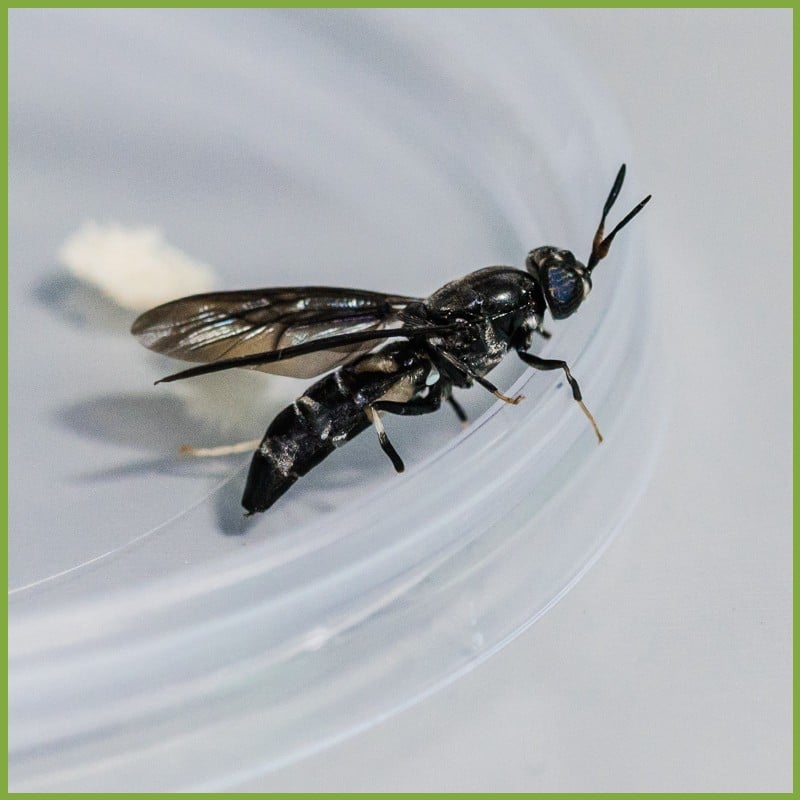
Naomi explains: “Our citrus waste is too wet and acidic and full of rots and moulds which makes it unpalatable for animal feed. We were having to send all our waste to AD plants. At the start of 2018 we were introduced to Joe Halstead from AgriGrub, who was looking for locally sourced viable waste products on which to grow his black soldier fly larvae.”

AgriGrub feeds waste vegetables and fruit to the larvae of Black Soldier Flies and when they are an optimum size they sell the larvae – branded as Calci worms – to pet food distributors and retailers as a form of live feed for reptiles. Their virtuous by-product is called frass, and is a sustainable source of nutrients for plants, and a novel bio-repellent for crop protection.

There is already a significant body of evidence on the efficacy of chitosan (the active component in frass) as a biopesticide. However for many years the cost of extracting the chitosan was considered too great, as the process involved boiling crustacean shells in sulphuric acid. Frass from insects, however, needs little processing and represents an economically viable source of chitosan for agriculture.

Joe Halstead explains: “We are focusing our attention at the moment on higher margin crops which have few treatment options for pests and diseases as this is likely to give us the best return in the least time. However longer term I hope and expect frass to have broadacre application, especially where neonicotinoids are being phased out. Our first frass trials, on brassicas, showed a 94% reduction in aphid numbers on frass treated plants versus controls.

“It is in the field where routine synthetic pesticide usage is most damaging to our environment, so ideally we’d like to see frass and its bio-repellent qualities used in the field to repel insects rather than killing them. This spares non-pest species and allows beneficial insects to persist in the local environment.”

Naomi says the relationship is working well: “This is a great example of a circular economy created through a mutually beneficial relationship. Our presentation will discuss this relationship, how it works and the benefits for all, including those for local farmers.”

Find out more Closing the loop on the circular economy 

Dr Belinda Clarke, says: “Food waste is a major issue and the work AMT Fruit is doing with AgriGrub is one of a number of inspirational approaches that use waste from one process as input to another.

Event is over.