Space technology companies encouraged to consider the agri-tech market for growth
 Agri-TechE
 With significant government investment in defence and intelligence applications of space technology, it might surprise some that a 2024 market analysis found agriculture to be the largest revenue source for Earth observation value services.
But for Becky Dodds, Director of Communities at Agri-TechE, a not-for-profit member organisation, space technology is an obvious solution for managing large areas of land in detail. This could be for land use, crop monitoring, water availability or improving wireless connectivity.
Looking further back, Becky notes that global navigation satellite systems (GNSS) technology began to be adopted 25 years ago for running tractor autosteer systems, and it is now almost universally adopted in some agricultural sectors. “It’s a great example of the market penetration that space technology can have if farmers see value in it,” she says.
The latest advancements in satellite technology, enabling higher-resolution and hyperspectral imagery, mean that their applications in agriculture are increasing significantly, says George Collison, director of Collison and Associates.
“Different crop and soil characteristics absorb different parts of the electromagnetic spectrum to different degrees,” he notes. “The more you split the spectrum up, the easier it is to identify different return signatures and use those to identify insights into specific parameters of crop health.”
The amount of mass required to reach space for high capability has been dramatically reduced, continues George. “For example, if you look at AAC Clyde Space’s new Cyclops constellation, its satellites are under 30 kilos, but their multi-spectral cameras cover a 15km swath to a resolution of 1.5m per pixel.”
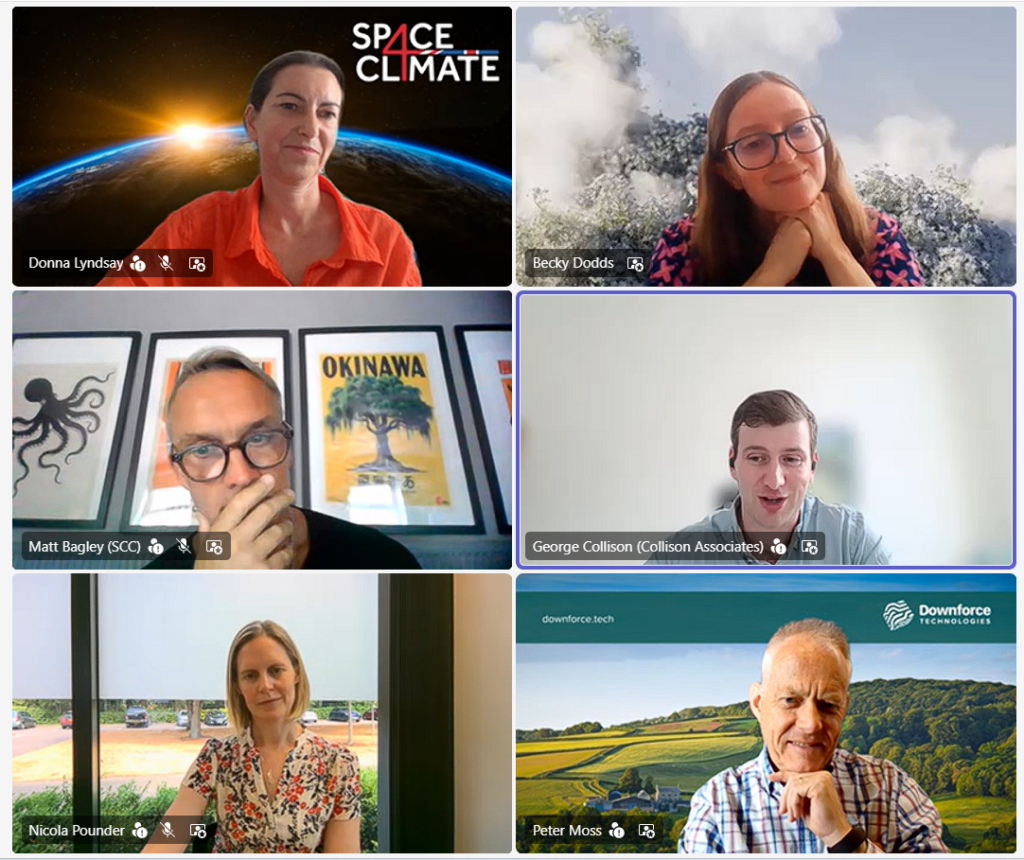
Downforce Technologies is an example of how these satellite applications have been leveraged to build a space tech business in the agricultural industry. They have used existing ground based data, combined with satellite imagery, to analyse the carbon present in the top 30 cm of farmers’ soil, explains Peter Moss, CEO of Downforce Technologies.
This provides a measurable indicator for measuring Scope 3 emissions and environmental actions for businesses in the food supply chain. It’s a business model that has proved scalable across the world, thanks to the satellite applications.
Peter says they have successful case studies working with brewers, grain merchants, and banks across the UK and Australia. “We can measure carbon stocks and carbon stock change with sufficient accuracy to meet the greenhouse gas protocol requirements,” adds Peter.
To help increase awareness of the opportunities in agriculture for technology developers and researchers in other industries, Agri-TechE has begun an outreach programme titled ‘Agri-Tech Meets…’, says Becky.

“There is a lot of support available for businesses to adapt their technology for agriculture, without the need for industry contacts or knowledge within the company.
“It’s valuable for Space East to work with people like Agri-TechE to cross-fertilise their communities.
“Agri-TechE specialises in connecting members in our agri-tech community. It means we can introduce sector specific consultants, researchers, farmers, and potential customers to space ecology companies interested in developing a business in agriculture,” she says.
Post Overview
Agri-TechE Related Posts
GNSS developers target agriculture’s expanding precision ag market

A trip to the Tees Valley HQ
Dual-use technologies to take the next leap
Space4Climate Agriculture Market Breakthrough – Report published

The Medici Effect: What Agritech and Biotech can learn from each other