The Productive Landscape: NatureTech for Profit and Planet
How can technology enable delivery of food, nature recovery, and climate resilience - all at once? The Head of the Environment Agency is asked: what's the national plan for dealing with land use pressures, plus you’ll hear from technologists and land managers working on nature-based and tech-enabled solutions for water, soils and climate adaptation.

Hacking, Sprinting and Providing New Solutions for Agriculture

Agri-TechE Blog
Agri-TechE

sudo grow hackathon - inspirational thinking, problem solving and prototype developmentThe “hackathon” concept has been used in the IT industry for some time to bring together technical experts around a key problem facing a business or sector, and engaging in a super-focused effort (or “sprint”) over a day, weekend or longer, to come up with some answers.
And we think it’s time to do some hacking and sprinting to generate new solutions for agriculture and horticulture.
In partnership with Allia Serious Impact, we are jointly hosting an agri-hackathon called >SUDO : GROW to focus some of the brightest brains around some of the biggest opportunities facing our exciting industry.
A hackathon is a term coined by the computing industry to rapidly develop new software technology. The “-thon” bit of the word comes from “marathon” – which is what the participating teams feel they are doing when they are brainstorming, creating ideas and problem solving, more or less without a break, to come up with a rapid, workable solution.

>SUDO : GROW

The SUDO GROW hackathon will bring together industry experts and technology enthusiastsHeld in Cambridge over a weekend in April, the >SUDO : GROW hackathon will bring together industry experts and technology enthusiasts.
The team from Cambridge Applied Research are sourcing equipment (sensors, robotic parts, microprocessors etc), open-source APIs (that allow different bits of software to talk to each other) and copious quantities of Post-It notes and flip charts.
They are experienced hackathon organisers who know how to keep participants motivated, focused (and fed and watered).
Working from Saturday morning, through the night and into Sunday, the final solutions will be presented to a panel of judges on Sunday afternoon.

Hack for Ag

Aponic vertical growing standSo how can this work for agriculture? Surely new plant varieties, crop and soil chemistries and even imaging and sensor technologies take years to develop and be approved? Of course, no-one is expected to come up with a new type of crop or novel chemical in a weekend, but its reasonable to expect some relevant engineering, robotic or mechanical solutions to emerge.
The three focus areas will be:

  • vertical farming
  • non-chemical weed control
  • poultry management

With industry champions from Aponic, Niab, Greenvale and G’s Growers, outlining the technical challenges and opportunities facing the industry in these areas to the participants.

How can I get involved?

You can come and hack if you have some technical expertise, you can come as part of a pre-formed team, you can be an industry champion or a mentor / guide for the teams, or even a judge or sponsor.
The hackathon is all about generation of technical solutions – in contrast to the GROW agri-tech business plan competition we’ve run over the last three years, the ideas that emerge from this process should be technically feasible, but will still be a long way from even being the basis of a business plan.
The hackathon weekend is part of a longer process throughout 2018 where we and the Allia Serious Impact Team will be working with the teams developing the ideas and the industry champions to move forward the plans for commercial adoption of some of the ideas.
To find out more about the >SUDO : GROW hackathon, meet the team from Allia Serious Impact and Cambridge Applied Research
To register click here.

Unicorns, gorillas and gazelles wanted to transform UK agriculture and horticulture

Agri-TechE Blog
Agri-TechE

Wanted - unicorns, gorillas and gazelles to transform UK agriculture and horticultureNo, it’s not a new form of diversified livestock management – unicorns, gorillas and gazelles are terms used to describe businesses in various stages of growth and success. The final of our GROW agri-tech business plan competition has got us looking at the global deal flow into agri-tech and how start-ups are developing.

While other, more mature sectors have examples of companies in these categories, “agri-tech” has needed time to begin to deliver this menagerie of success.

Unicorns are start-up companies that end up valued at over $1 billion, gorillas are market share leaders whose business is based on proprietary technology, and gazelle companies have increased their revenues by at least 20% annually for four years or more, starting from a revenue of $1 million.

Attractive for investment

Wanted - unicorns, gorillas and gazelles to transform UK agriculture and horticultureWith the final of GROW approaching we have been looking at the global landscape – how much is being invested, who are the rising stars, where the smart money is going, and how this is shaping the industry and the businesses within it.

According to the brilliant AgFunder “AgTech Investing Report,” 2016 saw $3.23bn invested across 580 agri-tech deals globally. The US attracted most of the deal flow (but this was still less than half of the total), followed by Canada, India, the UK, Israel and France.

Being the 4th most attractive market for private investment into agri-tech globally is pretty impressive – but for the UK, a relatively modestly sized market that has always punched above its weight in science and technology development, perhaps not completely unexpected.

Yet this is no time for complacency.

Keep an eye on the exit

Wanted - unicorns, gorillas and gazelles to transform UK agriculture and horticultureUnlike those in other more mature industries, global agri-tech deals have yet to deliver impressive and reassuring exits for investors. At Agri-Tech, we work with many companies seeking investment at various stages of their development, and one of our most common questions to them is about the expected size and scale of their exit – when can their investors expect to get their money back – plus more! We always encourage people to be really clear on the investment proposition – “how much”, and “by when” are the questions we know the investors will ask.
Mergers and acquisitions are an important ways of exit – as well as being an indicator of the interest among larger businesses to acquire the assets, people and technologies of another organisation. Here the UK has had some success, with BioLine (biocontrol products for agriculture) and Silent Herdsman (a sensing/ Internet of things business for livestock management) leading the pack.

GROWing investment opportunities

Growing a start-up to the point where it becomes an attractive proposition for acquisition is a big challenge – and in the UK we are fortunate to have investors with appetite to invest and entrepreneurs working hard to grow their businesses and deliver benefits to farmers.

Our GROW business plan competition is the very start of the agri-tech commercial innovation pipeline – the fact that eager investors are always looking for high quality deal flow was our inspiration to create the competition. Admittedly it’s a modest contribution to the UK’s effort to breed agri-tech inspired gazelles, gorillas and unicorns, but one that we hope will one day pay dividends.

Literally.

Come along to our GROW final on Monday 19th June to help decide who receives funding to further their business idea – click here for more details.

GROW - The UK

Every challenge creates opportunity

Agri-TechE Blog
Agri-TechE
Agri-TechE is two years old!

Necessity is the mother of invention, they say, and these challenging times are driving innovation. As Agri-TechE celebrates its second birthday we are seeing the agri-tech sector expanding and attracting new players against a background of volatility and uncertainty.

Growing pipeline of ideas

We were delighted to see six agri-entrepreneurs hit the finals of GROW, our business plan competition. They had been mentored by our membership to build their understanding of real world issues – improving response times in the 24/7 salad industry, driving down costs in the dairy industry, anticipating the needs of plants before the crop suffers, increasing yields with less water. Although these businesses are still in a nascent state, the competition is gaining traction and helping to create an entrepreneurial ecosystem that will support a growing pipeline of good ideas get to market.

Overcome obstacles

‘The future is now’ we were told by early career scientists and farmers at Cereals 2016 as they joined us at our Young Innovators’ Forum event. The show itself boasted a new Drone Zone and Soil Pit showing determination of the industry to go up and under to overcome obstacles!

…..and the sun (mostly) shone on the expanded Innovation Hub at the Royal Norfolk Show.

Tackling uncertainty

UK agri-tech faces a very different landscape to the one in which Agri-TechE was launched. Brexit discussions have dominated the discussions of the last couple of weeks, and continuing uncertainty has implications for practical farming and the underpinning research; both of these were already under significant strain.

Every challenge is an opportunity for an entrepreneur.

The uncertainty around the use of certain crop protection chemicals and the lack of new chemistry emerging onto the market puts even greater expectation on “agri-tech” to help deliver some solutions. So it is encouraging to hear how a number of our grower members are accelerating their commitment to new technology and innovation to build resilience to additional market, regulatory and labour pressures that may result.

De-risking innovation 

While collectively we have scratched our heads as to how “big data” is really going to deliver the ambition for agriculture that it is realising in other sectors, we are seeing some pro-innovation farmers bite the bullet and invest in controlled traffic farming and precision mapping.  To support this there has been a huge increase in interest in drone technology and satellite imagery, with clever algorithms being written and “taught” based on field data sets to help with crop modelling and supply chain forecasting.

National support

The last two years have also seen the emergence of all the new national Centres for Agricultural Innovation, over 100 Agri-TechE Catalyst projects funded, and the national review by Sir Paul Nurse leading to the formation of a new over-arching body called UK Research and Innovation.

In addition, the various levy boards have come together to form the Agriculture and Horticulture Development Board – with a strong focus on knowledge exchange and dissemination.

Cluster together

CAKE pieceMost of us have limited influence over how the future will play out, but it is an inspiring to see that entrepreneurs, researchers, technology developers and innovators remain focused on working with the agri-industry to provide solutions that will help ease the pressure we will undoubtedly face while the political landscape becomes more settled.

GROW supporting entrepreneurs in agriculture

Agri-TechE Blog
Agri-TechE

OFC report 2016 cover-001Entrepreneurship is the topic on everyone’s lips at the moment, as the 2016 Oxford Farming Conference launches its report titled: “Entrepreneurship: A kiss of life for the UK farming sector”  and Agri-TechE welcomes applications to its GROW business plan competition.

GROW is the UK’s only national agri-tech business plan competition and it aims to find and support entrepreneurs bringing new ideas from concept to commercial reality.

De-risking innovation

We spend a lot of time thinking how to help farmers de-risk the adoption of a new product, technique or service. Providing a forum for people to exchange ideas and experiences is one way we try to help; another way is understanding the drivers and motivations for farmers to adopt new innovations.

There is a list in the OFC report of the advantages to farmers of a more entrepreneurial approach: remaining profitable, avoiding destruction, seizing opportunities, competing with larger firms, and growing the business. While the report also reveals that farming is one of the UK’s less entrepreneurial sectors, the good news is that entrepreneurship can, to an extent, be learned.

There are tools, techniques and mind-sets that can be adopted to help with the entrepreneurial attitude. For this reason we launched GROW in 2014 and five entrepreneurs were featured in the final last June. (You can read their stories here).

The idea behind GROW is to help find new agri-entrepreneurs, support them, help them make their business idea a reality, and to attract the interest of agri- investors looking for new entrepreneurs and ideas. To help put some practical flesh on the entrepreneurial bones we also offer applicants an experienced mentor to help them hone their idea into a business plan.

Myths about farm entrepreneurship

Last year’s competition debunked a number of myths we hear about farm entrepreneurship.

The first is that only large farm businesses have the resources and capacity to be innovative and entrepreneurial. Some of the GROW applications were from farmers on relatively small holdings with new ideas to make their business (and those of others) more productive, profitable, or environmentally sustainable. The OFC report also revealed that levels of success are not proportional to the available resources.

The second myth is that entrepreneurship is the domain of the younger generation. Again, not true – the age range of our competition applicants spanned several decades.

The final and most damning myth is that farmers are risk averse and slow to adapt to change. Keen to de-risk a new idea, yes, careful to think through the potential return on investment, yes, but the farmers in our network are constantly looking for better ways to do things, using sound research and understanding systems, and we saw a number of these apply to GROW last year.

The OFC report features some key issues facing entrepreneurship in agriculture:
  1. Entrepreneurs are not necessarily high risk takers but are prepared to try something new and enter an unknown territory. So, whilst taking a step into the unknown arena, they often do so having made sufficient checks to reduce all business risks to a minimum. Market research, testing markets or new products and even sharing risks with others are examples of lowering risks.
  2. Truly entrepreneurial people, when they hit a failure of some kind, are quick to pick themselves back up and try again. People with these characteristics will sooner or later be likely to succeed.
  3. Who wants to hear the story of an un-entrepreneurial entrepreneur? We love success stories, and so we admire those who try and succeed. Those who try but fail are largely ignored.
  4. Few people who have tried something unsuccessfully would be as happy to have their story told as those who have been successful at it. If you recognise yourself as an entrepreneur, and you have an idea for a new product, service or practice, then do consider applying to GROW.

We’ll be looking for an expression of interest by 7th March and a final application by 29th April, with the final on June 22nd. Let’s make the UK the global go-to place for agri-entrepreneurship and hope to see a future OFC report celebrating all that is entrepreneurial about agriculture!
GROW - The UK


GROWing a business support ecosystem

Agri-TechE Blog
Agri-TechE

Creating a business plan is an important first step to making a business concept into a viable business and is also a vehicle for sharing the concept with others that can help. There is significant funding available for early stage agri-tech businesses so the issue is not finance but changing a mind-set; encouraging people to be more entrepreneurial and creating an ecosystem to support them.

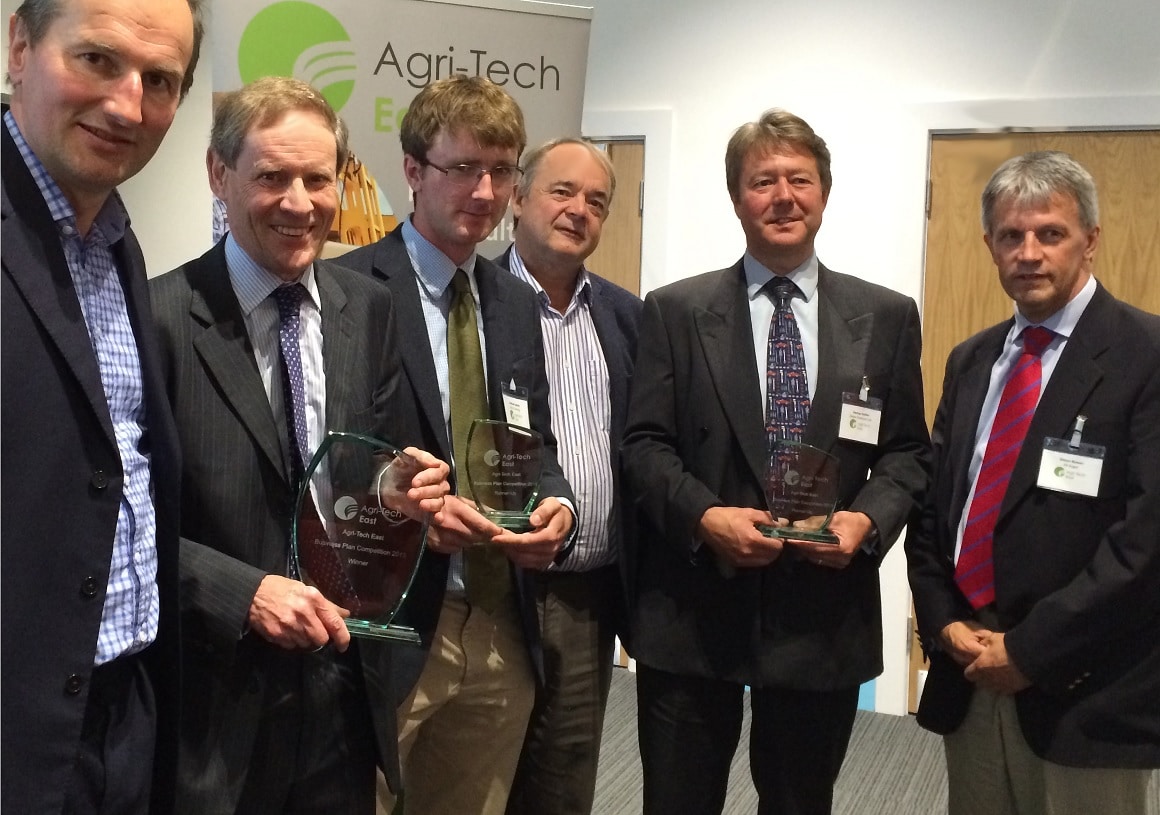
The judges and winners of Agri-Tech
L-R: William Kendall, Patrick Mitton, Andrew Spinks, Peter Cowley, George Kohler, Simon Bowen.

It was exciting to see how ‘agri-tech’ covers such a range of business opportunities and this was demonstrated by the variety of finalists in GROW, the UK’s first agri-tech business plan competition.

The aim of the competition was to stimulate entrepreneurial thinking, support people unfamiliar with business to gain support for developing a plan, and to give them an opportunity to pitch their idea to an interested audience.

There is also a significant business support ecosystem in the east of England with technology incubators, membership networks and specialist advice and consultancy available. GROW brought together these elements as support prizes in addition to the cash prize provided by HGCA (now called AHDB Cereals & Oilseeds).

A recent presentation I gave to representatives of the UK Local Enterprise Partnerships included some of our recent thinking on the key ingredients of an economically functional agri-tech “cluster.”

These include access to a strong knowledge base, an ability to translate that knowledge into the field, a range of companies of different sizes, maturities and disciplines, as well as access to finance, mentoring and coaching. A good agri-tech cluster also needs a focus on education, training and skills development to provide a pool of talent from which organisations can recruit high quality staff.

Members of the east of England’s agri-tech cluster came together around the business plan competition in a way which exemplifies how such a system can work.

Thanks to the generosity of organisations from both the public and private sector, we were able to offer a menu of support award prizes for the winner and two runners-up. They were able to choose the prizes that best suited their needs as they build their businesses.

Since the winners were announced, there has been a powerful demonstration of the value of a coordinated regional effort to support early stage ventures. Office and laboratory accommodation, training and mentoring, connections to researchers, legal advice, and membership of regional networks are just some of the Support Award Prizes being taken up by the winner and two runners-up of the competition.


Patrick Mitton, George Kohler, Andrew Spinks, the winners of the Agri-TechE GROW business plan competition
L-R: Patrick Mitton, George Kohler, Andrew Spinks

The winner, Patrick Mitton, is taking up a place on the University of Cambridge “Ignite” programme, run by the Centre for Entrepreneurial Learning. This week-long boot camp harnesses the expertise of the serial entrepreneurs in the network to coach and mentor people as they build their businesses. Patrick will also benefit from the support on offer from the Future Business Centre, and is receiving some free legal advice from Barr Ellison in helping to draft agreements.

As a runner-up, George Kohler from Diesel Dynamics chose a year’s membership of three regional business networks – Cambridge Cleantech, Cambridge Network and the Norfolk Network, recognising the value of engaging with the wider business community, both general and sector-specific.

The other runner-up, Andrew Spinks from B&C Farming, will have an office at the new Centrum building at the Norwich Research Park, where he can forge closer links to the research base and use the support on offer to help build his business. His membership of the Hethel Innovation Launchpad Programme will also help him network with those from different sectors and learn from the experience of others. Andrew is also joining the Norfolk Network as a member for a year.

Such support, properly resourced and delivered by experienced people who can mentor young businesses, is a critical element of the business innovation ecosystem.

With small companies increasingly being an engine of innovation for larger organisations, we must do all we can to provide a supportive environment for young businesses to grow and thrive.