The Productive Landscape: NatureTech for Profit and Planet
How can technology enable delivery of food, nature recovery, and climate resilience - all at once?
The Head of the Environment Agency is asked: what's the national plan for dealing with land use pressures, plus you’ll hear from technologists and land managers working on nature-based and tech-enabled solutions for water, soils and climate adaptation.
The views expressed in this Member News article are the author's own and do not necessarily represent those of Agri-TechE.
A daffodil extract could help reduce emissions by 30 per cent when added to feed
SRUC scientists’ research into reducing cattle methane emissions using a chemical from daffodils is part of a project awarded £2.8 million by the Department for Environmental Food and Rural Affairs (DEFRA).
The scientists have successfully extracted a chemical called haemanthamine from the plants.
In the laboratory, using an artificial cow’s stomach, they showed it could reduce emissions by 30 per cent when added to feed.
In partnership with Innovate UK, The Dancing with Daffodils project, which is being run by a consortium including SRUC, will look at transforming the efficiency and sustainability of ruminant farming.
The partnership organisations also include Rumenco, Agroceutical Products Ltd, Analox Group, Beneve Ltd, Bioextraction Ltd, Bangor University, CIEL (Centre for Innovation Excellence in Livestock), Grampian Growers Ltd and Wynnstay.
Professor Jamie Newbold from SRUC said: “New innovations are required to address the need to maintain ruminant production while decreasing the environmental consequences. We are delighted to be involved in such an innovative project with a wide range of partners.”
SRUC will be involved in the evaluation of the newly developed feed additive and will also be responsible for assessing the dose of feed additive with the greatest potential to reduce methane emissions and improve feed digestion efficiency at farm level.
Annie Williams, Business Development Manager at CIEL, said: “The project will focus on the development of an innovative feed additive to reduce methane emissions and enhance protein utilisation in ruminants. Secondly, the cultivation of a new cash crop, daffodils, for farm diversification purposes, and then finally the creation of a precision on-farm gas analyser to monitor methane emissions.
“Currently, livestock farming faces scrutiny in terms of its environmental impact and resource utilisation, particularly when it comes to methane contributions.
“Through the project, we can work to address these challenges head-on, and find a practical solution for making livestock farming more sustainable.”
The consortium will work closely with farmers, industry stakeholders, and policymakers throughout the project’s lifecycle to ensure alignment with the sector’s needs and priorities.
By fostering collaboration and knowledge exchange, the consortium aims to bring tangible benefits to the farming community while contributing to national and global sustainability goals.
Post Overview
This story has been submitted by an Agri-TechE member.
The views expressed in this Member News article are the author's own and do not necessarily represent those of Agri-TechE.
In light of the new rules on the use of inhibited urea, announced on 22 March, farmers are being encouraged to check levels of efficiency when purchasing urea, to maximise their investment when complying to new regulations.
New rules on the use of inhibited urea fertilisers have been confirmed by Defra, with applications to crops after 1 April 2024 needing to be inhibited if containing more than 1% urea, to slow the release of ammonia.
Nico Papworth, commercial manager at Timac Agro UK, says this new measure will put increasing pressure on farmers to be more vigilant about the fertilisers they are using on-farm.
“Farmers are being restricted on which products they can apply, and with non-protected forms of urea being available at much more attractive prices this season, the squeeze will certainly be felt when seeking alternative options that comply with the new regulations.”
Mr Papworth points out that practical considerations such as spreading characteristics and soil compatibility must also be considered.
The use of inhibited urea fertilisers, known as ‘Option 4’, is expected to be incorporated into the Red Tractor Farm Assurance Scheme to ensure emissions of ammonia are being reduced to meet targets set by Government, with the aim to reduce the impact from the volatilisation of urea.
However, Mr Papworth highlights that there has not been a standard set for the level of protection required at this stage. Unlike in some European countries, the UK operates under a ‘declaration, not regulation’ system.
“This means manufacturers are only required to declare that their nitrogen is protected but they aren’t regulated by the level of protection required,” he explains.
“This may change in time, and we can’t be sure of what the standard for protection will be, but it’s important that farmers are aware of what they’re applying to ensure they’re complying by these new rules.
“There’s a notable range of protected fertilisers available on the market, however within the Timac Agro range, we offer the only nitrogen fertiliser with molecular protection and plant stimulation, it’s not just a coating” says Mr Papworth.
For example, Sulfammo N-Process 26 supplies nitrogen, magnesium and sulphur for improved yield and quality. The N-Process technology controls the gradual release of nitrogen in response to crop demand leading to significant gains in NUE bringing it up to around 75% and higher in some cases. A substantial increase given the accepted efficiency for N fertiliser is around 50%. (RB209).
Not only does Sulfammo increase efficiency upon application, but the technology included also remains in the crop to increase the efficiency of further, conventional applications for three to four months-offering the opportunity to decrease your N requirements.
“Given these incoming restrictions, my advice would be to invest in a fertiliser of which you can guarantee its efficiency, to ensure you’re maximising your investment for 2024 application,” Mr Papworth concludes.
Get the latest agri-tech news, events and opportunities direct to your inbox
Flavourless pea protein could provide UK alternative to soya
Research Digest
Agri-TechE
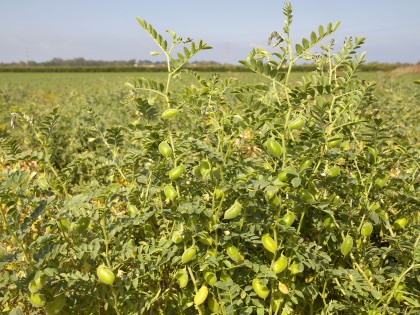
A flavourless pea that can be used as a substitute for soya protein in vegetarian and vegan foods is to be developed by the John Innes Centre in collaboration with PGRO, IBERS and Germinal UK, a leading forage specialist.
Currently peas are not used as a protein source in human foods as they taint the taste; but it could fill a significant market, as the UK instead imports half a million tonnes of soya for manufacturing vegan and vegetarian food products every year.
The flavourless pea project, funded through the Farming Innovation Programme, aims to replace imported soya with UK protein crops, meet market demand for taste and functionality and provide a more sustainable alternative.
Peas are suited to the UK climate, and they can boost soil health by fixing free nitrogen from the air in nodules in their roots providing a source of bioavailable nitrogen for the next crop; reducing the need for bagged fertiliser.
The John Innes Centre has a programme for increasing the use of peas, beans and pulses in UK farming and diet. The gene for the flavourless pea was first identified in the 1990s by scientists including Professor Claire Domoney, however the research was stopped. At the time there was no use for it, now it could be the basis of a new industry.
Robust testing at farm level will ensure that only the varieties that meet market demands and the agronomic requirements of UK farmers will be commercially progressed. The project will be a positive step forward in the drive to find tailored solutions for the food industry that consider both the climate and consumer.
To better understand the UK market opportunity for peas and to create a roadmap for increasing the quality and quantity of the crop, individuals from across the value-chain were brought together in 2019 to participate in a workshop, ‘Powering Pea Productivity’, co-ordinated by the John Innes Centre with support from PGRO and Agri-TechE and sponsored by the BBSRC.Read the resulting report here.
Post Overview
11th July 2023
Agri-TechE
Agri-TechE Article
Crops, Varieties, Breeds, Rotations
Share this Page:
Related Posts
Morrison replacing soy with insect protein from Better Origin
The views expressed in this Member News article are the author's own and do not necessarily represent those of Agri-TechE.
No time for weeding? Robots may be the answer. Agricultural students at Writtle University College are using a time-saving droid to support their latest project.
The FarmDroid FD20 uses GPS to remember the location of each seedling and weed between rows and plants. It can also plot a field and automatically sow crops.
The futuristic tech is part of a new student-led initiative. The University College is trialling regenerative farming methods to improve soil health, increase biodiversity and mix agroforestry with commercially viable crops.
The FarmDroid FD20 is imported and distributed in the UK by OPICO and was lent to the University College by Essex-based, family-run company, Ernest Doe. The machine offers an eco-friendly way to tackle labour shortages. If there’s enough sunlight, it can weed up to six hectares a day.
Mark Jolley said: “We are delighted to be able to support Writtle University College with this fantastic machinery. It is great to be able to provide an opportunity for the agricultural students to see first-hand the technology that is available in the market right now and help foster their interest in autonomous and robotic machinery – this is a growing area of agriculture that will only become more common place in the years to come.”
The University College’s project is growing fodder beet in addition to ‘naked barley’, a nutritious crop that pre-dates wheat. The area will also incorporate fruit and nut trees. Herbal leys which feature a mix of grasses, legumes and herbs can be used for grazing and will help to improve the soil.
The University College’s team plans to plough or ’till’ as little as possible to build soil fertility, but a bit of help was needed to kick-start the project and get the fields ready.
Ernest Doe stepped in again and loaned the University College a New Holland T6.180 Methane Tractor. This very clever piece of kit is powered by biomethane, a fuel made from specially-treated animal waste. It’s just as powerful as a traditional, diesel tractor but when it’s fuelled in this way the T6.180 is carbon-neutral.
The University College’s Farm Manager, Alex Hepburn, said: “Thank you to the team at Ernest Doe for helping us to launch this exciting new project. At Writtle University College we put ‘science into practice’ and we’re proud to launch a new initiative featuring cutting-edge agri-tech.”
For more information on Writtle University College’s agriculture courses, click here.
Post Overview
This story has been submitted by an Agri-TechE member.
The views expressed in this Member News article are the author's own and do not necessarily represent those of Agri-TechE.
Dairy farmers are being encouraged to focus on optimising soil health and nutrition throughout the grazing season to promote grass growth into the autumn.
Technical manager at Timac Agro UK, David Newton, explains that to help reduce the need to buffer feed in the autumn, improving grass quality during the summer, through soil and grassland management practices, is key.
By July, Mr Newton explains that grass quality will start to drop off. However, palatability can continue to be encouraged by buffering the natural acidity of the grass. He suggests using fertilisers that contain sodium, phosphates and trace elements which will prevent the grass from going sour as the season progresses and help maintain soil health.
“These nutrients often decline as we progress through the grazing season. So, to maintain grass quality, these nutrients should be replaced. “To alleviate this, I would recommend using a dedicated, slow-release grazing fertiliser such as Nutrigrass.,” Mr Newton explains.
“Nutrigrass is a specifically formulated grazing ground fertiliser, designed to speed up the conversion of nitrogen into protein, which boosts grass productivity supporting milk yields. It doesn’t over saturate the grass with nitrates and replaces the lost nutrients to enhance the soil biology.”
This grazing fertiliser is pH neutral and legume friendly, creating the perfect environment for microbial life to thrive, and for a strong beetle and worm community. Mr Newton notes this helps to redistribute the organic matter from any muck deposited throughout the field, reducing the contamination from muck piles that would otherwise cut the amount of available grazing ground.
“As Nutrigrass is nitrate free, cattle can be turned out within four to five days of application, so it slots seamlessly into a grazing system,” he adds. “Nitrate fertiliser in contrast, can require around 21 days between application and grazing, which can put an unnecessary hold on grass that is otherwise ready to be grazed.”
Mr Newton points out the benefits of prioritising soil health in the summer can be seen in August and September.
“When the soil has been stimulated to be as active as possible in between each period of grazing, the organic matter alone can negate the need for fertiliser at the back end of the season, because the soil is ‘feeding’ itself.
“This is where huge savings can be made from investing in high quality inputs,” Mr Newton concludes.
Post Overview
This story has been submitted by an Agri-TechE member.
The views expressed in this Member News article are the author's own and do not necessarily represent those of Agri-TechE.
A £2.9m project from DEFRA’s Farming Innovation Programme to breed sheep with a naturally low carbon footprint will use data and research from the Harper Adams Lleyn flock.
Delivered by Innovate UK, the ‘Breed for CH4nge – Breeding Low Methane Sheep’ project led by Innovis, a leading supplier of performance-recorded rams, aims to help English sheep farmers lower their carbon footprint and support agriculture’s journey towards net zero.
Over three years, the project will measure methane emissions from a total of 13,500 sheep across 45 flocks, and will use the data produced to build and develop tools to genetically reduce methane emissions and improve the efficiency of the national flock. The project will eventually demonstrate the impact of low-carbon sheep on whole farm carbon footprints.
Scientific input, technology and additional genetics expertise will be provided at institutions including Harper Adams University, where Dr Sarah Morgan, Beef and Sheep Production Lecturer, will be leading the research.
She said: “This project will be taking data ‘from the field’ including here on the Harper Adams Future Farm, and feeding it right back into the industry – working with a vast range of partners on a multi-million pound project.”
“We are delighted to be offering our research expertise – and our performance-recorded Lleyn flock – as part of the work, and it is great to know our data will be helping develop sheep which are both better for farmers and better for the environment.”
Three other members of Harper Adams staff – Innovation Manager Dr Eric Siquerios, Elizabeth Creak Chair in Agri-TechE conomic Modelling Professsor Karl Behrendt and Animal Production and Health Lecturer Nicky Naylor – will also be helping develop the project.
Nicky added: “This research is also going to support a number of final year student projects – so this work will not only benefit our flock, but will also benefit our students – as well as benefit the wider industry.”
Other sheep breeder groups involved include the Sheep Improvement Group (SIG), breeding the Exlana, Performance Recorded Lleyn Breeders (PRLB) and the Centurion Group of Dorset Sheep Breeders who will assist delivery of the research and host on farm events, and Signet Breeding Services, part of AHDB, providing performance recording services.
Industry and supply chain partners – Centre for Innovation Excellence in Livestock (CIEL), Pilgrims Pride and Waitrose, will steer farm system modelling including the use of carbon calculators and drive an integrated knowledge exchange (KE) programme.
The National Sheep Association (NSA) will link with the wider industry and offer a ‘guiding hand’ regarding policy issues.
Additional scientific input, technology and genetics expertise will be provided by Scotland’s Rural College (SRUC).
Innovis chief executive, Dewi Jones said: “We are an alliance of forward-thinking sheep farmers and commercially driven breeders applying genetic science and using performance-recording to deliver profitable maternal genetics at significant scale, all of which are designed to make the most efficient use of grass and forage to produce sustainable and healthy lamb of high nutritive value. Making use of grasslands by way of sheep grazing also helps sequester carbon into the soil.”
“This partnership unifies us with academics, a key lamb supply-chain and industry bodies whose networks extend to thousands of English and UK sheep farmers. We’ve all delivered many successful projects, applied research results on-farm and communicated with a wide audience but never before combined forces; ‘Breed for Ch4ange’ will consequently build on and strengthen existing relationships.”
The project will initially develop on-farm protocols and use new innovative tools and technologies including Portable Accumulation Chambers (PAC) to predict methane emissions from grazing sheep alongside measures of health, production and efficiency traits at the individual animal level.
Further measurements, including rumen size and microbiota, will improve understanding of underlying biology and ensure that reductions in methane emissions positively contribute to sustainable genetic improvement of ewe productivity on UK grass and forage.
The information gathered will enable understanding of the relationships between and genetic control of these characteristics, and DNA sampling will allow the underlying genome of the sheep to be investigated. This will help develop tools to compare the breeding value of sheep in the flocks, identifying stock that will contribute to a lower farm carbon footprint.
Dr Mark Young of CIEL added: “Modern genetic tools provide the means to focus in on hard to measure traits like methane production then incorporate them into balanced breeding programmes using DNA based genomics tools. The wider breeding programmes that Innovis, PRLB, SIG and Centurion run use such tools very effectively so they are well-placed to reduce emissions and improve the efficiency of sheep production using genetics. This is greatly needed to meet our Net Zero aspirations.”
Further plans could see a communication programme developed for other sheep breeders and farmers throughout England, working alongside supply chain partners and wider industry bodies, including NSA. This will identify the most effective ways of communicating the project’s outputs and implications to other farmers and help support them to make genetic changes.
Dewi Jones adds: “We collectively believe that this project will help to further improve the sustainability of our sheep by using genetic science and breeding to naturally reduce the amount of methane, which is a natural by-product of the sheep’s forage digestion process. Combined with the integrated knowledge exchange programme, we have an initiative that will ultimately reduce flock carbon footprint and help improve sheep farmers’ productivity, sustainability, resilience and profitability.”
Post Overview
This story has been submitted by an Agri-TechE member.
Get the latest agri-tech news, events and opportunities direct to your inbox
Kiss Blog: What’s the future of farming? And are we ready?
Member News
Agri-TechE
The views expressed in this Member News article are the author's own and do not necessarily represent those of Agri-TechE.
Cereals has for many years been the flagship event for the UK arable industry. We love to attend to support clients and keep in tune with what those in the know think, feel and plan to do in the world of arable.
Speakers and attendees of Cereals are the rule makers, policy influencers and ultimately the adopters of the systemic changes, practices and legislation that will impact the industry for generations to come. So where better to seek insight on the buzz topics in the world of agri of 2023?
Visitors got the opportunity to see the best of agricultural and arable farming innovation – from on-stand product launches from the industry’s leading companies, to the announcement of novel research topics, university experiment findings and big picture panel debates. And interestingly, this year, the three topics that reigned could be from any industry: data, AI and net-zero.
Data and tech-integrated farming
Day two of the Cereals event started with an update from the British Farm Data Council which announced its formation and purpose at 2022’s event. The team highlighted that there is a need to accelerate digitisation of the UK farming industry to enable data to inform ‘sustainable and efficient production’. What are the limiting factors to this ambition? Primarily, individuals wanting to retain control of their own data and a lack of trust in those wanting to part them from it, according to the Council’s research.
Although in its infancy as a council, its original objectives are nearing completion. As with similar bodies across industries, the council was created to provide governance not technical delivery. Predicated on an existing US initiative, the new standard for ‘good data governance’ will be there for companies to sign-up to and self-certify their compliance. However in a world of GDPR, existing national and international governance, and global data systems both owned by large corporates and not fully integrated, is this seal of approval strong enough to build the trust needed for farmers to share their precious information freely? And is this the biggest barrier to a data-informed production?
In the AgAnalyst Academy tent, a series of technical and practical discussions provided balance to the theoretical guidance of the British Farm Data Council, as progressive farmers from around the world discussed how data is shaping their daily practices. The best summary of the limitations to data leading the next agricultural revolution came from Jeremy Williams, chair of the Farm Data Integration panel, to paraphrase, “Data is at the heart [of farming] … but, organisation and integration cause difficulty and barriers to implementation.”
Anyone who has tried to create the coveted fully connected home will sympathise, the scenario often goes something like this, “Alexa connect to my iPhone”, “Hey Siri turn on the living room lights via the Phillip Hue app”, shortly followed by an error message from another device saying your heating system has been disconnected from the Wi-Fi!
So, as you sit in your cold, dark and silent ‘connected’ home imagine this sort of difficulty on a 1,000-ha farm; with hundreds of thousands of pounds of equipment managed by multiple apps and interfaces that struggle to communicate with each other as your weather system, that determines how quickly vital and costly inputs are applied to your crops, demands a software upgrade on a less than optimum data connection.
Neatly folded into the data conundrum is the speed of AI integration which is gathering pace. The tech accelerators of the world are poised and ready to bring AI, machine learning and integrated technologies to the agricultural sector. However without a significant level of data, platform agnostic connectivity and uptake, there will continue to be a limit to the learning capabilities AI brings that would unlock wide-scale adoption.
Net Zero in the world of agri
From one heavily debated topic to another: the challenges and opportunities of Net Zero and climate change were discussed from research, academic and producer perspectives. The main stage debate highlighted the desire of the agricultural community to be part of the solution while simultaneously addressing systemic and consumer barriers. Ultimately this debate looked to address the big question – ‘Can arable farming be sustainable and profitable?’
Theoretically, sustainability and profitability can coexist, according to research both Harper Adams University and Rothamsted Research have been working on. Their ongoing experiments hope to pinpoint which elements of farming practice contribute the most and least to emissions; identify the implications changing inputs have on air and water quality, biodiversity and productivity; and finally, prove that perseverance is everything i.e., an initial drop in potential yields will, with commitment, become an uplift as resilience is improved.
It’s all very encouraging, until the messy business of the end-consumer is factored in, and here are a just few of the concerns that were raised by the audience:
Supermarkets drive unit prices and minimum volume to fulfil their pricing obligations
Consumers want reassurance of safe practice and often want providence information and organic status, while still demanding an idealised version of the food they consume i.e., perfectly consistent, straight carrots
Demand for food no longer follows seasonal availability, price at the till and input costs then cut into profits
Trees are seen as an ideal carbon capture method, but the volume of trees required to have an impact limits the land available to grow crops, which drives the level of imports needed to feed the population
Storage and haulage are some of the biggest contributors to carbon emissions but unavoidable in the current system and expensive to make ‘green’
Don’t lose heart yet, the arable community will rise to the challenge!
The resounding sentiment in the room was – there is hope and the farming community can make a difference in moving towards the farm of the future. Ultimately, as the current stewards of this land, in the purest sense of the word, there is a widespread desire in the farming community to leave it better than when they found it. We, the consumers, simply need a better understanding of what compromises we have to make to enable growers to fulfil their promises to the land and world.
And the grower’s perspective, provided by one esteemed Cambridgeshire farmer, was, “The future will mean growing more on less, to create food security and more room for biodiversity and less carbon.” And of course, AI, data and technology will certainly play a huge part in this.
At ‘home’ at KISS we see similar systemic adoption barriers and challenges to new products, research and platforms across all industries – from education, science, tech, agriculture and beyond. Working towards a solution often starts with education and awareness, and overlaid with a keen sense of what your point of difference is while remembering you aren’t the only person talking to your audience. Any message, no matter how complex, can achieve cut-through.
We’re all effectively facing the same set of macro challenges in the world. Whether your target market is agriculture, technology, education, science or something altogether different, demonstrating ease of use, integration and real-world applications can reduce many of your audiences’ hesitancy to engage.
Post Overview
This story has been submitted by an Agri-TechE member.
10th July 2023
Agri-TechE
Member News
Share this Page:
Agri-TechE Newsletter
Get the latest agri-tech news, events and opportunities direct to your inbox
Salle Farms Employee presented with Bishop’s Award by Prince William at the Royal Norfolk Show
The views expressed in this Member News article are the author's own and do not necessarily represent those of Agri-TechE.
The Prince of Wales presented an award to a committed young Norfolk farm environmentalist during his surprise visit to the Royal Norfolk Show.
Prince William spoke to Robert Jackets, an apprentice at Salle Farms, near Reepham, while handing him the Bishop of Norwich Sustainable Environmentalist Young Employee of the Year Award.
The prize-winner is studying on a crop technician course at Easton College, and grew up just two miles away from Salle Farms, dreaming of working on the large machinery there.
His application explained how Salle Farms limits its environmental impact, and his particular interest in the field margins established through the arable farm’s Countryside Stewardship agreement.
“Growing up I’ve always had a passion for farming, agriculture and big machinery,” he said.
“I don’t come from a farming community family, but I grew up surrounded by countryside.
“Getting the apprenticeship was great, and now getting a full-time job is a dream come true.
“In the future I’d like to help mentor other apprentices and do more with cultivation and drilling. I’m really happy and grateful to receive this award.”
The Bishop of Norwich, the Rt Rev Graham Usher, was also on hand for the presentation of the award and its £1,000 cash prize at the Royal Norfolk Show.
He said: “Robert is a worthy winner in the second year of this award. It was encouraging to see his interest in soil types, minimal tillage and cover crops and I wish him well as he seeks to pursue a career specialising in crop cultivation.
“It gives me hope in the future of environmentally-conscious farming that seeks to enhance biodiversity.”
The annual competition was judged by the Food and Farming Discovery Trust (FFDT), the education arm of the Royal Norfolk Agricultural Association.
It is open to employees and apprentices aged under 21, who work for a Norfolk-based employer within the land-based sector focusing on land management, conservation, countryside management, ecology, climate change management, forestry management or horticulture.
Post Overview
This story has been submitted by an Agri-TechE member.
Get the latest agri-tech news, events and opportunities direct to your inbox
Fruit Focus 2023
Agri-TechE Article
Agri-TechE
It’s Wimbledon week so the focus is on strawberries – one of the great success stories for innovation in fruit production. Breeding at East Malling has resulted in an extension of the strawberry fruiting season to create a highly profitable product for the industry. More innovation will be featured at Fruit Focus on 12th July 2023 at Niab East Malling, Kent.
Highlights include:
Fruit Research Innovation Hub: featuring novel controls, detection, forecasting, and prevention of pests and diseases using a range of agri-tech. Research is funded by BBSRC and UKRI.
Fruit Forum: including a presentation of a recent report about overcoming labour shortages by John Shropshire with discussions including Mark Spencer, Minister of State for Food, Farming and Fisheries (Defra) and Martin Emmett, Chair of NFU Horticulture and Potatoes Board.
Exhibition: a diverse selection of services, equipment and agri-tech is on show, including by a number of Agri-TechE members (stand numbers in brackets):
ADAS(626): independent provider of agricultural and environmental applied/strategic research and consultancy.
Antobot(200): an award-winning start-up providing affordable robotics for sustainable agriculture.
BASF (32): a leader in crop protection and solutions for improving plant health.
Bayer Crop Science(26):one of the world’s largest lifescience businesses offering digital farming systems, seeds and traits, and crop protection products and services.
Elsoms(616): a leading independent seed and plant breeding business.
Kroptek(213):lighting for controlled environments.
Niab (500): plant research institute; will also be hosting and presenting recent research at 12:00 in the Fruit Forum.
Pro-Lite Technology (658): a supplier of specialist equipment with a technical focus in spectroscopy, spectral imaging, remote sensing, light measurement and photonics.
Sencrop (8): networked weather stations; will also be talking about efficient irrigation at 15:20 in the Fruit Forum.
The views expressed in this Member News article are the author's own and do not necessarily represent those of Agri-TechE.
After a long wait the Department for Environment, Food & Rural Affairs (Defra) has finally announced more details on the Sustainable Farming Incentive (SFI) . The details were unveiled by Rt Hon Mark Spencer on the Brown&Co stand at the Lincolnshire Show. These new standards include 23 actions, with quarterly payments and the promise of being more ‘simple and flexible’ for farmers.
Schemes will last for three years, with opportunities to apply for the next set of standards when they are published in 2024. Payments under the scheme will be paid in quarterly instalments with the first payment made four months after your agreement starts. The SFI 2023 offer now includes a management payment of £20/ha for the first 50 ha included in a SFI agreement.
There are a mix of rotational and static options with the possibility of varying the coverage of the rotational options, so they work with your crop rotation and different sizes of parcels. You can increase and decrease your areas – as long as it’s within 50% of the original area applied for.
All SFI applications for the arable and horticultural soil standard are now closed and this standard will not be included going forwards. The old arable and horticultural soil standard was a percentage cover option, with strict rules about overlap.
Anyone with an existing SFI scheme or who have previously applied for the arable and horticultural soil standard will be contacted by Defra to ensure that they do not lose out, but the RPA have not explained what this means.
The new Soils standard offers more flexibility with other agri-environmental scheme overlap, meaning you can receive payment for SAM1 to overlap with some options under Countryside Stewardship (CSS). In general, the payment rates for all SFI options are very similar to the equivalent options under CSS.
The options you can apply for under the SFI 2023 are listed in the table below, it is also indicated if they can be rotational or static and whole or part parcel.
If you have any questions about the Sustainable Farming Incentive, it’s interactions with other schemes or Countryside Stewardship please contact your local Brown&Co office.
Post Overview
This story has been submitted by an Agri-TechE member.
The views expressed in this Member News article are the author's own and do not necessarily represent those of Agri-TechE.
Farmers interested in growing pulses can get involved with a new £5.9m Defra-funded project that aims to increase the UK area of pulses from 5% to 20% and cut agricultural emissions.
Over the four-year Nitrogen Efficient Plants for Climate Smart Arable Cropping Systems (NCS) project, about £370,000 will be paid direct to farmers to carry out on-farm trials.
The project hopes to establish a core of at least 200 UK farmers to join its Pulse Performance Enhancing Platform (PulsePEP).
This will be a knowledge exchange hub for farmers, agronomists and wider industry striving to achieve the best from pulse crops and reduce carbon emissions.
From the PulsePEP, about 50 “Pulse Pioneers” will be selected and paid to host on-farm crop and feeding trials.
These will explore soils, crop yields and livestock rations, through better use and marketing of home-grown pulses.
Tailored assistance from the Farm Carbon Toolkit will be available to the 200 farmers to establish their carbon baseline, which will be monitored throughout the project.
What does the project hope to achieve?
Led by the Processors and Growers Research Organisation (PGRO) in collaboration with 17 industry partners including the British On-farm Innovation network (Bofin) and crop consultant Adas, the aim is to bring about a reduction of 1.5 million tonnes carbon dioxide equivalent a year or 54% of the maximum potential for UK agriculture.

“Pulses and legumes have considerable benefits for UK farming systems,” says PGRO chief executive Roger Vickers, who leads the NCS consortium.
“This will be achieved by increasing pulse and legume cropping in arable rotations to 20% across the UK. In addition, the project aims to market more home-grown legumes into livestock rations and reduce soya meal use by 50%,” he says.
Oxfordshire mixed farmer David Passmore, who has already signed up to the project, hopes it will promote a better understanding of pulses in UK arable rotations, improve yield consistency and drive market demand – particularly in the livestock industry.
Kent grower Andy Howard, who is also involved, explains: “Through on-farm trials and close involvement with the research community, we’re at last pulling valuable R&D off the dusty shelves of research institutes, into fields and the hands of farmers where it belongs.”
Currently, PulsePEP has 257 members, which includes 109 farmers who wish to be carbon baselined – which means the project is halfway to its target. Farmers interested in being involved can sign up at ncsproject.co.uk.
Post Overview
This story has been submitted by an Agri-TechE member.
The views expressed in this Member News article are the author's own and do not necessarily represent those of Agri-TechE.
A new £2.6M project has been launched which seeks to provide arable farmers with precision slug control solutions.
Strategies Leading to Improved Management and Enhanced Resilience Against Slugs (SLIMERS) is a three-year £2.6M research project involving over 100 UK farms and six industry partners, funded by Defra’s Farming Innovation Programme and delivered by Innovate UK.
The consortium of UK companies, research institutes and farmer networks, led by the British On-Farm Innovation Network (BOFIN), intends to provide two specific services to control slugs more sustainably.
“Since the ban on metaldehyde, there is now only one form of chemical control for slugs – ferric phosphate pellets – so protecting the longevity of this will require both a strategic and precision approach to slug management,” says project lead and BOFIN founder, Tom Allen-Stevens.
“Slugs are arable farming’s biggest pest issue which is estimated to cost the UK industry about £43.5M per year. Developing solutions to tackle these pests sustainably could be a game-changer for the entire industry and wider supply chain.”
Project aims
The aims are to reduce reliance on slug pellet usage through precision application of treatments to slug hotspots and advance alternative biological control, both via an economically viable approach.
Dr Jenna Ross OBE from UK Agri-TechE Innovation Centre, Crop Health and Protection (CHAP) is the project’s technical lead. “I travelled the world in 2018 as a Nuffield Farming scholar and noticed a gap in the market for improved slug control.
“Farmers urgently need alternative control measures that are effective, sustainable, environmentally and societally acceptable, and economically viable.
“This industrial focused research project utilises the consortium’s unique expertise and capabilities to develop cost-effective digital autonomous slug monitoring, forecasting and precision treatment tools, thus delivering on-farm game-changing solutions to benefit farmers.”
Slug Sleuths
The first stage of the project will be the recruitment of 30 ‘Slug Sleuths’ – a group of farmers determined to overcome their slug burdens – who will be selected and paid to host trials on their own farm. These farmers will test the developing technology and novel patch location forecasting to help researchers learn more about slug behaviour in a bid to create a long-term solution.
Next, the robots will move in, bringing infield cutting-edge slug identification and spot-treatment technology, building on the SlugBot project which was carried out by Small Robot Company and Crop Health & Protection (CHAP), funded by Innovate UK. The Slug Sleuths will work side-by-side with the autonomous bots to improve the AI models and advance pellet-free biological solutions.
While this technology will be tested infield by farmers, it will be supported and refined in laboratories, guided by leading scientists, and will include slug patch location forecasting and autonomous solutions for precision control.
How to get involved
Keen to expand the knowledge exchange beyond the core group of farmers, the project is also launching the Slug Circle – a platform and knowledge exchange hub designed to facilitate discussion, idea sharing and tips for best practice when it comes to slug burdens and controlling them.
The project team are urging farmers interested in being involved – or those who simply interested in alternative, precision techniques for control – to sign up now.
The project was officially launched to the industry on Wednesday 28 June at 1:00pm on the Small Robot Company stand (DF E27) at this year’s Groundswell event, with a follow up webinar to explain more about it and what’s on offer for farmers who wish to take part on 15 August at 8:30am. To register your interest in the Slug Circle Community, with no obligation click here.
More information about the project, including links to project partners and research initiatives that underpin the project can be found at slimers.co.uk
Post Overview
This story has been submitted by an Agri-TechE member.