Up-skilling agri-tech
 Agri-TechE
  One of the spin-off benefits from the rising profile of agri-robots is that it is making the sector an appealing career option for a tech-savvy younger generation.
The need to attract new ideas and skills into the agri-food industry is a subject that is never far away when you get a couple of farmers in the same room.
We’ve been having a number of discussions (even more than usual!) about skills in the sector recently, not least as part of the Agricultural Productivity Working Group (reporting to the Food and Drink Sector Council); about the pressing need for land-based skills training in the east of England with the Further Education Commissioner; and, most recently, conversations with a number of large employers recruiting and training agricultural engineers, mechanics and hydraulics experts (you can watch a vlog from member Refox, with our Director Belinda Clarke, on the subject below).
As agri-tech innovations continue to progress towards market, and exciting new technologies reach widespread commercial reality, questions have arisen about the impact of these solutions on the role of the farmer, pack house or dairy manager, and – the journalists’ favourite question – whether robots will replace human labour on farms.
Need for digital revolution
Ironically, it is the shortage of labour and the need for greater responsiveness to the environment and consumer demands that is driving the adoption of digital technologies.
It has been the introduction of machinery on to farms that has enabled so many smaller family operations to keep in business. From our analysis, “From Grass Roots to Blue Skies” productivity has increased by reducing the head count. One person with a few tractors and other specialist equipment now does the work of a team of people.
With the need to reduce labour to maintain margins, farming seems to have lost its ability to respond with precision to the conditions at field level. It is time consuming for one farmer to walk the walk, if this is the only person available to do all the other work.
This model is being disrupted by technology and, in particular, the promise of automation in the form of robotics.
Gaining information about growth stages of iceberg lettuce, for example, is allowing greater precision in forecasting yield dates and matching this with predicted consumption. Introducing a robotic harvester into the mix will enable differential harvesting of the lettuce heads that are reaching the right stage of maturity.
This type of process is increasing the range of skills needed in farming and diversifying the location of these people and their expertise. No longer will the industry need to rely on low skilled manual labour living on the farm.
Increasing professionalism
Instead it will attract professional farm managers with a desire to improve the soil, crops and yield, and an army of motivated people with skills in data visualisation, logistics, forecasting and analysis.
Agri-food is of fundamental importance to our economy. Plant-based materials are used in packaging, clothing, pharmaceuticals and energy generation. Agriculture in all its forms also offers an alternative to fossil fuels for the production of bio-degradable plastics.
The skills challenge facing the industry is well documented – and not unique to agriculture and horticulture. Skilled technical staff are recognised to be the critical backbone of many sectors. But it was only during a recent discussion with a major machinery manufacturer that it really hit home how dependent the industry is on the technical staff, present and future, and on whom many food-producing businesses depend.
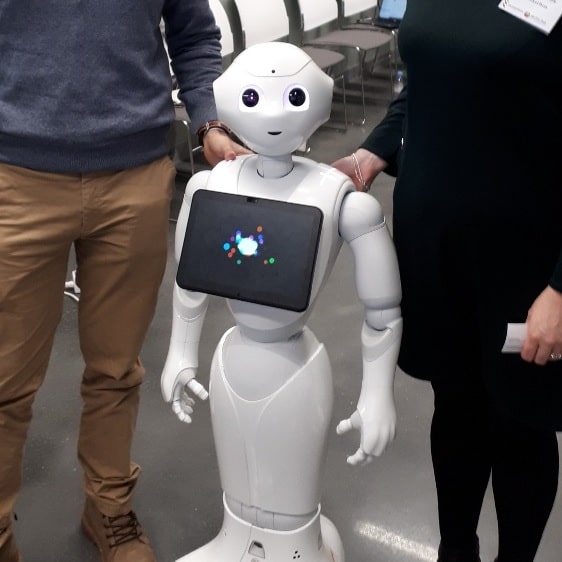
Our Pollinator this month considers how far robots can go to make life on the farm easier, and the potential for swarm robots to be the workforce of the future. (Spoiler alert – we think there will always a place for the higher skilled Managers of the Machines!)
We’re excited to be considering the potential for the technology and the progress that innovation is making towards inter-connected robot teams working together on farms and the implications this has for the shape of the wider industry.
Post Overview
Agri-TechE Related Posts

Apply to Pitch or Demo at the Demo Day, December 2026

Thank you! We received your application.
Sterilising the waste before it leaves the building
Apply to Pitch or Demo at the Demo Day, May 2026

Russ Farn joins eg technology’s Board of Directors