Glyphosate dependence demands answers on Britain’s route to biological weed control
 Bionema Group
As councils continue to rely on glyphosate, ministers must show that biopesticide reform is creating a credible route from scientific innovation to commercial use.
By Dr Minshad Ali Ansari, Founder and CEO, Bionema Group; Founder and Chairman, World BioProtection Forum
HortWeek’s finding that 95% of UK councils still rely on glyphosate raises a practical question: is Britain doing enough to bring credible additional weed-control tools to market?
Councils cannot replace an established herbicide with a policy aspiration. They need alternatives that work reliably, fit operational budgets and are authorised for their intended use.
Continued glyphosate use does not, by itself, prove regulatory failure. It reflects decisions about efficacy, cost, labour and the suitability of what is available. But it should sharpen scrutiny of whether promising new technologies have a clear and proportionate route to commercial use. Britain does not simply need more scientific discovery. It needs a system that can turn credible discoveries into products people can use.
Scientific promise is not a commercial product
I have spent more than 30 years researching and developing biological crop protection technologies. I have seen the progress this sector has made, and how difficult it is to turn promising research into commercially viable products.
Discovery is only the beginning. A biological technology must demonstrate reliable performance, formulation stability, manufacturing feasibility and safety, and then secure the relevant approvals and authorisations.
Not every candidate will succeed. A microorganism that suppresses weeds under controlled conditions may not perform consistently across temperatures, moisture levels, weed species or application timings. A technically effective product may still prove too expensive or impractical to use.
Those are genuine development challenges, and they must not be confused with regulatory barriers. Equally, a credible technology should not face avoidable duplication, unclear requirements or unpredictable assessment. The task is to separate scientific limitations from obstacles that better policy and regulatory delivery can remove.
Government already recognises the problem
The UK Pesticides National Action Plan 2025 states that biopesticides “can be complex to regulate” and that lengthy approval procedures are “a financial hurdle to smaller manufacturers”. Under Action 9, the government commits to improving arrangements for GB biopesticides, reducing burdens without compromising human health or environmental standards.
That acknowledgement matters. This is not simply an industry complaint: government has accepted that the route to market needs attention.
Nor is Britain starting from nothing. HSE operates a Biopesticides Scheme offering tailored advice and lower fees. Its guidance also allows applicants to meet data requirements with published studies, or with a reasoned scientific case explaining why a particular study is not needed.
The question is therefore not whether support exists, but whether existing arrangements deliver timely, predictable and scientifically robust decisions.
Regulatory precision matters too. The National Action Plan is UK-wide, but Northern Ireland follows EU active-substance approvals under the Windsor Framework and sits outside the GB Biopesticides Scheme. Reform proposals must clearly state which system they address.
The case has been made. Delivery has not followed
These arguments are not new. In November 2022, the World BioProtection Forum published a white paper, Creating the World’s Best-in-Class Biopesticide/Bioprotectant Regulatory System, produced by a 19-member international expert working group that I chaired. It set out 26 recommendations for a faster, more predictable and scientifically robust regulatory system.
In September 2023, the Forum brought parliamentarians, policymakers, regulatory experts, and industry together at a conference in the House of Commons to discuss how to implement those recommendations, and we engaged with Defra and HSE afterwards.
Three years on, the government’s own action plan recognises the same barriers. What is still missing is a baseline, a timetable and public reporting on whether the system is improving.
Rigorous assessment and efficient delivery belong together
The biological crop protection industry should not ask government to lower safety standards. Natural origin does not make a substance or microorganism harmless, and the National Action Plan itself notes that not all biopesticides are classified as low-risk. Biological products need appropriate assessment of their effects on human health, non-target organisms and the environment.
But appropriate scrutiny is not the same as identical scrutiny. Evidence requirements should reflect the characteristics, intended uses and risks of the technology being assessed. Where a study is scientifically justified, applicants should provide it. Where a reasoned case or alternative evidence answers the safety question, the system should accept it.
Applicants have responsibilities too. Incomplete dossiers, weak evidence and unrealistic claims delay decisions. Reform must raise the quality of submissions as well as the efficiency of assessment. The goal is predictability: clear requirements, competent assessment, transparent milestones and decisions built on sound evidence.
Public investment needs a route to commercial use
Research funding can show whether a biological technology has potential. It does not finance the full journey through field development, manufacturing scale-up, regulatory studies and market entry.
For an innovative SME, these stages are financially linked. A company cannot confidently plan manufacturing capacity, recruitment or distribution if it cannot reasonably assess its route to authorisation, and investors should not mistake scientific promise for regulatory readiness.
Government cannot guarantee that every publicly supported innovation will succeed. It can ensure that credible candidates meet a clear, proportionate and accountable assessment process. Otherwise, support for discovery risks becoming disconnected from the conditions needed to capture its benefits.
Three changes ministers should make
- Strengthen the existing pathway for qualifying biological products. Build on current arrangements rather than announce another scheme. Priorities should include specialist assessment expertise, early engagement with applicants, risk-proportionate evidence requirements and clear milestones. Where accelerated assessment is justified, eligibility should be transparent and scientifically defensible; biological origin alone should not qualify. Earlier advice would help companies find evidence gaps during development rather than late in assessment.
- Publish a meaningful performance dashboard. Applicants, Parliament and the public should be able to see:
- applications awaiting assessment and the stage each has reached;
- median assessment times and the range of processing times;
- performance against published targets;
- time spent with the regulator versus time awaiting applicant information;
- the principal reasons for delay;
- specialist assessment capacity and resource constraints.
The figures should separate active-substance approval from product authorisation and, where numbers allow, bioherbicides from the wider biopesticide category. That distinction is essential: evidence of barriers across biological crop protection does not by itself show that market-ready biological weedkillers are being held back. A good dashboard would reveal whether the main obstacles are dossier quality, scientific complexity, administrative process, assessment capacity, or a combination.
- Set a timetable and report outcomes. Government should publish an implementation timetable, establish a performance baseline and report progress against it. Success should not be measured by approvals alone; a sound system must also reject unsuitable products and identify where more evidence is needed. The measures that matter are the quality, timeliness and predictability of decisions. Where legally and scientifically appropriate, assessments by trusted international authorities should inform the process, while GB-specific uses and conditions keep the scrutiny they need.
Councils need a broader toolbox, not another promise
It would be irresponsible to suggest that one biological weedkiller could replace glyphosate in every setting. Pavements, highways, parks, farmland and horticultural production present different challenges, and any new product must prove itself for its particular use.
Biological technologies should be assessed as additions to a broader toolbox, alongside chemical, mechanical, thermal and integrated approaches, not presented as a universal replacement before the evidence supports it. Councils, farmers and growers need workable choices. The task is to expand them without substituting enthusiasm for proof.
Judge reform by delivery
HortWeek’s investigation should not become another exchange between those demanding an immediate end to glyphosate and those arguing nothing can change. It should prompt a more useful question: what is Britain doing to ensure credible new weed-control technologies receive rigorous assessment through a functioning route to market?
Government has acknowledged the barriers. It should now publish the baseline, identify the bottlenecks and set out a timetable for improvement. This is not an attack on the scientists who carry out regulatory assessments. It challenges the ministers responsible for giving the system the framework, expertise, resources and accountability it needs.
Public funding can help create an innovation. A functioning commercialisation system must give it a fair chance to reach the people who need it.
About the author: Dr Minshad Ali Ansari is Founder and CEO of Bionema Group, a UK biological crop protection technology company developing microbial biopesticides and advanced formulation and delivery platforms. He is also Founder and Chairman of the World BioProtection Forum and has more than 30 years’ experience in biological crop protection research, technology development and commercialisation.
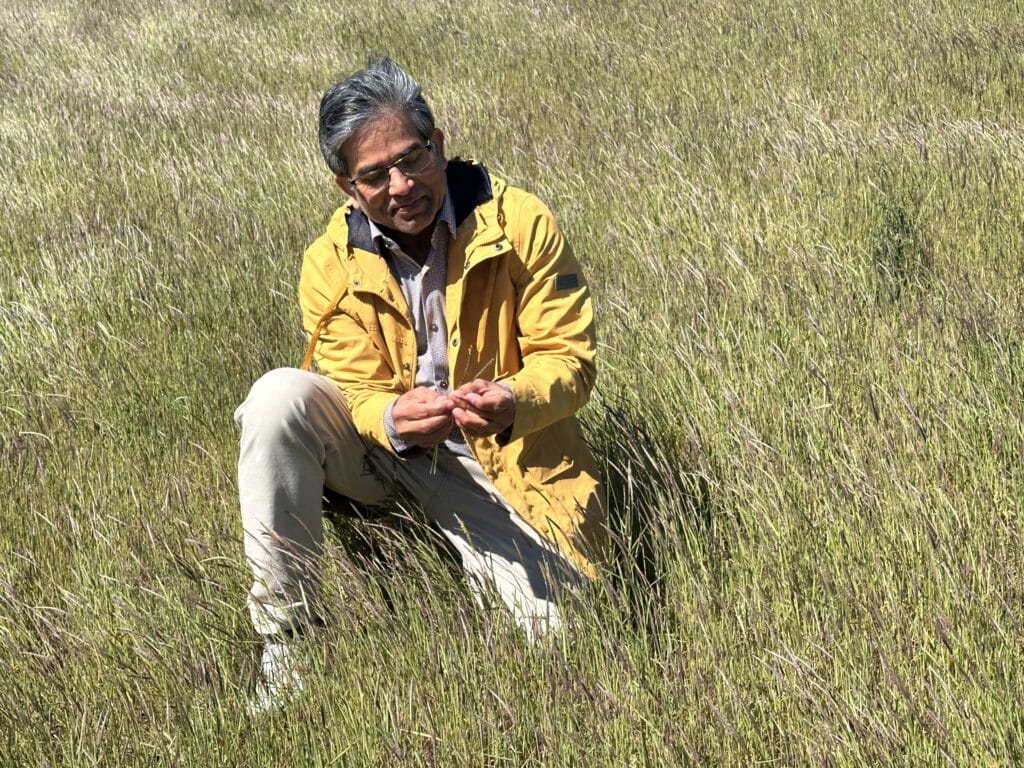
- *I have permission from the copyright holder to publish this content and images.
Related Posts

SugaROx secures £2.5M investment from fertiliser multinational to accelerate its first product launch

Uta Paszkowski recognised as a 2026 Top Agri-food Pioneer by the World Food Prize Foundation
Agri-tech venture SugaROx selected for HARVEST programme to advance field validation of precision biostimulants
Cut Synthetic Nitrogen by 50% on Wheat? What Our Field Trial Showed

Global Weather, Grain Markets & Nitrogen