Eagle Genomics takes latest funding past $25m and unveils new CEO and Chair

Member News
The views expressed in this Member News article are the author's own and do not necessarily represent those of Agri-TechE.

Eagle Genomics in Cambridge, a global specialist in microbiome-related research, has raised an extra $4 million+ to take its funding past the $25m mark inside the last 12 months.

The company has also appointed ex-Microsoft executive Dr Victoria Kimonides as CEO and recruited a new chair of the board. Previous CEO Anthony Finbow has become what the company describes as Eagle’s chief evangelist.

He will “support the company in reaching its full potential and promote the importance of the exploration of the Microbiome and innovative breakthroughs in the field.”

The funding has been topped up with continued participation from existing backers Environmental Technologies Fund, abrdn plc and a consortium of investors headed by Granpool Innovative Investments.

The money will be used to further deploy Eagle’s pioneering software platform. This enables corporate customers to explore and monetise on microbiome-related research. 

Prior to joining Eagle, new CEO Dr Victoria Kimonides spent almost 14 years in leadership positions at Microsoft, where she spearheaded co-selling with partners and oversaw channel sales across Central and Eastern Europe. Before that she led Enterprise Technology Strategy and Customer & Partner Experience for the region. 

She has a BSc in in Biochemistry and Microbiology from King’s College London and a PhD from the University of Cambridge where she studied neuroscience and is a leading expert in this scientific domain. She is also a Fellow of the Cambridge Judge Business School.

Dr Kimonides said: “Eagle is a company with tremendous potential as we can help large companies curate, analyse and make impactful the billions of dollars being invested into microbiome research.

“Our goal is to help those companies commercialise that research and develop new, sustainable solutions that are good for both the people and the planet.”

Eagle has also appointed a new chair – John Schoellerman – currently SVP, Corporate & Business Development at Oxford Nanopore Technologies plc, where he was instrumental in private financing, the public listing, and development of long-term strategy.

Previously he was a Managing Director and Head of the Medical Technology practice at Lazard, a leading global investment bank.

SRUC: 2023 – a big year for biodiversity

Member News
The views expressed in this Member News article are the author's own and do not necessarily represent those of Agri-TechE.
SRUC

SRUC’s Thriving Natural Capital Challenge Centre is invested in making 2023 a big year for biodiversity in Scotland

When the 15th meeting of the United Nations’ Conference of the Parties to the Convention on Biological Diversity (COP15) concluded just before Christmas, it secured a historic new ‘deal for nature’. 

More than half of global GDP is moderately or highly dependent on nature, according to the World Economic Forum. At COP15, 195 nations agreed that our world must not only become net zero, but also nature-positive, for the benefit of both people and the planet.

The Glasgow Financial Alliance for Net Zero (GFANZ), committed over US$130 trillion of private capital to transforming the economy for net zero, but the wide-ranging nature of the COP15 framework shows that nature and biodiversity is everybody’s business too.

There is now global commitment to halt and reverse biodiversity loss and to protect 30 per cent of land and oceans, all by 2030. There was also commitment to reduce all pollution to levels not harmful to wildlife and ecosystems, taking in significant cuts to nutrients, pesticides and plastic waste. The world has woken up in 2023 to the fact that there is no net zero pathway to limit global warming to 1.5°C to halt devastating effects of climate change, without addressing nature loss and land degradation.

SRUC’s Thriving Natural Capital Challenge Centre has been awarded a Natural Environment Research Council grant to focus on network building for nature positive projects – between Scottish biodiversity uplift programmes happening on the ground, and the investment and private finance sector. 

It’s important that the private investment sector concentrates financial flows on biodiversity projects, but first, they need to understand them. Biodiversity and ecosystem services are the basis of new business opportunities. This is most obvious in the case of organisations selling goods and services that are directly associated with biodiversity and ecosystems. I am also about to start a project with RSPB Scotland at its new Glencripesdale reserve in the Morvern peninsula to explore how digital data about biodiversity uplift can be presented to investors to assure them of progress and impact in nature-based projects in which they have invested.

Along with SAC Consulting, Dr Al McVittie, an environmental economist at SRUC, and I have also just started research for the Scottish Government on Approaches to Measuring Biodiversity in Scotland.

Kate Dowen, Head of Sustainable Nature Finance in the Scottish Government’s Environment and Forestry Directorate, said: “It’s important to be able to measure biodiversity so we can better protect and restore it. But this research will be important in a number of policy areas as well as conservation. What happens in planning, agriculture and natural capital or green finance all have a part in ensuring that Scotland protects 30 per cent of its land and seas by 2030.”

This is going to be a big year for biodiversity. The Thriving Natural Capital Challenge Centre is excited to have generated income of over £300,000 for the projects mentioned here, and I look forward to creating impact through nature positive action research. This work will be a really essential part of the natural economy’s pathway to net zero, as well as helping with the sector’s influence in the climate emergency and biodiversity crisis.

Dr Hannah Rudman

Co-Director, SRUC Thriving Natural Capital Challenge Centre

Eden Search’s Emerging Leader’s Programme 2024

Member News
The views expressed in this Member News article are the author's own and do not necessarily represent those of Agri-TechE.

A new round of funding and mentoring is available to talented executives working within small-to-medium sized enterprises (SMEs) in the food supply chain as Eden Search launches its second Emerging Leaders programme.

To help future SME managers fast track their leadership skills, Eden Search is making a training budget of up to £3000 available to one aspiring executive working for an SME in either food manufacturing, fresh food or agritech. The money can be used to fund a course, research project or work experience placement that will help unlock the individual’s potential and broaden their horizon. In addition, the winner will receive up to four hour-long mentoring sessions with sector specialists (founders, CEOs and senior leaders) over the course of a 12-month period. Mentoring will also be available to one other applicant.

Explaining more about the launch of the 2024 Emerging Leaders programme, Richard Macdonald, Non-Executive Director of Eden Search, said: “The last few years have been tough for companies in agri-food. Post-Brexit and COVID, the industry has been hit with ingredient shortages, labour issues and inflation. SMEs have borne the brunt of this. This is incredibly concerning given they are the backbone of the sector. In UK food manufacturing alone, SMEs account for 22% of turnover and 33% of employment. Yet many don’t have structured training and development programmes in place or, if they do, they’ve been impacted by recent macro-economic pressures. Emerging Leaders is designed to help bridge this gap – giving the most talented individuals in the sector the chance to apply for funding and mentoring that will help them achieve their professional and personal goals and keep SMEs innovating and leading the way.”

Eden launched its inaugural Emerging Leaders campaign in 2023, providing training and mentoring to three talented industry executives: Dr Ruth Bastow, Innovation Director for CHAP; Miranda Beebe, Head of Volunteer Management at Trussell Trust; and Dr Lisa Morgans is Head of Livestock for i4Agri.

Commenting on how her experience of the programme, Dr Ruth Bastow, said: “Being part of the inaugural Emerging Leaders initiative was fantastic. It enabled me to complete a MIT course on Leadership & Innovation. It also gave me access to an inspiring, supportive mentor. Working in a small business can be intense. There’s not much time to stop and think about training and development. Emerging Leaders helped me discover more about myself. With a clearer understanding of my motivations and strengths, I can make better use of my skills to drive the company forward. I’d urge anyone looking to further their career to apply to this programme.”

The Emerging Leaders programme is open to anyone with five or more years’ experience working within an SME (<£15m turnover) in food manufacturing, fresh food or agritech in the UK or internationally. Individuals must be able to demonstrate experience in a senior management position and have a clear view of the external support they require to continue their career path into leadership / board positions. Applicants need to send a copy of their CV and write a 500-word summary answering the following key questions:
• What are the challenges you would like to solve within your industry?
• What training / development would you need to achieve this?
• What difference will this training make to you and the industry, long-term?

Applicants need to confirm the support of their company and provide details of a ‘sponsor’ (e.g., their line manager) when they make their application. The deadline for applications is 23:59 on 19th November 2023. Applications should be emailed to: emergingleaders@edensearch.co.uk. For further information including all terms and conditions, go to www.edensearch.co.uk/emerging-leaders-program

NatureMetrics Win Tesco Agri T – Jam Competition

Member News
The views expressed in this Member News article are the author's own and do not necessarily represent those of Agri-TechE.

NatureMetrics has won the 2023 Tesco Agri T-Jam Competition, securing fast-track introductions to the Tesco supplier network and a trial with one of the retailer’s supply chain partners.

Now in its sixth year, the Tesco Agri T-Jam pitching event, run in partnership with Leading Edge Only, saw 10 different agri start-ups pitch to a panel of Tesco sustainable agriculture and commercial experts, Tesco suppliers, and stakeholders to find the most promising agriculture innovation.

This year, the event was dominated by innovations which can contribute to Tesco’s aim of building more sustainable supply chains, incorporating ideas with solutions to support on-farm measurement, data analytics, and supporting farmers in making informed choices around complex sustainability issues.

NatureMetrics, represented at the pitch event by its Head of Agriculture, Tom Ludwig, won the competition for its innovative solution which measures biodiversity using eDNA analysis of soil, water, and insects. The innovation converts this complex data into simple metrics which can be viewed through its Nature Intelligence Platform, allowing users to comprehensively report on biodiversity improvement in their supply chain.

Commenting on the competition this year, Natalie Smith, Head of Sustainable Agriculture at Tesco, said: 

“We are thrilled to welcome NatureMetrics to our network, and to offer them the opportunity to work with our suppliers and experience direct feedback and mentoring from our Sustainable Agriculture team. In an incredibly strong field, Tom Ludwig demonstrated his commitment to biodiversity and really impressed the whole of the judging panel.

“This competition is designed to help us find innovators who can help us build long-term resilience within our supply base, addressing key sustainability challenges so we can continue our progress towards our stretching climate and biodiversity targets. I’d like to thank all of our finalists for taking part – I’m sure there will be more opportunities in the future for these innovators to work with Tesco suppliers.”

Ludwig will also receive a one-year free membership to both Agri-TechE and Agri-EPI Centre and will have the opportunity to present on stage at the World Agri-TechE Innovation Summit taking place in London on 26-27 September, to an audience of over 900 international senior ag-tech decision-makers and innovators.

Alongside Tom Ludwig, the other finalists were: Viridian (Angus Middleton), Flexifarm (Kevin Gooding), Map of Ag (Joe Towers), Bloomfield (Mark DeSantis), Laguzze (Laurent Vigouelle), Yard Stick PBC (Chris Tolles), Snapp Laab (Donat Posta), Protiomix Ltd (Stephan Jaffe), and Sunamp (Ana Amaral).

Scott Sharp, founder and CEO of Leading Edge Only, said:“We are delighted for Tom and for all of the applicants who were shortlisted. This is a life-changing opportunity and it is incredibly exciting to see the level of talent across start-ups in the agri-tech space. We are confident that we will continue to hear these names as they each make their stamp within the landscape over the next few years.”

ADAS: Organic fertilisers ‘key to cutting dependence on artificial fertilisers’

Member News
The views expressed in this Member News article are the author's own and do not necessarily represent those of Agri-TechE.

To cut dependence on fossil fuel made artificial fertilisers, the agricultural sector “must find ways to make the most of nutrient-rich organic fertilisers like livestock manures, slurries and composts” – so says John Williams, Head of Soils and Nutrients at ADAS.

John was speaking ahead of the 18th International RAMIRAN Conference, a global gathering of nutrient management, soil health, and environmental research experts being held in the UK for the first time this September.

With record-breaking artificial fertiliser prices listed as a driving force behind food price inflation last year, there is renewed interest globally in how to best recycle organic materials like farm manures, sewage sludge, compost, and biomethane production by-products for food production. And importantly, how to limit their associated environmental impacts.

John, the Conference Co-Chair said
To feed a growing population, farmers are charged with producing more and more with finite resources. Fertilisers are essential for boosting crop growth and maintaining soil health. Instead of depending on artificial fertilisers created from natural gas, we ought to make better use of what we already have. It’s outdated to view organic materials as waste, they hold the key to enhancing world food production.

He noted though that if these organic materials are not managed well, not only were growers wasting a valuable resource, they could end up causing significant harm to the environment with ammonia and nitrous oxide emissions being released into the air and nitrogen and phosphorus losses to water.

“To sum up when it comes to these organic materials – we either use them or we lose them”.

Maintaining food production in an environmentally sound way is a problem every country can relate to, which is why the global reach of RAMIRAN is incredibly important.

Conference Co-Chair, Professor Dave Chadwick from Bangor University added

“For decades, the RAMIRAN network has played a leading role in sharing information across countries and continents to improve organic material use in agriculture. At this year’s conference, we’re expecting delegates from across Europe, China, the US, New Zealand, Nigeria, and Peru. It is a rare opportunity for leading agricultural scientists to meet, listen, discuss, and hopefully co-develop new solutions to maximise the efficiency of organic materials against the background of changing regulation, policy and market force and increasing pressure on the environment, soil quality and food production.”

The RAMIRAN (Recycling of Agricultural, Municipal and Industrial Residues in Agriculture Network) conference takes place between 12 and 14 September at the Corn Exchange and Guildhall in Cambridge. Organised by ADAS, with Bangor University and Rothamsted Research, the conference will attract more than 250 delegates from 25 countries and five continents.

Conference sessions will examine: policy and regulation, nutrient utilisation, soil quality, air and water quality, treatment and processing technologies and promoting best practice.

Find out more be visiting the RAMIRAN website or by following #RAMIRAN2023 on Twitter.

Cambridge Consultants Client Story: Carbon sequestration in action

Member News
The views expressed in this Member News article are the author's own and do not necessarily represent those of Agri-TechE.

Advanced climate tech that’s ready to accurately measure carbon capture

The challenge of accurately measuring soil carbon is crucial for the future of the carbon market. Yard Stick’s vision of real-time measurement relies on spectrometry. Its previous prototype probes were based on well-documented research linking visible infrared spectrometry to soil measurement. Our challenge – with a short turnaround – was to advance optical design and manufacture for its next-generation devices while dealing with mechanical and electrical constraints. The task involved maximising performance (signal noise ratio and wavelength) while minimising both form factor and power draw.

Carbon measurement plus validation

As well as addressing measurement itself, Yard Stick wanted to validate their soil carbon measurement against testing performed by existing laboratories. Why did they turn to CC? Our diverse and relevant experience bolstered their talented in-house team so that all phases of the development could be addressed. We have specific optical lab testing facilities and optical physics expertise that perfectly complemented their core software and electronics strengths. The addition of CC’s in-house manufacturing capabilities made sure that tight deadlines were met.

Carbon credits to offset emissions

Yard Stick is operating in a dynamic marketplace as the commercial world responds to the carbon crisis. Across the globe, carbon credits are used to offset emissions to mitigate environmental impact. Credits are available for capturing and sequestering CO2 in the soil via plants – opening a significant potential revenue source for growers. Right now, the system relies on trust, and the only way to definitively measure soil carbon content is analysing a core sample in an offsite lab.

Soil carbon real-time measurement

The trust model of carbon credits is slowly evolving to a compliance one driven by legally binding CO2 targets signed by governments worldwide. The imperative to prove carbon trading claims is propelling the switch from remote image-based modelling to physical soil measurement in the field. Yard Stick’s ambition for its devices to provide a real-time in-situ service will make the time-consuming process of sample extraction across acres of farmland – followed by composition analysis miles away – completely obsolete.

Evaluating optical design efficiency

CC’s North American team originally met up with Yard Stick during a start-up event in the heart of Boston’s vibrant innovation community. As alluded to above, discussions soon settled on a project with three key phases:

•  Development of the optical module for next-generation devices
•  Investigation of optical architecture for the generation after next
•  Construction of testing equipment for measurement validation

The first part began by evaluating optical design efficiency and identifying component architecture. This was then integrated into the significant space constraints of the existing device with new mechanical functionality.

Maximising the carbon measurement spectrum

With seasonally determined field trials looming, we pressed the button on manufacture and assembly of a small run of components in the UK. This pre-empted integration into the US manufacturing plan for the devices. Meanwhile, with an eye on the generation after next, CC investigated optimal device architecture to maximise the measurement spectrum. This demanded an agile pivot when the existing spectrometer was unexpectedly removed from production. We evaluated alternative suppliers and successfully carried out performance testing and commercial suitability assessment (price versus lead time versus difficulty of development and integration).

Carbon validation testing of soil

The final stage saw CC design and manufacture bespoke testing equipment for the validation of the new prototypes against the industry standard, ahead of sample collection in the next period of field testing. Despite fluctuating requirements, a working prototype has now been deployed for the validation testing of hundreds of soil samples.

NFU Mutual join the Farmers Weekly Podcast: Combating crime in the countryside

Member News
The views expressed in this Member News article are the author's own and do not necessarily represent those of Agri-TechE.

In this episode, as annual figures show another rise in farm theft, Farmers Weekly Podcast meet the former SAS soldier helping to combat crime in the countryside. Episode includes our members, NFU Mutual.

Listen Here

Farmscan AG: Enhancing Efficiency With Our New ISO Spray System

Member News
The views expressed in this Member News article are the author's own and do not necessarily represent those of Agri-TechE.

We are thrilled to announce the launch of our highly anticipated ISO Spray System after two years of meticulous development. ISOBUS technology has quickly gained recognition in modern farming practices and has become one of the fastest-growing components in the sprayer control market. Our cutting-edge technology enables seamless communication and integration between tractors, implements, and software, resulting in streamlined operations and significantly enhanced efficiency on the farm.

In this blog post, we introduce the concept of ISOBUS sprayer farming and delve into the numerous benefits of our new system, highlighting its profound impact on the agricultural industry.

Introducing the ISO Spray System

ISOBUS is an international standard that enables electronic communication between agricultural machinery, including tractors and implements. We discuss this in further detail in one of our earlier blogs, ‘What’s all the fuss about ISOBUS?’.

ISOBUS sprayers utilise this technology to establish a unified connection between the factory-supplied tractor terminal and the sprayer, allowing for real-time data exchange and control.

With ISOBUS sprayers, farmers can control various aspects of the spraying process, such as application rate, nozzle selection, and boom control, directly from the screen that was factory fitted in the tractor’s cabin. The seamless integration eliminates the need for multiple control systems, reducing complexity and improving ease of use. ISOBUS compatibility also enables interoperability between different manufacturers’ equipment, providing farmers with greater flexibility in implementing their machinery.

Let’s summarise the three key benefits of our ISO Spray System:

  1. Unmatched efficiency: ISOBUS sprayers optimise the use of fertilisers, pesticides, and other agrochemicals by precisely applying them at the required rates. The ability to control the sprayer directly from the tractor cabin allows for swift adjustments based on speed, field conditions, crop type, or weather changes, ensuring accurate application and reducing waste.
  2. Enhanced precision and productivity: Our ISO Spray System incorporates advanced technology, including GPS control systems and automated section control, to deliver exceptional precision. These features facilitate precise application, preventing overlaps or missed spots, resulting in uniform crop coverage. The automation eliminates the need for manual adjustments, saving time and enabling farmers to cover larger areas efficiently.
  3. Simplified machinery management: ISOBUS technology allows for seamless integration between different implements and tractors, reducing the complexity of managing multiple control systems. Farmers can easily switch between various implements, such as sprayers, spreaders, or planters, without the need for additional wiring or compatibility concerns. This flexibility enables farmers to adapt their machinery to different tasks and crop rotations efficiently.

Differentiating factors of Farmscan Ag’s ISO Spray System

Our ISO Spray System stands out from the competition due to two crucial factors:

  1. Collaborative design approach: At Farmscan Ag, we value close collaboration with both OEMs (Original Equipment Manufacturers) and farmers. Our engineers work closely with these stakeholders to develop equipment that specifically targets real-time efficiencies in the field. This approach ensures that our system is tailored to meet the practical needs and challenges faced by farmers, resulting in a highly effective and user-friendly solution.
  2. Simplicity as a priority: While there may be more advanced and complex controls available, we have intentionally focused on providing a simpler and cleaner user interface. Our ISO Spray System offers a user-friendly interface that is intuitive and easy to navigate. By prioritising simplicity, we have created a system that minimises complexity and avoids unnecessary distractions. This streamlined interface enables farmers to focus on their core tasks and operate the system smoothly, ultimately leading to enhanced efficiency in the field.

Want to learn more?

Contact our dedicated team today to learn how you can access the ISO Spray functionality on our current ISOPOD software system.

Second report from the TMAF Flux Towers monitoring carbon

Member News
The views expressed in this Member News article are the author's own and do not necessarily represent those of Agri-TechE.

Half a year into the carbon monitoring in sugar beet with the TMAF Flux Towers at Morley, lead researcher Dr Georgina Barrett from BBRO shares the latest news from the trial that is attracting lots of interest.

The flux towers have now been in place for six months. Since their arrival (reported in March 2023), conditions have been good for sugar beet growth with sufficient rainfall and few excessively hot days, the complete opposite to optimal conditions for the current cereal harvest!

The towers have been operating well, with only a small fault so far. This was a leak on the regulator which contains the zeroing gas. This is used by the system to calibrate the gas IRGA to ensure that the CO2 measurements are correct. Once detected, this was quickly rectified, and the data from the towers is looking good.

Another challenge we were aware of from the start was growing sugar beet immediately under the flux tower. It was decided that beet would only be planted directly under the radiometer arm so that the sensors could measure the crop which is then used in the flux calculations. This decision was made because managing the crop growing immediately under the flux tower would be challenging as it is not accessible by machinery, so would need to be hand sown and sprayed to control weeds, pests and diseases.

The small patches of beet grown under the flux tower arms has not grown as well as the commercial crop, and this has led to the UK Centre for Ecology and Hydrology (who operate the flux towers) to order a tripod system that means the crop monitoring sensors can be placed in the commercial crop, away from the main flux tower mast (Fig.1). 

Fig 1. Beet grown under the flux tower arms has not grown as well as the commercial crop.

What the data tells us so far

The data collected has shown a contrast between the two fields, mainly driven by an infestation of ryegrass in one field (Fig.2). Early on, this appears to have resulted in slightly more carbon being taken up compared to the field without the ryegrass as there was a greater amount of biomass being produced.

However, the ryegrass has competed with the beet which now has a lower biomass than the field without the ryegrass and resulted in this field having now taken up more carbon. This highlights an important message that good crop husbandry and growth of the crop will increase the amount of carbon taken up by the crop.

Although this carbon will be released in the short term, through harvest and processing of the beet, the carbon balance of the crop will be better as more beet will have been produced for the same amount of carbon input through inputs such as fertilizer, fuel and crop protection sprays.

Fig 2 Ryegrass in Flux Tower field at Morley
Fig 2. Ryegrass in one of the flux tower fields

Visitors to the tower sites

The flux tower sites have been visited by lots of groups, with farmers across the UK and from the wider agricultural industry curious to see what we are doing at Morley and why. This has been a great opportunity to engage in discussions and debates over the best approaches to reach net zero and the challenges and opportunities arising.  

It’s been fascinating following the carbon dynamics of the crop so far. The next phase will be interesting as we look at emissions from harvest and how management practices drive emissions into the following cereal crop.

Find out more about TMAF’s Carbon Monitoring in Sugar Beet.

Recruitment trends with Eden Search

Member News
The views expressed in this Member News article are the author's own and do not necessarily represent those of Agri-TechE.

Darren’s Observations

There has been, and remains, a real buzz and energy around the agriculture sector globally. The past 12 months have demonstrated the importance of food security during what can be viewed as one of the toughest periods ever for producers. The need for innovative solutions that can feed growing populations and solve the problems associated with climate change are paramount. But we’re constantly reminded that the road ahead is tough. Food system transition needs to be balanced against financial stability, and longevity, but many food producers are facing into incredibly challenging market conditions that disincentivise production which, ironically, is counter to the need for a concrete food security plan.

These factors, compounded by more global ‘shocks-to-the-system’ have forced many reinventions and the emergence of cutting-edge technologies that will help businesses to diversify. These impacts are yet to be felt further up the supply chain but this creativity will likely form the basis of our food production systems in the decades to come. Once again, the agriculture industry is proving itself the most resilient and adaptable of sectors. From vertical farming, through to genetically edited wheat and nanobubble irrigation systems, the future is really exciting!

Investors are keen to invest, innovators strive to innovate and companies are ready to adapt but at Eden Search we are conscious that the Farmer’s voice must be heard and it is critical that this remains a central part of the conversation. In our view it’s those emerging companies with the right support around the Board table as well as an in-depth knowledge and passion for their supply chains that are likely to be most successful. Knowing our customers is key but knowing our customer’s customer is better. The agricultural ecosystem, for all its challenges, cannot be ignored and the question is how do we work with farmers and producers to support them to unlock their own potential through the implementation of new technology? Alongside this we cannot discount the importance of people! We’re huge believers that it is, and will remain, people who move businesses forward by bringing the most important of qualities, empathy! More so, emerging companies need to be aware of the significance that potential investors pay to advisory Boards and the quality of ‘industry’ people around a Board table. It’s just good business sense that people will remain at the centre of the agriculture sector in the years to come.

But talent is changing!

We’ve spent many years supporting executive teams but it is during the past 12 months that we have witnessed the biggest shift. The changing expectations of leaders, the skills required for new technologies and the urgency of some of the challenges we are seeking to tackle mean that the Boards of today will look very different tomorrow. Skills are changing and will keep changing but our advice is let’s lean into it!

A strong people and talent acquisition strategy is critical to success but let’s not forget the importance of empathy and value added by the voice of the Farmer.

Darren Houghton, Director and Head of Agritech, Eden Search

A new headquarters for Seeded Marketing

Member News
The views expressed in this Member News article are the author's own and do not necessarily represent those of Agri-TechE.

Seeded was founded in February by Will Charlton, Limagrain’s former arable marketing manager. It has experienced impressive growth and has gained well-known businesses in the agricultural sector as clients.

“I am delighted by how well our clients have received Seeded’s service,” says Will. “We now support some of the biggest businesses in the industry with marketing and PR expertise. The most exciting thing is that they are reporting excellent results from the work we have done for them. Not only in terms of the exposure we are getting for their business but also in sales leads citing our marketing material as the reason they have approached our client.

“Seeded has got to a point where I felt it was important that it has an established headquarters, and Barn4 was a perfect solution. It is conveniently located just north of Cambridge, the facilities are excellent, and it is associated with Niab, one of the most well-known institutions in the industry.”

“Niab is delighted that Seeded has chosen Barn4 as a base to establish the business,” says Charles Gentry, Niab’s Barn4 manager. “Marketing to the agricultural industry is challenging, and Seeded’s presence at Barn4 will undoubtedly complement the Barn4 community. Will brings with him significant agricultural expertise, knowledge and skills, and I hope to see some member-to-member collaborations very soon.”

Everybody loves a prototype: eg technology

Member News
The views expressed in this Member News article are the author's own and do not necessarily represent those of Agri-TechE.

It makes an idea real

A tangible ‘something’ born out of a solution to an identified need, envisioned by the inventor. Every prototype is a great milestone, and we are often asked ‘do you make prototypes?’, as well as other product development-process related questions such as, ‘how do you test prototypes?’ and ‘do you transfer prototypes to manufacture?’.

They’re all great questions, and each one is integral to the product development process. But what is that process, and where do prototypes fit?

The point of product development is to monetise the innovation by selling a product (or associated service) that embodies it. Along the way there may be other forms of monetisation, but ultimately it all comes down to being able to place the product on the market.

Think of a product or piece of equipment you’ve bought, and why you’ve bought it. Chances are it’s to fulfil a need you have at an acceptable value, or to put it in ‘user requirements’ language because it’s commercially attractive and works as manufactured. And that’s what product development is really all about; designing and engineering a ‘thing’ to meet those requirements.

For complex products, that means both understanding those requirements, including the use environment which for AgriTech can be challenging, engineering a working solution, and importantly testing any uncertainties in the design effectively, which most often involves prototyping.

Tackling all uncertainties at once is often not only inefficient but impossible as many questions only reveal themselves once others have been answered. The art of product development is therefore to sequentially recognise the uncertainties and address those in the most appropriate manner, using prototypes designed to address the most pertinent questions at each stage.

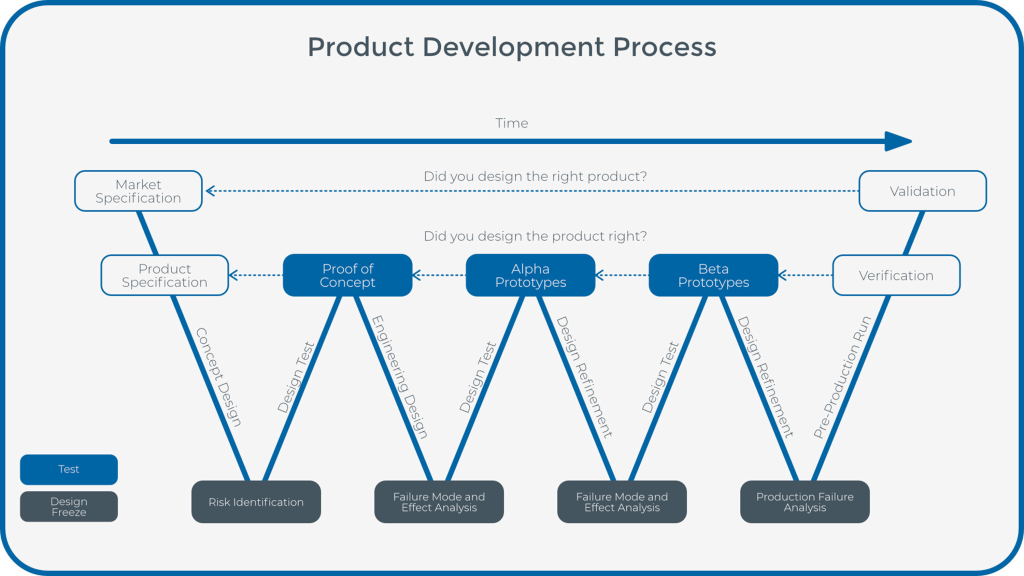
Most projects therefore go through several rounds of prototyping, hence terms such as proof of principle, alpha, and beta prototypes, each increasing in fidelity as the technical and commercial risk is reduced.

Conceptually, this looks like the process depicted in the diagram below, where each project has a different number of ‘W’ cycles – and activities within those cycles – depending on the specific pertinent uncertainties.


So back to the original questions…


‘Do you make (and test) prototypes?’

Yes, we do! Our workshops and labs are an integral part of our business for that very reason. The real questions are:

What are trying to learn?
How will we do that?’ and as such,
What does the prototype need to incorporate to enable that?


One must also bear in mind that not all prototypes are for technical testing; some may be to test investor appetite, customer reaction or manufacturing aspects. Not having the appropriate aspects or functionality in a prototype renders it unfit for purpose, while adding too much adds redundant costs.

‘Do you transfer prototypes to manufacture?’

Yes, we do! Production intent, pre-production and pilot production prototypes are all integral to the process of making sure that designs are delivered from their manufacturing processes as intended. All prototypes are means to an end, and upstream of that prototypes are useful tools to refine the design, but rarely suitable for commercial deployment.

There are of course many more nuances to the process, and each development project is unique in the challenges it identifies and how it addresses those. The art is understanding the process of developing the appropriate prototypes to get it to its commercial market as effectively as possible.

If you were thinking about these questions, or have any others about product development, don’t worry, it’s often unchartered waters for innovators and investors alike, and there is no such thing as a naïve question. The good news is that in working with eg technology, you’ve come to the right place to have them answered in a constructive way.