Patenting, Trademarks, Copyright, Trade Secrets...
In the next installment of our micro-learning series, we’ll explore potential legal solutions to help you keep your ideas safe and sound.

Farmscan AG: Enhancing Efficiency With Our New ISO Spray System
Member News
The views expressed in this Member News article are the author's own and do not necessarily represent those of Agri-TechE.

We are thrilled to announce the launch of our highly anticipated ISO Spray System after two years of meticulous development. ISOBUS technology has quickly gained recognition in modern farming practices and has become one of the fastest-growing components in the sprayer control market. Our cutting-edge technology enables seamless communication and integration between tractors, implements, and software, resulting in streamlined operations and significantly enhanced efficiency on the farm.

In this blog post, we introduce the concept of ISOBUS sprayer farming and delve into the numerous benefits of our new system, highlighting its profound impact on the agricultural industry.

Introducing the ISO Spray System

ISOBUS is an international standard that enables electronic communication between agricultural machinery, including tractors and implements. We discuss this in further detail in one of our earlier blogs, ‘What’s all the fuss about ISOBUS?’.

ISOBUS sprayers utilise this technology to establish a unified connection between the factory-supplied tractor terminal and the sprayer, allowing for real-time data exchange and control.

With ISOBUS sprayers, farmers can control various aspects of the spraying process, such as application rate, nozzle selection, and boom control, directly from the screen that was factory fitted in the tractor’s cabin. The seamless integration eliminates the need for multiple control systems, reducing complexity and improving ease of use. ISOBUS compatibility also enables interoperability between different manufacturers’ equipment, providing farmers with greater flexibility in implementing their machinery.

Let’s summarise the three key benefits of our ISO Spray System:

  1. Unmatched efficiency: ISOBUS sprayers optimise the use of fertilisers, pesticides, and other agrochemicals by precisely applying them at the required rates. The ability to control the sprayer directly from the tractor cabin allows for swift adjustments based on speed, field conditions, crop type, or weather changes, ensuring accurate application and reducing waste.
  2. Enhanced precision and productivity: Our ISO Spray System incorporates advanced technology, including GPS control systems and automated section control, to deliver exceptional precision. These features facilitate precise application, preventing overlaps or missed spots, resulting in uniform crop coverage. The automation eliminates the need for manual adjustments, saving time and enabling farmers to cover larger areas efficiently.
  3. Simplified machinery management: ISOBUS technology allows for seamless integration between different implements and tractors, reducing the complexity of managing multiple control systems. Farmers can easily switch between various implements, such as sprayers, spreaders, or planters, without the need for additional wiring or compatibility concerns. This flexibility enables farmers to adapt their machinery to different tasks and crop rotations efficiently.

Differentiating factors of Farmscan Ag’s ISO Spray System

Our ISO Spray System stands out from the competition due to two crucial factors:

  1. Collaborative design approach: At Farmscan Ag, we value close collaboration with both OEMs (Original Equipment Manufacturers) and farmers. Our engineers work closely with these stakeholders to develop equipment that specifically targets real-time efficiencies in the field. This approach ensures that our system is tailored to meet the practical needs and challenges faced by farmers, resulting in a highly effective and user-friendly solution.
  2. Simplicity as a priority: While there may be more advanced and complex controls available, we have intentionally focused on providing a simpler and cleaner user interface. Our ISO Spray System offers a user-friendly interface that is intuitive and easy to navigate. By prioritising simplicity, we have created a system that minimises complexity and avoids unnecessary distractions. This streamlined interface enables farmers to focus on their core tasks and operate the system smoothly, ultimately leading to enhanced efficiency in the field.

Want to learn more?

Contact our dedicated team today to learn how you can access the ISO Spray functionality on our current ISOPOD software system.
Second report from the TMAF Flux Towers monitoring carbon

Member News
The views expressed in this Member News article are the author's own and do not necessarily represent those of Agri-TechE.

Half a year into the carbon monitoring in sugar beet with the TMAF Flux Towers at Morley, lead researcher Dr Georgina Barrett from BBRO shares the latest news from the trial that is attracting lots of interest.

The flux towers have now been in place for six months. Since their arrival (reported in March 2023), conditions have been good for sugar beet growth with sufficient rainfall and few excessively hot days, the complete opposite to optimal conditions for the current cereal harvest!

The towers have been operating well, with only a small fault so far. This was a leak on the regulator which contains the zeroing gas. This is used by the system to calibrate the gas IRGA to ensure that the CO2 measurements are correct. Once detected, this was quickly rectified, and the data from the towers is looking good.

Another challenge we were aware of from the start was growing sugar beet immediately under the flux tower. It was decided that beet would only be planted directly under the radiometer arm so that the sensors could measure the crop which is then used in the flux calculations. This decision was made because managing the crop growing immediately under the flux tower would be challenging as it is not accessible by machinery, so would need to be hand sown and sprayed to control weeds, pests and diseases.

The small patches of beet grown under the flux tower arms has not grown as well as the commercial crop, and this has led to the UK Centre for Ecology and Hydrology (who operate the flux towers) to order a tripod system that means the crop monitoring sensors can be placed in the commercial crop, away from the main flux tower mast (Fig.1). 

Fig 1. Beet grown under the flux tower arms has not grown as well as the commercial crop.

What the data tells us so far

The data collected has shown a contrast between the two fields, mainly driven by an infestation of ryegrass in one field (Fig.2). Early on, this appears to have resulted in slightly more carbon being taken up compared to the field without the ryegrass as there was a greater amount of biomass being produced.

However, the ryegrass has competed with the beet which now has a lower biomass than the field without the ryegrass and resulted in this field having now taken up more carbon. This highlights an important message that good crop husbandry and growth of the crop will increase the amount of carbon taken up by the crop.

Although this carbon will be released in the short term, through harvest and processing of the beet, the carbon balance of the crop will be better as more beet will have been produced for the same amount of carbon input through inputs such as fertilizer, fuel and crop protection sprays.

Fig 2 Ryegrass in Flux Tower field at Morley
Fig 2. Ryegrass in one of the flux tower fields

Visitors to the tower sites

The flux tower sites have been visited by lots of groups, with farmers across the UK and from the wider agricultural industry curious to see what we are doing at Morley and why. This has been a great opportunity to engage in discussions and debates over the best approaches to reach net zero and the challenges and opportunities arising.  

It’s been fascinating following the carbon dynamics of the crop so far. The next phase will be interesting as we look at emissions from harvest and how management practices drive emissions into the following cereal crop.

Find out more about TMAF’s Carbon Monitoring in Sugar Beet.

Recruitment trends with Eden Search

Member News
The views expressed in this Member News article are the author's own and do not necessarily represent those of Agri-TechE.

Darren’s Observations

There has been, and remains, a real buzz and energy around the agriculture sector globally. The past 12 months have demonstrated the importance of food security during what can be viewed as one of the toughest periods ever for producers. The need for innovative solutions that can feed growing populations and solve the problems associated with climate change are paramount. But we’re constantly reminded that the road ahead is tough. Food system transition needs to be balanced against financial stability, and longevity, but many food producers are facing into incredibly challenging market conditions that disincentivise production which, ironically, is counter to the need for a concrete food security plan.

These factors, compounded by more global ‘shocks-to-the-system’ have forced many reinventions and the emergence of cutting-edge technologies that will help businesses to diversify. These impacts are yet to be felt further up the supply chain but this creativity will likely form the basis of our food production systems in the decades to come. Once again, the agriculture industry is proving itself the most resilient and adaptable of sectors. From vertical farming, through to genetically edited wheat and nanobubble irrigation systems, the future is really exciting!

Investors are keen to invest, innovators strive to innovate and companies are ready to adapt but at Eden Search we are conscious that the Farmer’s voice must be heard and it is critical that this remains a central part of the conversation. In our view it’s those emerging companies with the right support around the Board table as well as an in-depth knowledge and passion for their supply chains that are likely to be most successful. Knowing our customers is key but knowing our customer’s customer is better. The agricultural ecosystem, for all its challenges, cannot be ignored and the question is how do we work with farmers and producers to support them to unlock their own potential through the implementation of new technology? Alongside this we cannot discount the importance of people! We’re huge believers that it is, and will remain, people who move businesses forward by bringing the most important of qualities, empathy! More so, emerging companies need to be aware of the significance that potential investors pay to advisory Boards and the quality of ‘industry’ people around a Board table. It’s just good business sense that people will remain at the centre of the agriculture sector in the years to come.

But talent is changing!

We’ve spent many years supporting executive teams but it is during the past 12 months that we have witnessed the biggest shift. The changing expectations of leaders, the skills required for new technologies and the urgency of some of the challenges we are seeking to tackle mean that the Boards of today will look very different tomorrow. Skills are changing and will keep changing but our advice is let’s lean into it!

A strong people and talent acquisition strategy is critical to success but let’s not forget the importance of empathy and value added by the voice of the Farmer.

Darren Houghton, Director and Head of Agritech, Eden Search

A new headquarters for Seeded Marketing

Member News
The views expressed in this Member News article are the author's own and do not necessarily represent those of Agri-TechE.

Seeded was founded in February by Will Charlton, Limagrain’s former arable marketing manager. It has experienced impressive growth and has gained well-known businesses in the agricultural sector as clients.

“I am delighted by how well our clients have received Seeded’s service,” says Will. “We now support some of the biggest businesses in the industry with marketing and PR expertise. The most exciting thing is that they are reporting excellent results from the work we have done for them. Not only in terms of the exposure we are getting for their business but also in sales leads citing our marketing material as the reason they have approached our client.

“Seeded has got to a point where I felt it was important that it has an established headquarters, and Barn4 was a perfect solution. It is conveniently located just north of Cambridge, the facilities are excellent, and it is associated with Niab, one of the most well-known institutions in the industry.”

“Niab is delighted that Seeded has chosen Barn4 as a base to establish the business,” says Charles Gentry, Niab’s Barn4 manager. “Marketing to the agricultural industry is challenging, and Seeded’s presence at Barn4 will undoubtedly complement the Barn4 community. Will brings with him significant agricultural expertise, knowledge and skills, and I hope to see some member-to-member collaborations very soon.”

Everybody loves a prototype: eg technology

Member News
The views expressed in this Member News article are the author's own and do not necessarily represent those of Agri-TechE.

It makes an idea real

A tangible ‘something’ born out of a solution to an identified need, envisioned by the inventor. Every prototype is a great milestone, and we are often asked ‘do you make prototypes?’, as well as other product development-process related questions such as, ‘how do you test prototypes?’ and ‘do you transfer prototypes to manufacture?’.

They’re all great questions, and each one is integral to the product development process. But what is that process, and where do prototypes fit?

The point of product development is to monetise the innovation by selling a product (or associated service) that embodies it. Along the way there may be other forms of monetisation, but ultimately it all comes down to being able to place the product on the market.

Think of a product or piece of equipment you’ve bought, and why you’ve bought it. Chances are it’s to fulfil a need you have at an acceptable value, or to put it in ‘user requirements’ language because it’s commercially attractive and works as manufactured. And that’s what product development is really all about; designing and engineering a ‘thing’ to meet those requirements.

For complex products, that means both understanding those requirements, including the use environment which for AgriTech can be challenging, engineering a working solution, and importantly testing any uncertainties in the design effectively, which most often involves prototyping.

Tackling all uncertainties at once is often not only inefficient but impossible as many questions only reveal themselves once others have been answered. The art of product development is therefore to sequentially recognise the uncertainties and address those in the most appropriate manner, using prototypes designed to address the most pertinent questions at each stage.

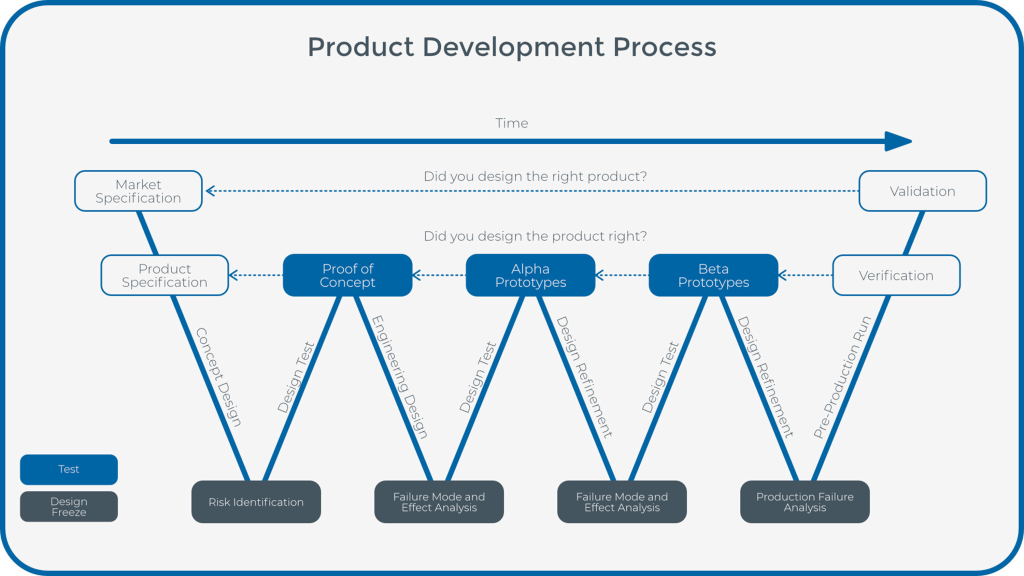
Most projects therefore go through several rounds of prototyping, hence terms such as proof of principle, alpha, and beta prototypes, each increasing in fidelity as the technical and commercial risk is reduced.

Conceptually, this looks like the process depicted in the diagram below, where each project has a different number of ‘W’ cycles – and activities within those cycles – depending on the specific pertinent uncertainties.


So back to the original questions…


‘Do you make (and test) prototypes?’

Yes, we do! Our workshops and labs are an integral part of our business for that very reason. The real questions are:

What are trying to learn?
How will we do that?’ and as such,
What does the prototype need to incorporate to enable that?


One must also bear in mind that not all prototypes are for technical testing; some may be to test investor appetite, customer reaction or manufacturing aspects. Not having the appropriate aspects or functionality in a prototype renders it unfit for purpose, while adding too much adds redundant costs.

‘Do you transfer prototypes to manufacture?’

Yes, we do! Production intent, pre-production and pilot production prototypes are all integral to the process of making sure that designs are delivered from their manufacturing processes as intended. All prototypes are means to an end, and upstream of that prototypes are useful tools to refine the design, but rarely suitable for commercial deployment.

There are of course many more nuances to the process, and each development project is unique in the challenges it identifies and how it addresses those. The art is understanding the process of developing the appropriate prototypes to get it to its commercial market as effectively as possible.

If you were thinking about these questions, or have any others about product development, don’t worry, it’s often unchartered waters for innovators and investors alike, and there is no such thing as a naïve question. The good news is that in working with eg technology, you’ve come to the right place to have them answered in a constructive way.

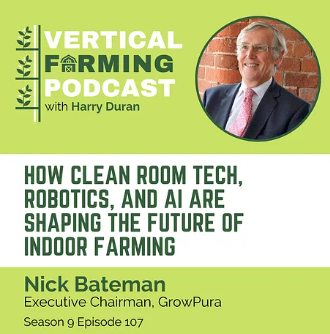
Growpura featured on Vertical Farming Podcast: How Clean Room Tech, Robotics, and AI Are Shaping the Future of Indoor Farming

Member News
The views expressed in this Member News article are the author's own and do not necessarily represent those of Agri-TechE.

Nick Bateman, Executive Chairman of Growpura talks robotics and AI to Harry Duran on the Vertical Farming Podcast.

Listen Here

Food & Agri Regular Update

Member News
The views expressed in this Member News article are the author's own and do not necessarily represent those of Agri-TechE.

Jessica Burt & Bella on Linked In provide regular rolling vlog updates on the latest food and agri news.

LinkedIn: Jessica Burt

Consumer Food Insecurity – What does it mean for food businesses?

Member News
The views expressed in this Member News article are the author's own and do not necessarily represent those of Agri-TechE.

New government research shows that one in four people in England, Wales and Northern Ireland are food insecure – the highest level since tracking began in 2020.  FSA’s flagship survey shows food insecurity continues to rise | Food Standards Agency But what might this mean for consumer behaviour and the impact on food and agri businesses in this sector?

The latest wave of the Food Standards Agency’s (FSA) Food and You 2 survey, conducted between October 2022 and January 2023, revealed that levels of food insecurity reached 25%, an increase from 16% when the first wave of the study was conducted between July and October 2020.

In simple terms, food insecurity means having limited or uncertain access to adequate food. 

For the first time, the survey asked people to specify what changes they were making to their eating habits for financial reasons.

The findings show that 80% of respondents reported that they had made changes to their eating habits for financial reasons in the previous 12 months. 

The most common changes related to what and where respondents ate, with 46% eating out less; shopping habits, with 42% of people buying items on special offer more; and food preparation, with 29% of people preparing food that could be kept as leftovers more often.

This is likely to cause concern for the hospitality industry that was hard hit by covid. It will also mean increased demand for special offers and basic deals on retail food products, the buy one get one free (BOGOF) aspect would also be utilised but consumers are much more aware of food waste and use by dates.

The research indicated, as expected, that food prices remain the top food-related concern for people (65%), but with food waste only slightly below this (62%), the quality of food (62%), and the amount of food packaging (56%) also featuring amongst the most common concerns when prompted.

Other key findings in the report include: 

  • Across England, Wales, and Northern Ireland, 75% of respondents were classified as food secure (61% high, 14% marginal) and 25% of respondents were classified as food insecure (12% low, 12% very low). 
  • 78% of respondents who had at least some knowledge of the FSA reported that they trusted the FSA to make sure ‘food is safe and what it says it is’.  
  • 93% of respondents reported that they were confident that the food they buy is safe to eat.  
  • 76% of respondents reported that they had confidence in the food supply chain.  
  • 64% of respondents reported that they always check use-by dates before they cook or prepare food. 

Read the research    The full Wave 6 report is available F&Y2 Wave 6: Executive summary | Food Standards Agency.

RAVIC: the past, present and future of SRUC’s newest innovative hub

Member News
The views expressed in this Member News article are the author's own and do not necessarily represent those of Agri-TechE.

2023 is an exciting year for SRUC; key projects are coming to fruition, bringing with them the opportunity to bring research, education and business closer together to lead the way for progress in all areas of the agriculture industry across Scotland and the North of England. 

RAVIC is one of these key projects. The idea began some years ago, before the pandemic hastened the regular use of online learning, as SRUC was seeking to create a way to ensure agricultural education was available across the country. An educational hub was envisaged, which would offer regular online learning from secondary schooling, right up to degree level, and which would be situated in Inverness to provide an accessible physical institutional presence for northern rural locations. 

While this function of reaching all students virtually is now an industry standard, the hub that we now call the Rural and Veterinary Innovation Centre remains primed to work towards prosperity in rural Scotland through partnerships and a unique approach to collaboration. Offering flexible, modern working, teaching, research and business spaces, RAVIC has been designed to facilitate close collaboration across all agricultural sectors.

While RAVIC was an idea only just beginning to take shape, the Northern Faculty at SRUC developed CEPH (Centre for Epidemiology and Planetary Health) from its existing epidemiology unit. This research group has been progressing key scientific studies to improve the health of livestock in both agriculture and aquaculture, investigating the health of wild animal populations, and the centre is a major focus for research excellence in disease surveillance including zoonoses (diseases which can be transmitted from animals to humans). CEPH will provide a core function for RAVIC, once the new centre is complete. 

RAVIC will also work closely with another of SRUC’s key projects, the new Vet School. Headquartered at our Aberdeen Campus, the Vet School will also have facilities and functions across SRUC, including at RAVIC. The inclusion of veterinary services and specialist equipment makes RAVIC unique among innovation hubs, and offers a particularly strong benefit to farmers in the region. Furthermore, RAVIC is well placed to provide solutions to modern issues, such as climate change, which creates the need to ensure reduced carbon emissions and also find solutions to rapidly evolving animal diseases.

The construction of RAVIC is now well underway, with the building expected to open in Autumn 2023. Not only will the centre become a hub of education and research, but it is currently seeking businesses to reside within the centre.

Following a recent press release issuing a call to businesses to take up residence at RAVIC, the upcoming centre was featured in many titles, including BBC News, Farming UK and The Press & Journal.

​​​​​​​

Educators, students, research groups and businesses will coexist in this unique space to identify problems faced by the agricultural sector, to develop solutions and to swiftly make them available to agricultural businesses.  

PGRO launches new podcast for pea and bean growers

Member News
The views expressed in this Member News article are the author's own and do not necessarily represent those of Agri-TechE.

The Processors and Growers Research Organisation (PGRO) has launched its first podcast.

 
The new podcast, titled ‘Inside the Pod’, will cover all topics related to the growing of pulse crops in the UK and will feature interviews and insights from PGRO’s staff members, as well as guests from across the industry.
 
The first episode, which is live now, covers PGRO’s vining pea open day that was held in late June in Nocton, Lincolnshire, and features Dr Chris Judge speaking about the Descriptive List trials that were held there involving vining peas. The second episode, covering PGRO’s trials with intercropping, trap cropping and lentils, is also live.

Listen to ‘Into the Pod’ on Spotify or wherever you get your podcasts now.

What is agricultural ethics and why does it matter?

Member News
The views expressed in this Member News article are the author's own and do not necessarily represent those of Agri-TechE.

Agriculture is facing unprecedented scrutiny for its social and environmental impacts. Many of the key choices it must make are fundamentally about ethics.

Key issues in agricultural ethics explores key ethical debates surrounding agriculture and agri-food supply chains. These include issues such as animal welfare, use of labour, the effects of new technologies and the overall impact of agriculture on the environment. It considers the ways these ethical dilemmas may be better understood and potentially resolved.

Edited by a leading researcher in the field, Key issues in agricultural ethics will be a standard reference for researchers in agriculture and environmental science, government and other private sector agencies responsible for monitoring good agricultural practice, as well as researchers involved in the social sciences with a focus on ethics.

To hear more, see here

Savills launches a six-part Nature-based solutions podcast series

Member News
The views expressed in this Member News article are the author's own and do not necessarily represent those of Agri-TechE.

Nature-based solutions podcast series launched

Savills launches a new six part podcast series as part of the wider Savills Real Estate Insights series.  The six-part series touches on: water, restoration and rewilding, biodiversity, woodlands, and regenerative agriculture; and includes guests from a wide range of organisations including WaterAid, the Tree Council and Rabobank.

The podcast is hosted by Alex Godfrey Savills joint head of natural capital and Nicky Wightman Savills director of emerging trends, and each episode takes a candid look at some of the issues we are facing, and how they might be solved.

It takes a different approach to the well-established format of the other Savills podcasts and some of the conversations may be deemed controversial. However, with the line-up of guests and topics covered we believe this series helps to position Savills at the heart of many aspects of nature-based solutions.

Each episode will be released at midnight on Wednesdays from 26th July to 30th August and you can find the episodes on Apple or Spotify or via https://www.savills.co.uk/blog/article/349769/podcasts/real-estate-insights–climate-change-is-primarily-a-water-crisis.aspx: