Dynium shifts gear from the pit lane to polytunnels
 Agri-TechE
Based at Silverstone, the home of British motorsport, Dynium was founded by former Formula 1 engineers to channel trackside innovation into farming. Operating from the heart of the Oxford-Cambridge technology cluster, the company blends elite vehicle engineering with advanced robotics to bring that ‘need for speed’ to agriculture.
In fruit farming, time-saving is essential. However, when pickers spend up to a fifth of their time transporting harvested fruit instead of picking it, valuable time is lost.
With persistent labour shortages, rising employment costs, and the challenges of operating autonomous technology in rural environments, finding a solution is not straightforward.
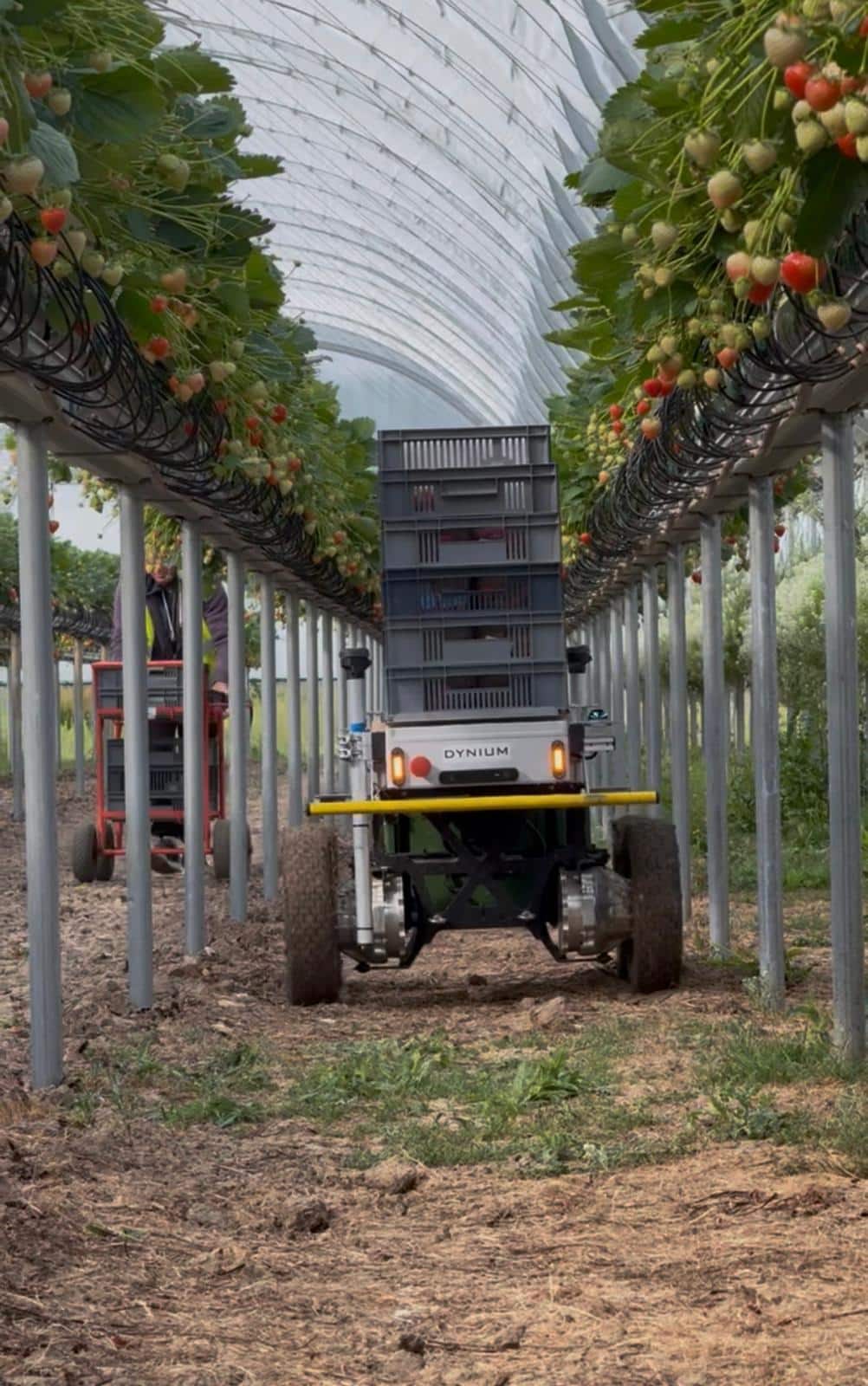
Enter ‘Berries on Board’ AKA ‘BOB’. Roughly the size of a coffee table, Dynium’s autonomous vehicle has a deceptively simple job: take the legwork out of fruit farming, so pickers can spend more time picking.
The small vehicle is tackling a big challenge. According to Dynium, the real measure of its success is not just what happens when BOB is on farm, but what growers notice when it’s gone.
From motorsport to fruit farming
Founded in 2010, the company began as a niche vehicle business, producing vehicles primarily for the motorsport industry. But in 2015, an approach from an agricultural company set it on a different course: could Dynium develop a fully autonomous tractor for use in orchards?
CEO Chris Horton explains that the company began looking for a solution, ultimately moving away from the idea of a conventional tractor and towards something considerably smaller.
“We have created a much smaller vehicle that can operate on a 24-hour basis and achieve what a human-operated vehicle can do in eight hours,” says Chris.
This partnership, and the technology it developed, ultimately led Dynium to incorporate as an autonomous logistics provider last year. Today, the company focuses exclusively on agriculture, conducting numerous trials with growers across the UK.
A small vehicle making a big impact
BOB’s purpose is to tackle an everyday inefficiency in fruit picking: getting the harvest from the picker to the weighing station.
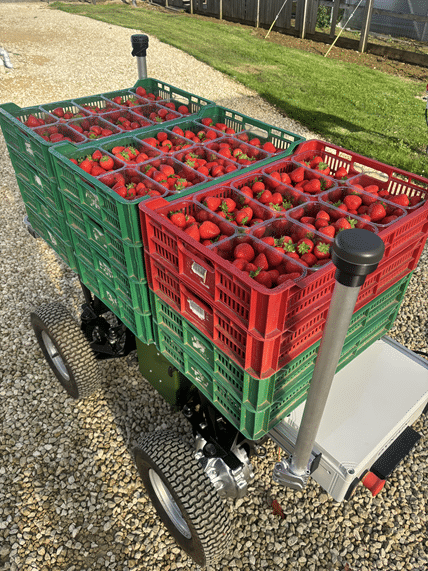
Pickers fill trays with fruit; the vehicle transports them to the headland for weighing. Instead of pulling workers away from picking, the vehicle handles the transport.
A straightforward concept, but one with the potential to make a meaningful difference.
“Pickers spend 15–20% of their time moving fruit, taking time away from the skilled discipline of picking itself. With our technology, we can increase valuable picking time and reduce time spent transporting fruit,” explains Chris.
In an industry where productivity matters and skilled labour is hard to come by; reclaimed time could be significant.
Easing fruit farming pressures
Labour remains one of fruit farming’s biggest challenges. Workers can be hard to source. Wages, accommodation, and holiday pay all contribute to operational costs.
In spite of these challenges, introducing a robot to a human labour-led farming operation presents a possible tension around how the pickers feel about the technology.
According to Molly Snow, key account manager at Dynium, the response has been encouraging.
“We get very positive feedback from pickers. The technology is a job enhancer, rather than a job remover.
“Pickers genuinely enjoy working with it. It saves them both time and effort,” says Molly.
Rather than positioning autonomy as a replacement for the workforce, Dynium sees BOB as a way to make working life easier and more productive.
The benefits have also become apparent to growers during trials. Chris says that when BOB is taken out of an operation, the difference is noticeable.
“Growers find the need to use a truck to run fruit is removed, as it’s all done autonomously. They have felt the impact when the technology is removed,” he says.
A smaller vehicle can also reduce ground impact compared with a truck or traditional tractor.
Rather than skid steering, BOB has articulated steering, helping to minimise soil disturbance and reduce damage to the growing environment.
Despite its small size, the vehicle has undergone rigorous testing to ensure it can handle challenging terrain, with a load capacity of up to 300kg and a design capable of carrying 12 trays of fruit.
Focus on adoption
For Dynium, getting BOB into growers’ hands is only part of the challenge. The bigger objective is making autonomous technology easier to adopt.
The company’s focus on core logistics is central to that ambition. Rather than trying to build a machine that does everything, Dynium has focused on a specific task growers already need to do.
“By offering a product that is focused on core logistics, other service providers can utilise it to develop their services, or benefit from the fact that there’s already fleet adoption in place in those target areas,” Chris explains.
The appeal, he suggests, lies in that simplicity.
“That is what is great about it. In its simplest form, it’s a logistics transport platform that is robust, rugged, reliable and works.”
For an industry facing mounting pressure on labour, costs and productivity, the potential is clear. BOB won’t solve every challenge fruit growers face, nor does it need to. The purpose is much more focused: to take on the repetitive task of moving fruit, giving pickers more time to pick and growers another way to improve efficiency.
“The future is adoption. We know the product works. We want to show people what it can do and how it can help them,” concludes Molly.
Post Overview
Agri-TechE Related Posts
The Inevitability of AI Quality Control
UK-based Drone Ag gains unique ENAC BVLOS authorisation for autonomous crop-trial monitoring in Italy
Dyson’s Fresh Approach to Agri-Tech Innovation
AI removing the “subjectivity tax” on the supply chain
IAgrE Conference 2026, Automation in Agriculture – From Innovation to Impact, Harper Adams, 21st October.