Agricultural digital twins reveal alternative futures
 Agri-TechE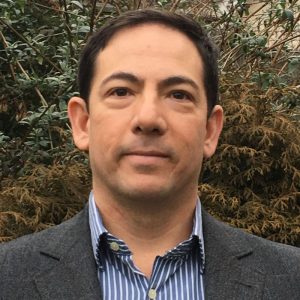
Future climate projections show that the frequency of more extreme events in terms of precipitation and droughts is predicted to increase and this is leading to an increase in demand for better climate information and agricultural digital twins will have a role in this, explains Dr Marcelo Valadares Galdos, ahead of REAP 2022 where he is speaking.
Marcelo’s particular interest is soil health and climate-smart agriculture. He was on secondment to the Met Office for several years, exploring how its climate services could provide additional benefit to farmers. He has recently joined Rothamsted Research as a Soil Carbon Specialist in the Sustainable Soils and Crops department.
His research projects have included developing agricultural digital twins and agri-environmental sensor networks for decision support. This has included experimenting with novel sensors and use of robotics for soil monitoring.
Turning climate data into actionable insights
Previously as part of the Leeds Smart Agri-Systems initiative, Marcelo was involved in turning the highly instrumented farm at Tadcaster, Yorkshire, into a Smart Farm to monitor soils, vegetation and livestock. The Smart Farm aims to study processes that are important economically for productivity and yields but also for the environment and in mitigating climate change.
He explains: “By using the UK climate projections UKCP18 – which is the most recent high-resolution climate projection for the UK – we have examined how extreme events could impact soils, particularly in terms of highly erosive rainfall events, when precipitation falls in a short period with a lot of energy and volume.
“This has obvious links to flooding, runoff and pollution, but it also leads to the detachment of soil particles, leading to losses of nutrients, carbon and fertile topsoil, which takes centuries to replenish.”
The concept of Climate Services – turning weather and climate data into something that stakeholders can actually use to make smart decisions – has a lot of potential applications in the food production sector.
“Translating what seasonal forecasts might mean for when to cultivate the soil, plant, apply fertilizer and harvest is a whole area of interest to me.
“Combining climate projections with information on land use and agricultural management practices, we can develop ‘what if?’ scenarios, which are useful to identify ‘climate-smart’ options that contribute to climate change mitigation and adaptation.
“One of the advantages of this approach is to see ‘what could I do to improve the sustainability in my specific farm or region with my microclimate and my soil type?’
“I think the most interesting approach is when you include economics as well – input costs, commodity prices, environmental externalities and so on. The question then becomes ‘What could I do in an economically viable way to become more sustainable?’”
Improving methods of carbon measurement with sampling robot
Soil health is important for mitigating climate change. Carbon as a component of organic matter is important to the structure, fertility and soil moisture retention in soils, but storage is also important. Accurate ways to measure carbon directly in soils is a major challenge and one that Marcelo’s team has been addressing.
“We have been taking a science-based approach to the monitoring, reporting and verification of soil carbon, by deploying sensors at multiple scales – satellite-based but also drones and proximal sensing, such as sensors that scan soils and direct sampling.
“Conventional soil sampling is costly and time-consuming, so part of the project is looking at non-destructive ways to scan key properties of soil and how to locate sensors to provide the most useful information
“Our approach is to use a lot of other information from remote sensing, from management systems and from scanning the soils with certain sensors, then identifying the best places to actually do in-depth sampling.
“This is a really exciting area of science. We particularly want to know the carbon stocks – ie how much carbon is in a certain area to a certain depth.
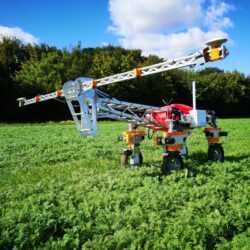
“One of the projects is a scoping study using a rover robot instrumented with novel sensors. This will provide a deeper understanding of spatial variability across the plot I hope to have some interesting results to discuss at REAP.”
Modelling – Sensor networks and agricultural digital twins
Marcelo’s team has been applying the Internet-of-Things (IoT) concept to agri-environmental monitoring, generating data on soil chemical, physical and biological variables, and also on climate and vegetation. However, collecting the data is just one element of the jigsaw.
“The idea is that these sensors are connected but also that there is data fusion with different types of sensors combined to generate other outputs that are viewable from a dashboard.
“For the last several decades we have been applying computer representations of crops and soils for scientific research, and this is one part of the puzzle, but the idea of digital twins encompasses the workflow of the data, from collection and analysis through to visualisation and its presentation on a dashboard of real-time data with actionable insights.
“However, connectivity is still an issue. At the Leeds smart farm, where I was working before, there is a lot of instrumentation already, and it is a challenge to transmit and to have near real-time connectivity, and this is an issue in most rural settings.
“Improved connectivity would be game-changing everywhere, not only in the globally remote areas.
“When all of those elements start to come together we can start to use agricultural digital twins for decision support, and I think we will have something that is very powerful indeed.”
 REAP 2022: ‘Making Sense of Agriculture’ – Tuesday 8th November 2022
From yield mapping and precision livestock through to digital twins and cloud computing, at REAP 2022 we will be exploring the technology and looking at the implications from a field to landscape level. Making technology farm-centric is core to Agri-TechE ’s mission so a key feature of the conference will be a panel of farmers and producers discussing the emerging technologies and future scenarios.
Post Overview
Agri-TechE Related Posts
Farming brothers launch crowdfunding campaign for drone app that reduces use of pesticides
Outfield’s Precision Orchard Dosing System to enable real-time decision making
Post REAP news Gardin raises $10.8m for plant stress tech

Managing risk in agri-tech
Digital Divide faced by Rural Businesses and Organisations