Ten ways agri-tech has changed agriculture
 Agri-TechE
 Starting a revolution
Agri-TechE conducted a review of the agriculture technology sector in 2014 to capture a baseline. At that time the industry was dominated by a small number of agri-suppliers, providing ever bigger machinery, delivering plant protection and inorganic fertiliser, supported by agronomy that achieved the goal of improving yields. But change was coming.
The UK Agri-TechE Strategy, announced the previous year, was the first time that an ‘Agri-Tech’ sector had been recognised by government and recognised as a means to improve productivity in the sector. The aim was sustainable intensification to produce “more with less input and environmental impact” and underpinned by funding directed at stimulating innovation.
The Agri-TechE Strategy identified that the ‘sector is diverse and complex, making it difficult for individual institutions to make connections and develop new partnerships.’
It was at this pivotal moment that Agri-TechE , an independent membership network, came into being with the support of its founder members and some charitable organisations. By bringing together a multi-disciplinary community underpinned by new sources of finance, innovation in the sector started to accelerate.
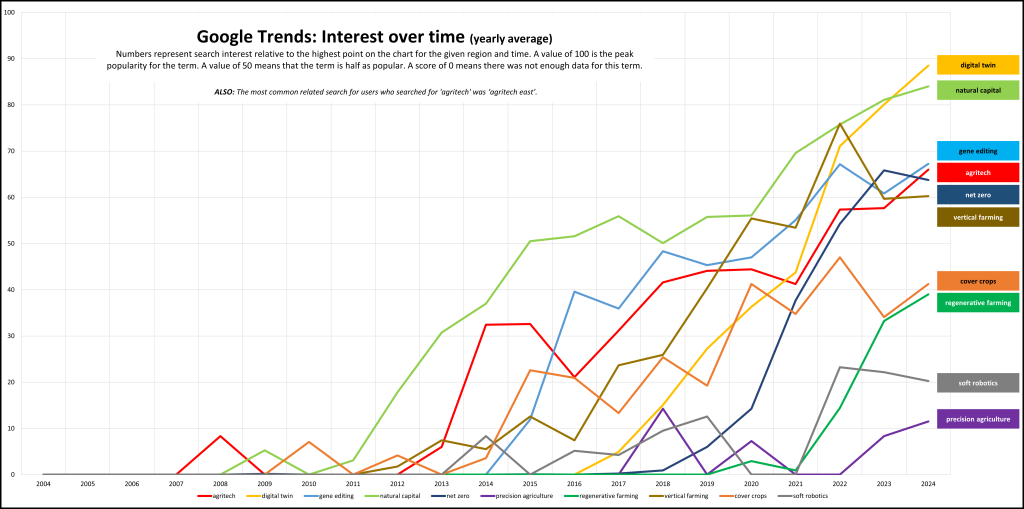
Ten radical ways that farming has changed
Ten years on the agricultural landscape it is very different – with many new players and types of agri-tech. We have picked out some of the radical ways that this combination has changed farming.
1 Automation of time-consuming tasks
Smartphones are now ubiquitous on-farm and used for everything from data capture to remote control of irrigation. Visualisation from drones is replacing field walking and agri-robotics are starting to be used commercially for picking and packaging.
2 Advanced breeding
The sequencing of the wheat genome was a major breakthrough, followed by tools for gene editing. The Genetic Technology (Precision Breeding) Act 2023 was a major milestone.
3 Precision livestock
A suite of technologies are now available for continuous, automated monitoring of each animal, enhancing health, welfare, production, and reproduction, as well as reducing environmental impact.
4 On-farm energy production
The need to reduce greenhouse gas emissions has created a new urgency for alternatives to reduce the reliance on fossil fuels.
The concept of the circular economy – where byproducts previously wasted are used as raw materials for a new process – has become more economically viable. Anaerobic digestion, solar farms, and growing crops for fibre and bioenergy are all creating new income streams for farmers.
5 Controlled Environment Agriculture/vertical farming production
Indoor farming has moved away from being a lifestyle statement to be scaled commercially. Although the learning phase has been long and the sector has been hit by the hype cycle, there are signs that the sector is moving into a new phase.
6 Insect-tech
Insects were previously an untapped resource. The future of insects as human food in the UK may be uncertain, but circular systems now use black soldier flies to convert food waste into protein for animal feed and fertiliser. Other insect knowledge is creating artificial pheromones as deterrents and ‘impersonators’ as alternative pollinators.
7 Natural capital and ecosystem services
The economic value of ecosystem services was recognised, driving the development of metrics and tools for accessing how the natural environment has been degraded or improved. This is the pre-requisite for asset management.
8 Regenerative farming
Over the last ten years a new ‘soil first’ approach to farming has encouraged rotations with novel crops and introduced new concepts such as minimum tillage, cover crops and the use of biologicals to enhance the natural processes.
9 Smart farming
The vision of a part-time farmer managing their land from the office is getting closer. The falling cost of smartphones and improvements in the cellular network has created the opportunity for real-time data capture and analysis, with the infrastructure emerging to enable ‘hands-free’ farming.
10 Migration to Net Zero
This top-down driver to reduce emissions is now moving through the agri-food value chain, creating an imperative for farmers and growers to evidence their credentials.
Agri-TechE creating an innovation network:
“Agri-TechE is one of the largest and longest established networks in Europe, facilitating exchange of ideas between key stakeholders over the last 10 years.
“If the UK wants to fulfil its ambitions of improving agricultural productivity whilst reducing environmental impact,
“The role of networks such as Agri-TechE will become even more crucial over the next decade.
Graham Moore,
John Innes Centre
“Connections made via the Agri-TechE team have been valuable and have assisted IAG to participate in many opportunities which would have not come to our attention had we not been members.
“The team are strong at enabling diversity – bringing compatible technologies, theories, aspirations and personnel together to understand how collaboration can work and strengthen project pathways.”
Kate Brunswick,
Innovation Agritech Group
We asked individuals across the ecosystem – what have been the game-changers and what needs to happen next ?
Data-driven farming
Oliver Wood, Hutchinsons
“Machine telematics. Over the last decade there have been significant changes made by machinery manufacturers to make their machines more “visible” from a data perspective. In most cases it is now possible to stream data to and from the machine directly in the field, which makes variable applications, collecting yield data and planning logistics much easier than it ever has been.
“Data driven decisions. We are seeing more clients than before now leveraging their data to make management decisions and review crop performance. This is not just for the whole field but more focus is now being put on separate parts of fields to raise the whole field profitability.
“However, as a sector and an industry I don’t feel that we have made as much progress on this as was hoped. There appears to be fewer startups and less private funding available than prior to Covid, and those that are there don’t seem to be able to gain commercial traction. There is still innovation taking place, but I think that we are a long way from the UK being a global centre of excellence.”
On-farm energy
Stephen Temple, Temple Farms
“We are generating electricity and heat from anaerobic digestion, using lower quality silage, dairy slurry and whey from our cheesemaking. We are about to install photovoltaics as well.
“It is a useful addition to our business, but I would not say it is a game changing development for new adopters since the feed in tariff and renewable heat incentive are no longer available, but it certainly helps with energy independence.”
Post-chemistry solutions
Andy Diprose, Rootwave

“Herbicides are struggling against the headwinds of resistance and safety. There is no new innovation in chemistry given the time and cost of development, especially since any new active is likely to be susceptible to the same resistance and safety issues the industry faces today.
“Physics and engineering offers solutions today, that work and are cost-competitive, and because there are no residues to create resistance and safety issues, it gives farmers certainty in their future.”
Insect-tech
Mary Ellis, CEO, Pherosyn
“Insect tech covers a multitude of technologies and applications, but we see huge opportunity in the use of more sustainable approaches to crop protection, such as the use of pheromones in monitoring and controlling pests.
“Monitoring crops for early signs of pest emergence and accurately determining the optimal timing of intervention (e.g. biopesticides or agrochemicals), will allow farmers and growers to manage pest pressures in a more sophisticated and efficient manner.
“Using pheromones as control products (e.g. to disrupt mating) results in a vastly reduced environmental footprint for pest management when compared to the state-of-the-art. We must move away from mass application of chemicals that are destroying biodiversity.
“More natural fertilizers will also be a welcome addition to the armoury.
“Looking forward, there should also be a focus on entrepreneurship as this has value in all organisations. For example, get the CAP table correct from the start by limiting the amount of equity a research institute/university can take, this would encourage inbound investment to stimulate the entrepreneurial culture.
“There needs to be a focus on entrepreneurship as this has value in all organisations.”
Controlled environment agriculture (CEA)
Kate Brunswick, Innovation Agritech Group Ltd.
“In the UK, following one of the wettest winter seasons on record, there is increasing recognition that we are developing our own food security crisis and CEA is a part of the solution.
“The ability to grow nutrient rich edible crops without interruption in a controlled ‘space’ means that we can guarantee a secure supply chain. Also it will use less land, less water, create less disruption to the environment and production will be closer to the consumer.
“Significant innovation advances have been made within CEA and TCEA (total CEA). Automated systems deploying AI and driven by data analytics have made key progressions, this has the potential to revolutionise the sustainable production of food, medicinal and pharmaceutical crops. However, there is still a long way to go in terms of cost of inputs/energy.
“There have been winners and losers in the CEA ‘space’ over the last five years – as high commercial aspirations have not been aligned with consumer confidence, expertise and knowledge, or key market insights. ‘Funding’ rather than ‘investment’ is now need to be accelerate further research and place CEA or Vertical Farming firmly on the agenda for food security.”
Advanced breeding
Graham Moore, John Innes Centre

“Agriculture is under enormous pressure to address urgent global challenges such as climate change, food security and global health. To deliver on these challenges, agriculture will need to be underpinned by excellent science and technology, and the best innovators in the country provided with a platform to produce solutions.
“Science plays an important role in boosting sector efficiency and innovation in the UK, creating opportunities to develop new crop varieties and practices that can improve productivity, whilst reducing environmental impact.
“UK capability in areas such as agricultural genetic technology has increased enormously over the last decade, allowing us to develop crops with improved traits in nutrition, sustainability, and resilience.
“Fully realising the benefits of these breakthroughs will require new ways of working together as a community.
“I’m excited to see what the next decade brings.”
Post Overview
Agri-TechE Related Posts

Using tech to tackle challenges – Innovation Hub live now!
Time for Research

Digital twinning moves networking from real to virtual worlds
Improved yields under uncertain conditions: Crop4Sight at the Innovation Hub
How Earth’s earliest photosynthesizers could offer farmers a new commercial – net zero – opportunity