Digitisation becomes the ‘new normal’ at the virtual Innovation Hub
 Agri-TechE
 “The agri-tech innovation pipeline remains full,” commented Dr Belinda Clarke, speaking about the range of agri-tech innovation demonstrated at the RNS Innovation Hub, this year.
“It is vital within the ‘new normal’ that the sector continues to ensure that the crucial generation and gathering of evidence that is needed to show the value of new innovations. Digitisation is the next phase of the agri-tech revolution.”
Innovation Hub is a roaring success
Digitisation featured in the format of the Innovation Hub itself. Agri-TechE has experimented with a new immersive virtual experience this year, to roaring success with the highest ever single-day visitor count to the website, and interest coming from across the globe.

The Innovation Hub saw exhibitor videos and presentations supplemented by podcasts on subjects such as boosting soil-health with a co-product of paper recycling to nutrient-management under no-till and building resilience with genetics.
A wide range of opportunities for exhibitors and customers to interact seems to have stimulated online conversation, with twitter reach exceeding stated statistics for some of the big national online events.
Belinda says: “Thanks to the responsiveness of our members, we were able to pull this event together in record time to fill the huge gap left by the cancellation of the physical Royal Norfolk Show.”
Read more on some of the exhibitors below. The Innovation Hub will remain online, and can be accessed here.
Aphids and bad weather: BBRO keen to share knowledge
“The number of aphids detected in 2019 reached record levels” says Dr Simon Bowen of BBRO. “That was the first year of growing crops without the seed treatments that help protect crops against virus-carrying aphids”
Simon is keen to talk about the BBRO research that helped sugar beet farmers deal with the aphids and the potential for virus epidemic, as well as the increasingly unpredictable weather conditions. Seeing the opportunity to provide their knowledge to the wider farming community, BBRO was pleased to sponsor this year’s Innovation Hub.
The importance of discussion at this point is paramount, as the aphid problem is not going away: “Unfortunately, it looks like 2020 is going to be another record year for aphids and test our control strategies even more thoroughly”, Simon points out.
Turning biomass into plastic with Cambond
“Our technology platform can make bioresins that are safe, low carbon and environmentally sustainable…” explains Cambond’s Head of Business Development Dr Gareth Roberts. A reusable coffee cup made from spent coffee grounds is just one of the products created using Cambond’s bioadhesive.
The Cambridge-based company explained, in the Hub, how agricultural waste such as straw, fruit and vegetables could provide a replacement for plastics.
Nutrient management all-you-need-to-know, with ADAS
“Grain analysis adds particular value as it tells us about crop performance… We now advocate analysis of grain samples at harvest to gain an indication of the success of the overall nutrient management strategy” says Prof Roger Sylvester-Bradley, Head of Crop Performance at ADAS.
At this year’s Innovation Hub, ADAS launched ‘YEN nutrition’ to help farmers keep on top of the latest nutrient management research. The first product will be the ‘Share-to-Learn’ Grain Nutrient Benchmarking service. ADAS has used grain analysis for 2019 and the previous three harvests and discussed the insights gained in these trials.
Reusing paper for a soil-carbon boost with UEA and Greenworld Ltd
Could a co-product from paper recycling help farmers to improve soil health whilst building carbon stocks?
“Soil carbon enables soil to self-structure, and thus increases water infiltration, increase water storage and decreases the risk of flooding,” says Brian Reid, Professor of Soil Science and Associate Dean for Science (Innovation) at the University of East Anglia.
UEA is working with Greenworld Ltd to explore the potential of Paper Crumble (PC) to improve soils and improve the delivery of public goods. The partners discussed their work at the Innovation Hub.
Brian continues: “We were looking forward to talking to famers and growers about the opportunities to increase soil carbon and achieving Net Zero on the farm to help realise this vision.”
Empowering potatoes without using chemicals, with TSL
Potato performance and quality is always a hot topic. At The Sainsbury Lab, in Norwich, scientists have been using the latest methods enable some improvements for the humble spud.
“Our goal at TSL is to replace chemistry with genetics for control of important crop diseases, so that farmers and consumers everywhere can benefit from reduction in the need for agrichemical applications, by enabling creation of crop varieties that carry genetic resistance.”
Jonathan Jones, Agnieeszka Witek and Sebastian Fairhead showed how high-tech breeding can improve lives for potato growers and processors at the Innovation Hub.
Improved yields under uncertain conditions with Crop4Sight
As extreme conditions seem to be getting more frequent, tools that enable growers to mitigate the impacts within the growing season will be invaluable. Crop4Sight is aiming to do just that with its growth tracker that uses imaging via the camera-phone and Bluetooth enabled scales to allow farmers to benchmark crop development.
Paul Coleman of Crop4Sight explains: “If the crop is performing differently to intended then understanding optimum yield potentials and crop value increases is key to making the greatest financial return.”
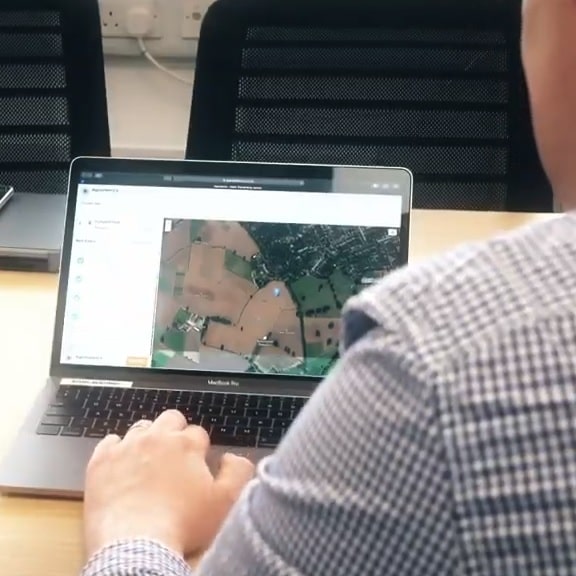
At the Hub, Paul Coleman demonstrated the web and app elements of the product via laptop and iPad and discussing the role of plant physiology and agronomy in agriculture.
New Cropping Systems and old experiments with Niab
“There is no simple solution [to soil nutrient management] but these experiments are helping farmers understand the impact of management decisions for the whole crop rotation and therefore select the best combination of approaches for their farm” says David Clarke, Soils and Farming Systems Technician at Niab.
For over 10 years, Niab has been working with the Morley Agricultural Foundation and the JC Mann Trust on the New Farming Systems experiment for combinable crops, and this work is starting to pay dividends.
At the Hub, David Clarke and colleagues discussed the soil health lessons that Niab had learnt from this and other long-term experiments, one of which has been running for 120 years.
New tech helps fertiliser go further, with Hockley Agro
Precision application of foliar fertilisers is more effective if the product can coat the leaf, so Hockley Agro have created an innovative biodegradable super-spreader that has been shown to boost effectiveness whilst reducing environmental side-effects.
The new technology can be added to herbicides or insecticides or any foliar spray. Peter Rosevere of Hockley Agro gave his lowdown at the Hub.
[1] Figures recorded on 1st July 2020, by TweetReach
Post Overview
Agri-TechE Related Posts
Water stewardship tool gives field specific advice

Honingham Thorpe Farms joins Agri-Tech
EU has 100 years of top soil left Soil SIG told

Connect, Co-Develop, Co-Exist: the REAP Report 2025 is launched
Assessing economic value to move science into commercial world