Two hundred litres a day and zero tolerance for anything getting through
 AstellBio
A bespoke thermal effluent decontamination system for a Containment Level 2 plant-science glasshouse
*ANONYMISED VERSION — The customer, project partners and named individuals have not yet given permission for their identities to be published. Identifying details have been removed or generalised below pending that agreement. This version should not be published alongside, or cross-referenced against, any material that could re-identify the parties involved.
The challenge
A UK plant-science research institute needed a guarantee: not one viable micro-organism could leave its Containment Level 2 glasshouse in the waste water it produced.
AstellBio builds bespoke effluent decontamination systems for problems exactly like this one. This particular challenge came from an institute studying how crop diseases take hold — and how crops resist them — work that feeds directly into food security as growing conditions become less predictable.
Background
The glasshouse grows genetically modified plants and micro-organisms under a plant health licence, generating 200–300 litres of waste water a day that has to be proven free of live organisms before release. The institute had been treating it chemically — dosing with sodium hypochlorite, then neutralising with sodium thiosulfate, before filtration and discharge — but wanted a validated thermal kill it could point to with confidence when its regulator’s plant health inspectors came to call.
Essential features
- Reliably decontaminate the daily volume, and prove it, batch by batch
- Buffer capacity to smooth out a day’s uneven flow
- Headroom to run hotter, in case a more stringent treatment was ever needed
- A way for the institute to verify performance independently, on its own terms
The solution
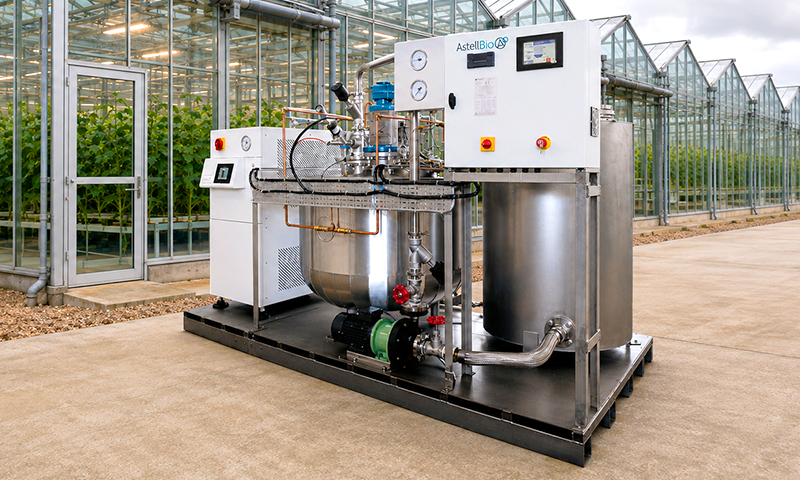
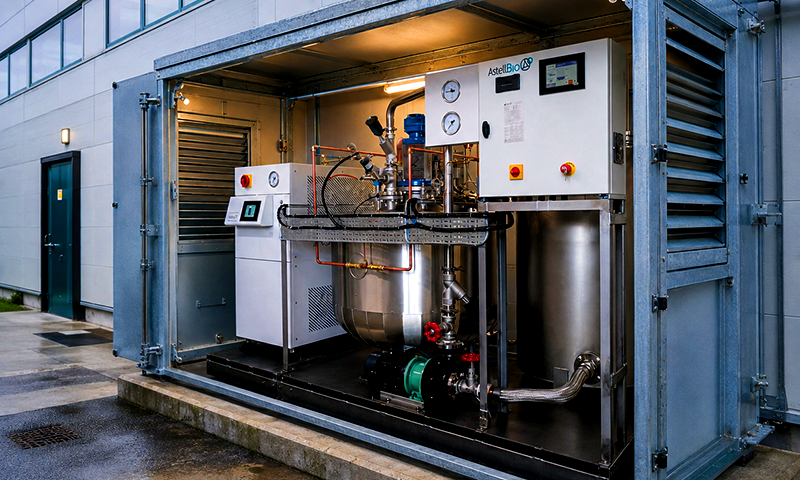
Astell designed and delivered a single-tank EFF350H batch effluent decontamination system, sized to the glasshouse’s daily output rather than to a generic off-the-shelf standard.
How it works
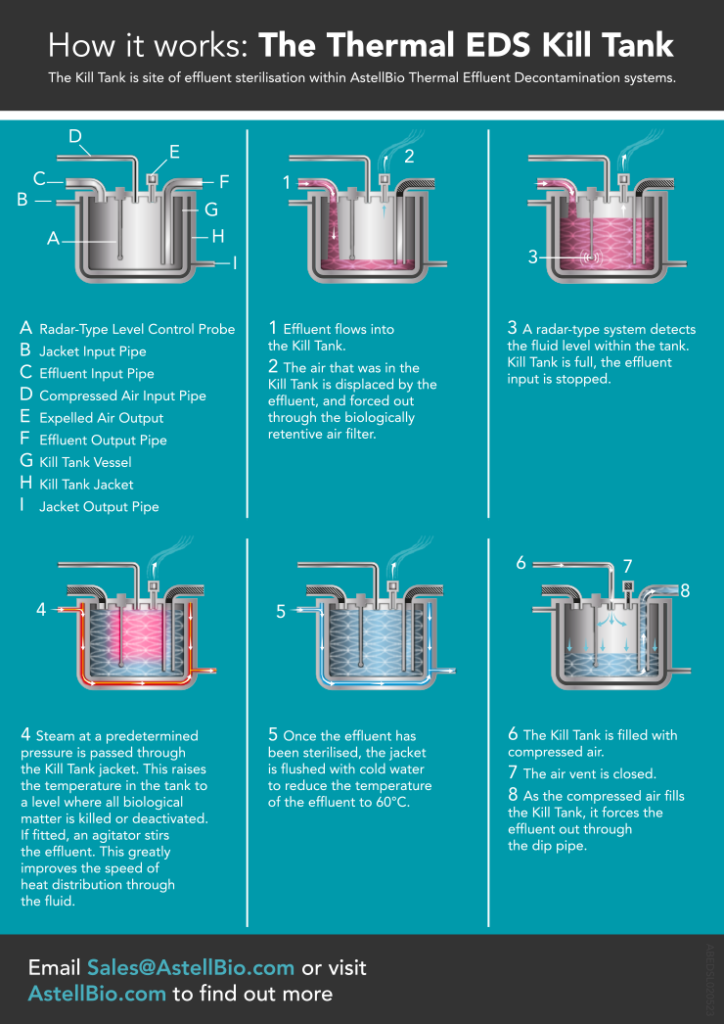
Effluent collects in a 600-litre holding tank, then transfers in measured batches into the 350-litre sterilising vessel, where it’s heated, held at temperature — 121°C for 15 minutes in day-to-day use, with the vessel built to run as hot as 135°C should it ever be needed — and cooled before discharge. The controller records every cycle and will not release a batch unless the required temperature and hold time have both been met. If a sensor fails mid-cycle, the unit holds at that stage rather than pressing on: a fault halts the process, it never bypasses it.
Engineering collaboration and delivery
Astell’s team qualified the requirement in detail before quoting — confirming feed arrangements, temperatures and steam supply — then visited site with its Area Sales Manager and Technical Director to confirm the vessel would physically fit the space allocated to it. That visit led to a revised proposal sized to the site rather than a compromise.
When it turned out, partway through installation, that compressed air wasn’t available where the unit needed to sit, Astell supplied a compressor at no extra cost so the project wouldn’t stall. A sample port was also added during commissioning so the institute could draw its own samples and run independent microbiological checks, rather than take performance on trust.
Outcome
The institute’s plant health inspectors signed the system off for operation, satisfied not just that it worked, but that a single sensor failure couldn’t quietly let untreated waste through. The relationship didn’t end there either — the institute returned to Astell for further equipment in the years that followed.
Why it matters
Research into how plant pathogens interact with their hosts, and how crops resist disease, continues to inform the wider understanding — and control — of crop disease. None of that research can happen inside containment without a dependable way to treat what comes out the other end, which is the quieter, less glamorous half of the story this project was really about.
- *I have permission from the copyright holder to publish this content and images.
Related Posts
More to Harvest: Why the Difference Starts Earlier than You Think

Netvion: Greenhouse automation for OEMs, integrators, and growers
Inside JEPCO’s sustainable shift to indoor leafy salad production

Free webinar: pathways to commercial-scale vertical farming
Sterilising the waste before it leaves the building