Norfolk based Gravitilab Aerospace Services closes its £500k Bridge round with significant over-fund

Member News
The views expressed in this Member News article are the author's own and do not necessarily represent those of Agri-TechE.

Gravitilab has raised more than £900k during the last quarter, including one investment from an ACG member, and is now embarking on a new £5mil Series A round.

Gravitilab, based at the Scottow Enterprise Park just north of Norwich, is a SpaceTech business that provides Research, Testing and Qualification services, specialising in microgravity and Space environments. Its customers come from a wide variety of sectors including Commercial, Academic and Government. In the Anglia region there is particular interest from AgriTech, BioTech, Engineering, and ClimateTech industries.

“It’s not everyday that we see a pitch which involves launching rockets! Gravitilab have seen excellent growth since inception in 2019 and is a fantastic example of the exciting innovation which we’re proud to see coming out of our region.” Hannah Smith, Managing Director, Anglia Capital Group.

In an exciting development, Gravitilab recently achieved a “world first” with the launch of its commercial microgravity service using its patented LOUIS UAV / drone technology. This was the first time that a UAV drop-pod has been used to generate a microgravity environment and paves the way for widespread commercial use across industries as diverse as cosmetics and satellites.

Gravitilab’s technology solutions are set to disrupt the existing institutional market for research and testing (which remains dominated by legacy technology), but with safer and more affordable services available at much shorter notice it is also opening up new avenues within the £65bn UK R&D industry.

“We are delighted to have overfunded to such an extent last year and been able to successfully launch our microgravity service last month. We now look forward to raising £5mil from venture funds in order to complete the development of our hybrid suborbital rocket and roll out our full suite of commercial services.” James Kilpatrick, Founder, Gravitilab Aerospace Services.

In addition to making microgravity and Space environments so much more accessible Gravitilab is also on a mission to improve Sustainability in Space. Its hybrid rockets are initially set to reduce launch emissions by 75%, and it hopes to be carbon neutral before long as it is developing a new rocket fuel based on beeswax in conjunction with a leading Norfolk apiary. What is more the advent of more rigorous testing regimes, which the company can facilitate, will substantially help to reduce the build up of debris in Space.

Don’t invest unless you’re prepared to lose all the money you invest. This is a high-risk investment, and you are unlikely to be protected if something goes wrong. Take 2 mins to learn more. Investor Risk Warning – Anglia Capital Group

Gardin and Boxford Farms Partner to Improve Commercial Glasshouse Crop Performance

Member News
The views expressed in this Member News article are the author's own and do not necessarily represent those of Agri-TechE.

Glasshouse Innovation

Gardin has partnered with Boxford Farms to showcase its innovative technology that helps commercial glasshouse growers monitor their crop’s health, reduce variance across the farm and increase yield. As part of their ongoing partnership, Gardin and Boxford Farms have collaborated to monitor the health of commercially grown strawberry plants using Gardin’s innovative technology, demonstrating it’s potential to drive performance improvements for glasshouse growers.

Addressing Variability

A key challenge for commercial glasshouse growers is microclimate variability within the same greenhouse zone, which leads to non-uniform distributions of temperature, relative humidity, carbon dioxide concentration, and irradiation. This heterogeneity creates problems for crop growth, production, and quality. Gardin’s technology provides easy to read, actionable insights through measurements of photosynthetic performance, which are highly sensitive early indicators of stress, providing farmers with a way to monitor their crop’s health in real-time.

Positive Results

The collaboration, conducted in partnership with award-winning, British fruit farm Boxford Farms, involved the monitoring of the grower’s strawberry plants in two areas of their commercial glasshouse – the historically best and worse yielding areas. Gardin’s monitoring system detected immediate differences in plant health between the two areas, with the lower yield area seeing a continuous deterioration in health, while the higher yield area maintained a steady health status.

“Our technology’s ability to detect these differences in plant health and provide real-time insights to farmers is what sets it apart,” said Dr. Steven Grundy, Senior Plant Scientist at Gardin. “The trial results show a promising positive correlation between the change in plant health and the yield of the strawberries, demonstrating the value of our technology in improving crop health and boosting yield.”

Mike Marita, Boxford’s Farm Manager said:

“We have noticed before that plants in certain areas of our glasshouse were getting stressed, but it was difficult to know exactly when or what was going wrong. The Gardin solution allows us to see decline in health in real-time and well before it becomes visible. This in turn allows us to adjust our growing strategy and farm operations. The correlations between Gardin insights and yields were very promising, and we hope they will allow us to optimise performance next season […]”

A Fruitful Partnership

Gardin is delighted to continue its partnership with Boxford Farms into 2023, monitoring strawberries throughout their growing season. This partnership will help Boxford optimise farm performance and further demonstrate the company’s commitment to improving crop health and yield for commercial glasshouse growers.

Slugs sought for feeding trials

Member News
The views expressed in this Member News article are the author's own and do not necessarily represent those of Agri-TechE.

A farmer-led research project exploring new ways to manage slug damage is seeking ‘Slug Scouts’ who will trap and send in slugs for feeding studies.

Farmers across the UK are being encouraged to capture grey field slugs and send them in to John Innes Centre in Norwich for what is claimed to be a “ground-breaking” scientific study taking place early this spring.

The scientists are hoping farmers will harvest around 1000 slugs from their fields. These will be used for feeding trials just getting underway at the John Innes Centre Insectary.

The project, led by the British On-Farm Innovation Network (BOFIN), aims to gauge how palatable a range of different wheats are to slugs, and help farmers move away from a reliance on chemical control measures and the potential environmental impact of those chemicals.

It follows initial studies that indicated one landrace wheat, known as Watkins 788, may be resistant to the slimy pests, that cost UK arable farmers £100M every year.

“Slugs are UK arable farming’s most damaging pest,” notes Oxfordshire farmer and BOFIN founder Tom Allen-Stevens, who co-ordinates farmer involvement in the project. As they get active again this month, rather than let them graze on our crops, we’re keen for farmers to join our group of ‘Slug Scouts’, who will trap the pests and send them in for this important study.”

Setting up a ‘slimery’

The Slug Scout volunteers will be provided with a pack, including containers and postage-paid envelopes, as well as instructions on how to set up an effective ‘Slimery’.

“This is what you use to attract and trap your slug population that you can then harvest periodically – it’ll want to be in the most slug-infested spot of your farm,” explains Tom.

The trials are part of a wider project that aims to explore the palatability of wheat and the grazing behaviour of slugs, with the aim of identifying a possible slug-resistant trait for the development of future varieties.

Watkins 788 is one of a collection of landrace wheats currently being screened for interesting traits by scientists working on the Defra-funded Wheat Genetic Improvement Network (WGIN) programme.

“The initial feeding trials showed Watkins788 was consistently spurned by slugs,” explains Dr Simon Griffiths of John Innes Centre who leads the research. “So we multiplied up enough of the variety for farmer-led trials that took place on farms across England over the autumn and winter.”

These were conducted by Slug Sleuths, 10 BOFIN farmers who followed an in-field trial protocol drawn up by slug behaviour expert Professor Keith Walters of Harper Adams University.

Results are currently being assessed and are due to be published next month at a webinar taking place on 16 March 2023.

“The feeding trials will repeat the initial trials and then look in more detail at how slugs graze – whether it’s the Watkins seed or young shoots they tend to spurn, for example,” continues Simon. “We also now have 84 RILs (Recombinant Inbred Lines) of Watkins 788 crossed into Paragon, a more modern wheat, and we aim to screen these for palatability which should allow us to select more precisely for resistance.

“And there’s an elite line – a cross of KWS Santiago and Graham – that we believe may have a special quality. So we’re testing this in the feeding trials for the first time,” he adds.

How to get involved

The Slug-Resistant Wheat project is a farmer-led study that started in April 2022. Co-ordinated by BOFIN, anyone can join for free and get involved in the Slug Circle – a group of around 60 farmers and scientists who have come together to explore alternative forms of slug control and who have helped shape the project as it progresses.

“The field trials, that we intend to repeat this coming autumn, are essential to finding out whether there truly is a slug-resistant trait,” says Tom “The lab-based feeding trials will inform what we put in the field and the urgency now is to collect enough slugs to explore thoroughly how they feed. So we’re really keen for farmers to volunteer as Slug Scouts, collect the slugs and send them in.

“But it’s not just about the trait – we have learned so much already that the Slug Sleuths will be sharing with members of the Slug Circle over the coming months. We want this farmer-led voyage of knowledge discovery to help build a more resilient and sustainable approach to managing slugs in future that moves away from our current over-reliance on chemical control.”

The Slug Resistant Wheat project is a one-year study, led by BOFIN and is supported through a contribution by the Environment Agency as part of its Environment Programme. This supports partner-led projects as part of a Catchment Based Approach to improve the chemical and ecological quality of waterbodies.

Driven and steered by the farmers themselves, at the centre of the project are the 10 Slug Sleuths, who carry out the on-farm trials with genetics expertise provided by Dr Griffiths, and seed multiplied up by JIC at its Dorothea de Winton Field Station, Norwich. Trial protocols were drawn up by Prof. Walters of Harper Adams University who has provided additional insight on slug behaviour.

The feeding trials are the final, new element of the project and will involve the volunteer Slug Scouts who will gather slugs from the field and send them in for lab-based feeding studies. These are conducted by Victor Soria-Carrasco and the team at the John Innes Centre Insectary.

To find out how to become a Slug Scout, join the Slug Circle and for details of the webinar on 16 March, visit www.bofin.org.uk or email info@bofin.org.uk

Perennial inspiration from the TMAF annual meeting

Member News
The views expressed in this Member News article are the author's own and do not necessarily represent those of Agri-TechE.

TMAF demonstrated again at its annual meeting how it maintains its role at the heart of agricultural development. Illustrations of the research it is supporting was combined with discussion of key current issues such as measuring farming’s real carbon footprint and asking what the science of regeneration actually looks like.

An audience of over 50 East Anglian farmers, advisors and other agri-professionals gathered to hear the afternoon of talks and debate. For, while field walks and online talks are one way to feel the pulse of the current challenges, there is nothing as satisfying or as inspiring as hearing research updates and perspectives in person from those at the forefront of discovery.

Trial and tribulation

Whether or not virus yellows disease becomes an issue for the region’s beet crop in 2023 remains to be seen. The extraordinary weather and the beet moth infestation in 2022 certainly posed challenges for the research underway at Morley to test varietal resistance to these yield-damaging infections, according to Suzannah Harder.

Suzannah’s TMAF-supported research is well underway, as she has reported recently. She shared the trials (and tribulations) of rearing six variants from three strains and the aphids to inoculate them into her sugar beet plots at Morley. “No-one else I know has put six variants of disease into a beet field trial. It is very stressful but very rewarding.

I have found significant differences between varieties’ in-bred resistance, and adjusted yield tonne/hectare from the harvested crop, and is making me think we have to make changes to a strain, such as BBRO BMYV that have been kept and multiplied for years now. It might have gone a bit ‘soft’ and should be replaced with a strain more akin to the wild strains, such as I received into the lab in my ‘bouquets’ of infected beet leaves sent to me.”

No longer in a state of flux

oon there will be new structures appearing in Morley fields. BBRO’s Dr Georgina Barrett is the driving force behind the new TMAF-supported project to assess the carbon dynamics in sugar beet. The means to measure the carbon emissions will be two flux towers. As wind pockets flow across the fieldscape, the instruments capture samples and, through “clever maths by CEH” will give information on COproduction.

Dr Barrett explained that this will happen over the farming year with sugar beet from bare soil, through drilling and the full season of growth. “This is a long period to measure capture or release of carbon. Also, what is novel about the plan here at Morley is that this trial will just focus on sugar beet. What’s more we will have two flux towers to be able to compare management systems.”

It is recognised that there could be a push to reach net zero for sugar beet and the research at Morley could provide the data to show what is possible. “The data from this work could help British Sugar with carbon mapping, guide growers with the best practice to reduce greenhouse gas emissions, contribute to wider soil health objectives and add value to UK grown sugar in the supply chain.”

Regenerating research along same lines

Contributing to the science of regenerative farming was the topic addressed by the final TMAF annual meeting speaker, Niab CEO Mario Caccamo. He began by stating that food production must undergo a transformation in order to tackle the multiple challenges of producing enough food, restoring biodiversity and averting climate change.

“In 100 years of Niab’s work” he said “we have worked on the same issues and crises. Our priority areas remain crop improvement (with gene editing and precision breeding), new farming systems and getting crop perfomance data.” He also says he advocates the production of tools to. make measuring easier, such as with Niab’s Soil Health cards.

Making change

For John Wallace, the TMAF annual meeting was his last as Chair. For his seven years of leadership he was thanked and presented with a silver platter. Longtime trustee Philip Richardson, also retiring, was also presented with a gift.

In his acceptance of the engraved platter, John announced that his successor will be Richard Wilbourn, assisted by new Deputy Chair Sue Lord. He also took the moment to reflect on how, since he very first visited Morley as a young Suffolk farmer, he has continued to be inspired by the evidence from the TMAF research at Morley of what good agricultural practice can be. On such foundations and with the outlined expectations TMAF’s next year will be a positive one.

What is the Relationship Between Organic Farming and Vertical Farming?

Member News
The views expressed in this Member News article are the author's own and do not necessarily represent those of Agri-TechE.

Once seen as a silver bullet for sustainable and food production, sales of organic produce have fallen by 2.1% over the past year and research has shown that if countries like the UK were to go fully organic it would increase greenhouse gas emissions and reduce biodiversity.

In opposition to this trend, the market for controlled environment agriculture has been steadily increasing and is predicted to exceed £9 billion worldwide by 2026.

Whilst vertical farms do not grow in soil, they do allow for dramatic reductions in water use and can completely cut out pesticide use and food waste. Many vertical farms suggest that their produce should be considered organic

In this article, we review why produce grown in vertical farms doesn’t qualify as organic and look to some of our clients to see some of the reasons it should or shouldn’t be.

According to UK and EU law, fresh produce can only be considered to be produced organically if the farm is registered with an approved control body, such as Organic Farmers & Growers or the Soil Association and must undergo regular inspections to ensure they meet their standards.

Standards such as using non-GMO seeds, the responsible use of resources, maintenance of biodiversity, and the maintenance of local water quality.

Crucially, to be classified as organic, produce must be grown in soil and be part of a sustainable effort to manage soil quality. As a result, anything grown using hydroponics or aeroponics as is the case with vertical farming can’t be classified as organic.

The Overlap Between Organic and Vertical Farms

Despite this many vertical farms suggest they meet many of the other standards needed to be classified as organic.

  1. Firstly, because crops are grown in a sterile controlled environment, the risk of contamination is significantly lower compared to all existing alternatives, thus vertical farms don’t need to use pesticides or herbicides. It is to note that organic produce may still contain some pesticides but in quantities that are below thresholds set by the industry body.
  2. Secondly, as factors affected by ecosystems such as atmosphere, animals, bacteria, or soil quality are negligible in vertical farms, there is little reason to use genetically modified seeds as non-GMO as heritage seed varieties can thrive without these external stressors. There is however a vibrant research community that is looking at optimizing the cultivars and varieties for this new growing environment.
  3. ertical farms have a range of advantages when it comes to the use of natural resources compared not only to traditional farms but also to organic farms. They can use up to 95% less water than traditional farms due to their ability to recycle it. Using state-of-the-art LED lights like Kroptek’s range of LEDs allows for considerable gains in energy efficiency, resulting in lower energy use. Vertical farms have a much smaller land footprint relative to their yield, so they use far less land to produce more food. Finally, vertical farms free the supply chain from having to grow in specific locations as food can be grown within a walking distance from its consumers in urban areas for 12 months a year. This has a very big impact on reducing the food chain’s carbon footprint as it eliminates the need to transport refrigerated produce across thousands of miles.

Whilst not allowed to be classified as such, these regulations are not identical globally.

Under the Singapore Standard 632 introduced in 2019, produce grown in urban vertical farms can be classified and sold as organic. That means the produce grown using Kroptek’s LEDs by vertical farms like this can be deemed organic.

The Organics of Tomorrow

It is unlikely that the classifications in the EU or UK will change anytime soon to reflect the type of classification on offer in Singapore. But there is a lot the vertical farming industry can learn from the experience of the organic farming industry.

Crucially, both movements are driven by the mission to create a more sustainable food system that is better for the consumer than the modern intensive farming techniques developed in the second half of the 20th century. Whilst sales of organic produce have fallen over the past year since the movement began many of the principles of organic farming have been integrated into conventional farming methods. Using fewer pesticides, monitoring water maintenance, and improving biodiversity on farms has become common practice for many farms.

With greater awareness of the benefits and the methods of organic farming, its popularity soared over the last 30 years.  It is clear that the lesson to learn from organic farming is that increasing public awareness of the role vertical farms can play in climate-orientated efforts is key. From reducing air miles, localising food production, and improving food security, to being able to grow regardless of climate and extreme weather conditions; boosting public awareness of the value of vertical farms is a key lesson to be learnt from organic farming.

If you’re interested in how Kroptek supports local and urban indoor farms as part of the larger mission to develop a more sustainable food system, get in touch with one of our experts today.

Diversity of thought in agri-tech innovation

Member News
The views expressed in this Member News article are the author's own and do not necessarily represent those of Agri-TechE.

9 February 2023

Highlighting the work of female innovators working on the transforming food production challenge of feeding a growing world population in a changing climate.

In the last couple of years, the aftermath of the COVID-19 pandemic, as well as recent climate, food and energy crisis have caused current global challenges to be exacerbated. As a result of this, we have experienced drastic changes within our economic sectors and their supply chains. The agricultural sector has been undergoing change to address these emerging issues. However, these growing problems also open up new opportunities for innovation in the sector.

Innovation and more innovation

Innovation in agri-tech is important to help increase the resilience of the sector and address the challenges we’re facing. This includes finding new and sustainable solutions to:

  • produce food
  • improve animal welfare
  • reduce emissions and pollution
  • deal with rising energy costs

All this, while meeting the challenge of feeding a growing world population in a changing climate. New ideas, technologies, and the adoption of these solutions, are going to be key for both the immediate and near future. Innovation in the sector requires diversity of people as well as diversity of thought to realise these ambitions.

Dispelling the stereotype

In the past, the sector has been widely considered to be an older male-dominated industry. When you look at this from an outside perspective, onlookers might feel like one has to conform to the stereotype to fit into agriculture, but this really isn’t true and there is already great talent, from a range of backgrounds, within agri-tech right now.

Trail-blazing women in agri-tech

Last summer we released a series of videos featuring some of the founders and pioneers we have worked with as part of the transforming food production (TFP) challenge. Among them were several women working on tackling sustainability, productivity, and resilience of the UK food sector through their innovations and businesses.

View the ’meet the pioneers’ playlist on YouTube.

There are lots of exciting technologies and changes happening within this sector. Women in agri-tech have a large role to play in challenging the gender stereotype of what a typical person working in this sector looks like.

Within the TFP team, we wanted to shine a light on the diversity that exists across our current project portfolio. So after speaking to our female innovators to understand their journeys into the sector, we put together a video of our 4 leading innovators. Here they share their journey and provide valuable advice to anyone interested in a career within the sector.

The TFP team, is also looking at what more we can do to help support greater diversity within the agri-tech sector. We have seen that some of the best solutions to the challenges we’re facing initiate via creative thinking from individuals from a diverse range of backgrounds and cultures.

Embracing diversity within the innovation process will be critical to develop solutions that tackle the biggest and most pressing challenges we will face in the coming decades, such as food security and climate change.

The TFP challenge is delivered by Innovate UK.

Tiptree partners with Antobot to deliver affordable robotics for sustainable fruit production!

Member News
The views expressed in this Member News article are the author's own and do not necessarily represent those of Agri-TechE.

We’re thrilled to announce our partnership with Wilkin & Sons Ltd, you might know them as Tiptree, the historic jam and conserve producer based just next door to us in Essex!

Wilkin & Sons Ltd started growing fruit in the 1700s with their jam and conserve business dating back to 1885. Since then, the company has gone from strength to strength, acquiring several well-respected brands, opening tea rooms in Essex and beyond, all whilst maintaining their 850 acres of top grade fruit. Receiving Royal recognition with a visit from Her Majesty Queen Elizabeth II to mark the anniversary of 125 years of their jam-making, Tiptree is the best-known jam business in the UK and one of the most iconic producers worldwide.

Now sharing ownership with their employees, the team at Tiptree are striving to keep their products high quality and increasingly sustainable. They are dedicated to innovation such as through irrigation systems with reservoirs built on site and installation of the first New Growing Systems in the UK in 2016 which involve movable suspended platforms for strawberries.

Our team visited their site this Wednesday to discuss our collaboration for 2023. After enjoying some warm freshly made scones with their iconic strawberry jam, we learnt all about Tiptree’s history and enjoyed a tour of their facilities including their innovative growing and irrigation systems.

“We’re excited about getting the Antobot team working on site here at Tiptree with their robots. We look forward to the innovations which this collaboration will bring.” – Andrey Ivanov, Farm Manager Tiptree

“We are looking forward to working closely with the team at Tiptree as an iconic British brand and brilliant innovator in horticulture. We can’t wait to see how this partnership can strengthen robotics and automation for the fruit sector.” – Howard Wu, CEO & Founder Antobot

Thank you to Andrey, Veso and Rado for the warm welcome and we are looking forward to a jam-packed year of activities on farm!

You can read more about Tiptree, its history (from 1757!), its ethos (sustainability and innovation!) and much more here on their website

Group of people standing in front of a sign for Tiptree
Group of people walking outside in poly tunnels
Scone with Tiptree strawberry jam

Grants4Ag – Bayer funding and testing initiatives

Member News
The views expressed in this Member News article are the author's own and do not necessarily represent those of Agri-TechE.

Bayer have two cyclical schemes open to anyone to apply for. First introduced in 2015, the initiative has since evolved to offer researchers financial and scientific support to develop ideas for novel solutions across all research and development areas in the Division of Crop Science. Current deadline for submissions is 31st March 2023, but subsequent rounds on different themes will likely be open for applications.

“Our previous Grants4 programs succeeded in attracting top proposals in targeted niches – particularly biotech traits and biologicals,” said Phil Taylor, Open Innovation Business Partner for the Crop Science division. “The new Grants4Ag model expands the reach to a greater number of potential applicants, and therefore more diverse innovations.”

As with previous Grants4 programs, there are no formal reporting requirements and applicants retain ownership of any intellectual property developed. Taylor says the company views these grants as an initial investment with the potential to become larger-scale, longer-term collaborations with Bayer.

Topics can include Plant Breeding, Crop Protection, Biotechnology, Digital Farming and Data Science although there are other opportunities on occasion.

About Bayer
Bayer is a global enterprise with core competencies in the life science fields of health care and nutrition. Its products and services are designed to benefit people by supporting efforts to overcome the major challenges presented by a growing and aging global population. At the same time, the Group aims to increase its earning power and create value through innovation and growth. Bayer is committed to the principles of sustainable development, and the Bayer brand stands for trust, reliability and quality throughout the world. In fiscal 2019, the Group employed around 104,000 people and had sales of 43.5 billion euros. Capital expenditures amounted to 2.9 billion euros, R&D expenses to 5.3 billion euros. For more information, go to www.bayer.com

For more information and to apply, please visit the company pages.

App to digitalise potato crop performance

Member News
The views expressed in this Member News article are the author's own and do not necessarily represent those of Agri-TechE.
Updated version helps growers.

CROP4SIGHT has announced the launch of an updated version of their web and mobile app, designed to make it easier for potato growers and agronomists to access, and view, potato crop performance on the go.

The latest version of the app makes it easier to use all data that is collected throughout the growing season, while out and about – making it easier to make agronomic and commercial decisions.

Additionally, there is now a module for growers to compare and benchmark their crop performance against anonymised data describing performance of other crops planted at similar times.

Senior Agronomist Fiona Law-Eadie said: “Realistically growers and agronomists don’t spend that much time in front of a computer, especially not when the season gets busier. The latest version of the mobile app gives you easy access to the crop insights you need, to make management decisions on the go.”

Content continues after advertisements

Having a tool to monitor crop performance throughout the season, and therefore confidently forecast yield and performance, is crucial for mitigating risk for the farmer.

“For example, if emergence is a week earlier than expected but you have a set lifting date, this could mean the crop has a 7 to 10 days extra growing period and will likely require changes to crop management plans (e.g. earlier burndown) to maintain the optimum commercial yield of the crop,” Fiona said. “This can be problematic for growers working to contract specifications.”

Mrs Law-Eadie also explains that, currently, there are no other platforms which allows growers and agronomists to compare potato crops, despite it being a crucial element for forecasting marketable crop yields.

“Benchmarking helps growers determine how ahead of the game they are in the growing season, compared to other potato farmers across the country – helping to assess the options available depending on predicted yield and lifting time.”

YEN shows new world record cereal yields are sustainable, profitable and inspiring

Member News
The views expressed in this Member News article are the author's own and do not necessarily represent those of Agri-TechE.

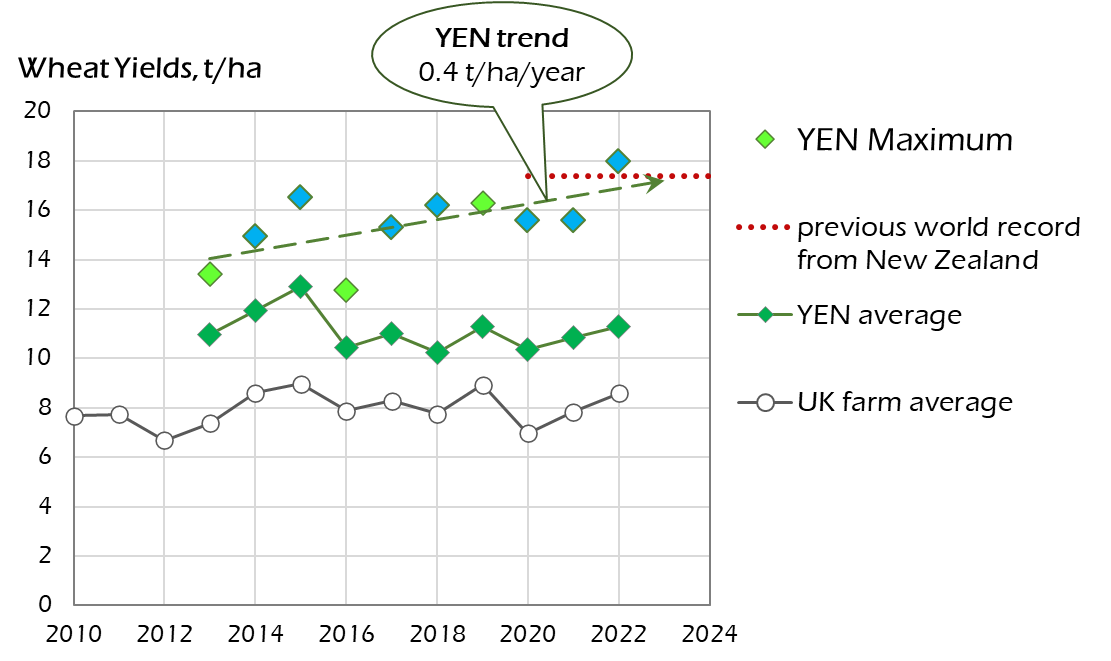
It’s news across the world – the biggest wheat crop ever grown, yielding 18 tonnes of grain per hectare[1]! This is fantastic, and laudable in all respects, but it’s no accident. Tim Lamyman has grown high-yielding crops for many years, and throughout, he has been a member of the Yield Enhancement Network – or YEN – which celebrated its 10th birthday last week. The YEN provides Tim – and many other farmers in the UK, Europe, and now in North America – with detailed intelligence about each of their crops, including crop structure and nutrition, so Tim and all YEN members can learn how to do better from year to year.

YEN yields

Figure:     Tim Lamyman’s YEN yields (blue diamonds) have set the standard in seven of the 10 years since the YEN started. 

In 2022 Tim achieved not only the Guinness World Record for wheat but also the Guinness World Record for barley at 16.2 tonnes per hectare[2], and his oilseed rape crop would also have broken records if an authority existed – 9.0 t/ha, after accounting for its oil content.

The YEN has come to understand that Tim’s achievements over the past decade arise from a combination of his soils, his farm’s climate, and most importantly, the intensity of his thinking and management. This doesn’t mean huge expense on seeds, fertilisers and sprays; it means intensive appreciation of and attention to his crops’ needs, and frequent treatments so that his crops experience a minimum of setbacks. Tim has described how he grew each of his crops below.

Tim’s crops belie the common suspicion that large yields require large inputs. Tim knows his main inputs are light energy and water which come free if his crops can capture them. Whilst YEN doesn’t study economics, Tim’s reported inputs in the YEN’s database indicate that his world record crop must have achieved a 60% greater financial margin than the average YEN crop (which yields 11 t/ha), and double the margin of the average UK wheat crop (which yields 8 t/ha). Furthermore, the Nitrogen Use Efficiency of his wheat crop (at 57 kg grain produced per kg N applied) was better by 8% than the average YEN wheat crop and 35% better than the average UK wheat crop.

To sum up, Tim’s dedication, and his engagement with the YEN, have enabled all YEN members and sponsors to truly appreciate this world-beating achievement. It is not just a biological marvel, but also an exemplar for successful high-performance farming worldwide. Such high-performance crops produce more food from the same amount of land (dubbed ‘land-sparing’), they make more profit, and they use scarce or polluting resources more efficiently. It remains to be seen, but all the evidence indicates that they also fix more carbon into the soil and leave that soil better able to absorb over-winter rainfall and so reduce flooding.

YEN data show that yields of 14 t/ha are possible almost anywhere in NW Europe, and its mission through the next ten years will be to help as many farms as wish it, to achieve as close to their potential yields as Tim does.

[1] = 267 bushels per acre

[2] = 241 bushels per acre

Agricultural policy: where have we got to in England?

Member News
The views expressed in this Member News article are the author's own and do not necessarily represent those of Agri-TechE.

The agricultural transition period in England means a seismic shift in agri-environmental policy, away from the legacy of the EU Common Agricultural Policy and towards a brave new English future focused on Environmental Land Management (ELM). So, one year into this seven-year transition period, where have we got to?

MORE MONEY FOR COUNTRYSIDE STEWARDSHIP

At this year’s Oxford Farming Conference (OFC), Secretary of State George Eustice announced that Defra is increasing current and future payment rates for Countryside Stewardship (CS). On average, rates will be increased by 30 per cent. In reality, only some CS options will increase, some will remain the same and some may drop in 2023.

Existing agreement holders will be paid based on the new rates for options where the rate has increased. There is a clear drive from Defra to make CS as attractive as possible in order to encourage more land managers to put in applications. CS is intended to be the ‘bridge’ from the old to the new schemes.

SUSTAINABLE FARMING INCENTIVE: SOMETHING FOR EVERYONE?

The Sustainable Farming Incentive (SFI) is the part of ELM that Defra has shared the most specific information on, it will pay for actions that relate to farming activities and create environmental benefit.

The types of action the SFI will fund include soil management plans, growing green cover crops over the winter, and establishing herbal leys. Currently, farmers can receive between £22 per hectare per year and £58 per hectare per year, depending on the level of SFI standard they choose.

The scheme will be open to all who are currently eligible for the Basic Payment Scheme (BPS). The first application window opens this year and payments will be made before the end of 2022.

LOCAL NATURE RECOVERY: A CONTINUATION OF COUNTRYSIDE STEWARDSHIP

Local Nature Recovery (LNR) is the second element of ELM, and it is focused on paying for locally targeted actions to ‘make space for nature’ within the farmed landscape and the wider countryside.

LNR will be the ‘improved and more ambitious successor’ to the CS scheme. It will pay for things like habitat creation, species protection and woodland creation. Defra wants it to reward collaboration on nature recovery projects, but we don’t know how it intends to do that yet. The scheme will be available to all rural land managers by the end of 2024. Farmers are supposed to be able to sign up to both LNR and SFI, so long as it isn’t double funding the same activity. 

LANDSCAPE RECOVERY: LARGE-SCALE AMBITIONS

This is the most environmentally ambitious part of ELM and is intended to deliver long-term, large-scale ecosystem recovery projects. The scheme will be open to applications from sites of 500–5,000 hectares. Applications can be made by individual land managers as well as collaborative groups. Each project will have bespoke payment rates that are negotiated during project development.

Defra wants to pilot up to 15 Land Recovery projects between 2022 and 2024 which it hopes will deliver over 20,000 hectares of wildlife-rich habitat.

HOW IS DEFRA DOING?

At the OFC, George Eustice reminded the audience that the agricultural transition is an ‘evolution not a revolution’ and that he hoped he had ‘been able to articulate a clear path that we have towards our final destination’.

However, at the same time, a House of Commons committee report heavily criticised the ELM proposals for lacking detail, being based on ‘blind optimism’ and not fully quantifying the impact rural land use change will have on the UK’s food security. The proof will most likely be in the pudding.

IS IT ENOUGH?

There has clearly been a lot of activity from Defra in the past year – this blog doesn’t even touch on the new productivity and capital grants schemes – but that does not necessarily make up for the BPS income reductions that farmers are now experiencing.

It is important to remember that ELM doesn’t offer a replacement for BPS. ELM is paying farmers for managing their land in new ways – unlike BPS, there will be costs involved. To make up for that lost income, the opportunities of emerging private markets are tempting, and it is good that Defra doesn’t want to ‘crowd out’ private finance. But how exactly it will make sure of this is less clear.

One thing is certain: there is a lot of new information for land managers to get to grips with. And that’s before we’ve even touched on the Environment Act and things like Biodiversity Net Gain and Local Nature Recovery Strategies. It can seem quite daunting, but our advice would be to think innovatively, positively and possibly even collaboratively in order to make the most of these new funding opportunities.

FURTHER INFORMATION

Contact  Molly Biddell 

Savills Rural

New officer team for Fram Farmers

Member News
The views expressed in this Member News article are the author's own and do not necessarily represent those of Agri-TechE.

Fram Farmers, the Suffolk-based input purchasing and crop marketing co-operative, has a new chair and vice chair following its annual general meeting in November.

Wendy Houston moves from vice chairman to become chairman of the company, succeeding Suffolk farmer and haulier Andrew Read who has completed a three-year term. As well as running the family 1,100 acre arable and pig farm, she is a director of MPS Agri, the international electronic sow feeding business.

At the same time, Doug Inglis – a board member since 2020 – becomes vice chairman. A former director of the Velcourt corporate farming business, Mr Inglis now runs his own arable business and agronomy consultancy.

“I aim to ensure the co-operative continues to be best placed to serve members in navigating the challenges both arable and livestock members face, and to prosper in the years to come,” says Ms Houston.

Earlier in the year, Fram Farmers appointed Michael Muncey, former UK managing director of Bayer Crop Science and David Sheppard, former managing director of ADM Agriculture to its board, together with farmer directors Mark Williams and Frans de Boer.

“Farming is undergoing a period of unparalleled change, challenge and opportunity – the new board membership will deliver strong, critical and demanding leadership to Fram Farmers,” adds Fram Farmers chief executive Andrew Knowles.

“This will enable us to continue to evolve and strengthen our performance to members, whilst remaining faithful to the values of the cooperative, and ensure our performance is unparalleled with leading commercial agribusinesses in an increasingly competitive marketplace.”