Horizon scanning at the AHDB
 Agri-TechE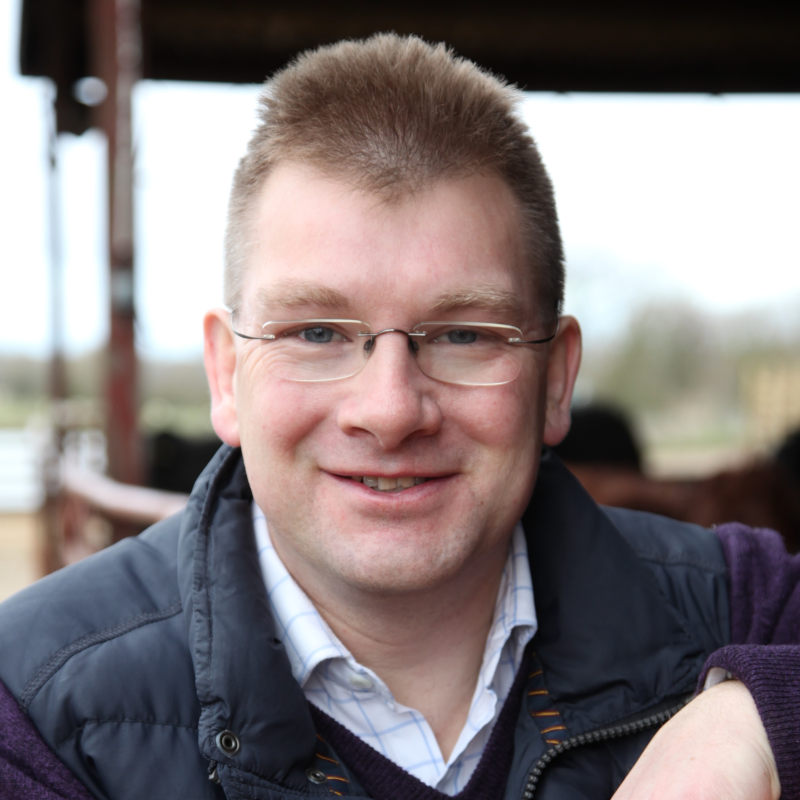
Mike Gooding is the Crop and Livestock Services and Farming Systems Director for AHDB. A farmer by background, he joined the AHDB a year ago, after a turbulent period in the levy board’s history, which has seen two sectors leave the board.
With the new CEO Graham Wilkinson at the helm, and AHDB focused on delivering levy payer value, Mike’s focus is to bring a more holistic, systems-based approach to food production.
Levy payers are a diverse group including farmers in different sectors and processors such as abattoirs, millers, and maltsters, while there are many and varied stakeholders right across the industry.
We talked to Mike about the role of AHDB and his thoughts about the future.
A farmer at heart
Mike explains: “It’s a lengthy title, but what I am actually responsible for is the genetics, breeding and research of both crops and livestock, animal health and welfare, and much of AHDB’s research activities.
“I’m a farmer by training, and at heart, and have spent many years working alongside researchers and developers. My aim is to try and bridge that gap that between research and practical reality, to bring new thinking about how those things fit together, rather than sitting in defined silos.”
Horizon scanning
AHDB’s focus is four sectors: beef and lamb, dairy, pork, cereals and oilseeds. It collects a levy from operators in those areas and each sector has its own Council, which, in consultation with levy payers, determines the priorities for its sector.
Part of the remit of AHDB is horizon scanning, providing customer and market insights and an independent evaluation of what is being developed for, and supplied to, the industry.
“We are looking at where we think priorities need to lie, and where the sector councils might want to invest levy money, and that varies from sector to sector,” Mike continues. “For the livestock sectors the emphasis is on marketing activities, to ensure that as buying behaviours change, production is meeting customer needs and aspirations.
“Across cereals and oilseeds, the focus is more on research and pre-farm-gate technical improvement including efficiencies of fungicide use, nutrient uptake and performance in the variety trials.”
Mike gives the example of the newly formed R&KE (Research and Knowledge Exchange) subgroup of the Cereals and Oilseeds Sector Council. Its remit is to gather research ideas from levy payers and stakeholders, evaluate propositions, and commission research and development projects.
Recommended list
One of AHDB’s most iconic products is the Recommended List, which is celebrating its 80th anniversary this year. This ongoing set of varietal trials provides the industry with a unique and objective assessment of new varietal performance.
The research is subcontracted to organisations like Niab, and there are technical boards around each of the cropping groups who assess trial performance. This provides the critical independence and arms-length disconnect from the commercial considerations that is a very important element of AHDB’s role and valued by levy payers.
Mike continues: “As farmers, we tend to focus on immediate problems. And I am just as guilty. If I’m worried about fly strike in my sheep flock and there is potential for strike resilient genetics, I’d be on it tomorrow, but that might not be the most important thing for the long-term future of my sheep flock, or the sector.
“So, part of AHDB’s remit is looking at the direction of travel. We are operating in a world with changing demands on farmers. For example, it is likely we will see the withdrawal certain crop protection products, either through build-up of pest and disease resistance or through market and trading circumstances. This means that the existing arsenal of products will no longer be available to growers. It is critical that we understand these risks and work on alternatives to avoid leaving our farming businesses exposed.”
He explains that AHDB is able to provide the strategic insight that is so important to the future success of agriculture, by bringing together crop and livestock genetics, breeding, and the development of farming systems.
“Intrinsically, farmers understand the value of this,” he says. “They experience day-to-day that their farm has its own variables in soil, climate, management practices and that they are managing a complex system that has many interacting factors.
“However, understanding that these variables always exist and that one ‘blueprint’ cannot relate to all, is not always obvious to those working in R&D that are new to agriculture. So, it is vital to communicate the wider context that new ideas and the opportunities have to operate in.
“I think this disconnect contributes, in part, to the void that people talk about between research and the practical application. Addressing this is part of my role, so in addition to the technical development activity AHDB also has engagement teams to help disseminate this knowledge.”
Q&A with Mike
Q. How do you think the Recommended Lists will evolve, for example do you see the wider use of molecular methods for assessing genetic differences? Also, in the move towards regenerative farming are priorities changing? Is returning a reliable yield under adverse conditions becoming more important than a high potential yield in perfect conditions?
A. We are sitting on a massive bank of data from varietal trials over the last 80 years. We are exploring how we might make greater use of data and new data techniques may well help.
The principles of the RL as an independent assessment are not going to change. As a farmer there is nothing quite like a field trial in your area to give you a clear indication of performance. But these trials are a big investment, so other tools for determining genetic potential are being investigated in parallel.
Additionally, although there will always be a need for the baseline and consistency provided by the RL, many levy payers would like to take the data and evaluate it in their own farming scenarios. For example, a sort of ‘RL plus’ for those moving to a lower input system. We are working on those elements.
So yes, I can see us extending and developing the RL data, benefiting from a greater understanding gained from new science, particularly around data modelling. This will enable us to extract greater value from this resource. If we can use the levy budget to apply the data to more farming situations, then that would be an obvious direction of travel.
Q. At Groundswell earlier this year, one of your colleagues was discussing consumer insights and the difference between what consumers say they want – high animal welfare, lower environmental impacts – and what they actually buy. A member of the audience suggested that rather than adding a premium to products that have been produced more sustainably, wouldn’t it be better to introduce a carbon tax for the others, particularly imports?
A. I have great empathy with the principle that if your domestic production is required to meet a certain standard, you shouldn’t allow products to come into that market that don’t meet the same standards. International trading arrangements are riven with political challenge.
I can see a scenario in the future where we effectively have a licence to farm and if you don’t meet certain standards, you don’t farm.
That said, there is a fundamental difference between what is required as a base level of standards and what I, as an individual farmer, may aspire to in order to generate added value and attract a premium price.
Q. Looking to the future, do you think there is a need for a ‘land use strategy’?
A. There are over 8 billion people on the planet who are only alive because they eat. As a farmer, I think it’s very humble to produce food to feed humanity, and I think we should be very proud of that.
Looking to the future, the pressure on us as food producers to feed society are going to become even greater and we’re going to have to consider how we deliver the nutrition society needs.
All I would observe is the needs of someone who hasn’t eaten for three days are very different from those who can afford to waste 30% of the food they buy each week.
Post Overview
Agri-TechE Related Posts
Celebrating Agri-TechE Week 2024!
Regulation of NGT plants in Europe
New ‘high tech sheep shed’ added to Rothamsted farm lab
Barenbrug: Check ‘Made for SFI’ seed mixtures carefully
Exporting High Farming and Food Standards From the UK and NZ