Government responds to labour shortages review
 Agri-TechE
 In his independent review into “Labour Shortages in the Food Supply Chain” John Shropshire recommended a ‘moonshot’ approach, advising that it is vital not underestimate the investment required in capital and human terms to realise its potential.
Now the UK Government has now produced its long awaited response but does it go far enough to address the recommendations of the review?

The Shropshire review highlighted the pressing need to address workforce challenges and warned against over reliance on the promise of technology. It also emphasised that the cost of innovative technology is a major barrier to adoption.
Automation of packhouses is a focus
In response, Steve Barclay, Defra’s Secretary of State, says that the UK’s innovation ecosystem can expect increased support for agri-innovation by up to £50 million, with a focus on automation of packhouses in horticulture. This aligns with the call-to-arms issued in Prof Simon Pearson’s review into automation in horticulture, also published last summer. The aim is to have fully automated systems within 12-18 months.
Investment in robotic harvesters
In more good news for innovation and technology development, there will also be an emphasis on fast-tracking the R&D of robotic crop harvesters, which, according to Barclay, “builds on the exciting innovation already emerging within the sector.” The government will be working with industry to accelerate development of robotic crop harvesters, aiming to bring prototypes to the point where they are as effective as human pickers within 3-5 years.
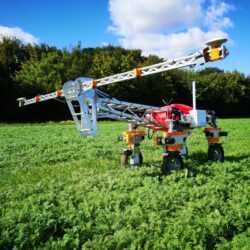
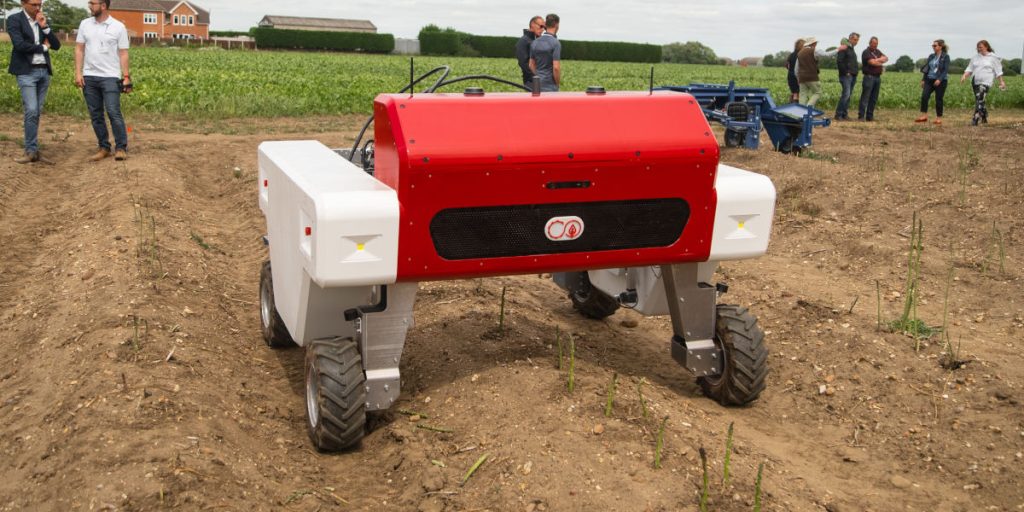
Muddy Machines has been developing a small herd of Sprout robots to support the asparagus harvest season. Their CEO, Chris Chavasse, comments that grants from Innovate UK and DEFRA have supported the development of the versatile electric robots and allowed the company to advance its selective vegetable harvesters.
He also welcomes the Farming Investment Fund, which will play a crucial role in enabling growers to adopt this nascent technology and mitigate some of the risks.
However, he comments: “Early adopters of this technology stand to gain a competitive advantage whilst strengthening the UK’s agricultural sector in a sustainable way.
“The grant funding has been invaluable, but there is still a pressing need for the Government to encourage and de-risk private investment into startups and scale-ups that are solving agriculture labour challenges.”
Continuing to de-risk adoption
An increased £50m will be available from the Farming Investment Fund to help support this work and the fund will also continue to be available for growers and farmers to adopt new technologies through instruments such as the Farming Equipment and Technology Fund.
Already grants have been made available, although do seek advice as to whether your desired technology meets the criteria for a grant.
A dedicated FDSC Automation Project Group is to be established to increase knowledge sharing and accelerate adoption of automation technology.
Addressing labour challenges
It has long been lamented that agriculture remains a less attractive sector to attract young people. The government looks to address this by increasing investment in apprenticeships including funding 100% of training and assessment costs for new apprentices aged 16 to 21 in SMEs.
Regional recruitment strategies will also be put in place to help businesses attract workers from the surrounding areas as well as – crucially – the seasonal worker visa will be extended by five years. This will give some longevity and opportunity for workforce stability – at a time when farming businesses are increasingly having to recruit globally for enough seasonal labour.
Is it enough, quickly enough?
Through its response, the government has clearly responded to the needs of the industry, and the document lays out its commitment to addressing these most pressing of issues. As is always the way, there is some talking, some planning and some action. However, with the major issues of food inflation, supply chain pressures, weather challenges and energy costs, they literally can’t come soon enough.
We’ve waited long enough for the government to respond to the Shropshire review. We now have their commitment. Let’s see some action.
Post Overview
Agri-TechE Related Posts

Artificial Intelligence is speeding up the development of the next generation of biostimulants

Assessing the economic future of precision farming in the UK
The Rise of the Machines

Alex Macdonald-Smith, Drone Ag, on the challenges of time…

Lettus Grow: Innovate UK backs collaborative project linking AI with automation & control to improve indoor farming sustainability