ATW22: Wednesday: Data in Agriculture
 Agri-TechE
“Data, data, everywhere, and so many bytes to chew.” Fresh insights into the use of data in agriculture was the topic of the day at this Agri-TechE Week 2022 event, hosted by Rothamsted Research. From automated identification of flying insects, use of AI to map and control blackgrass, field-edge yield decisions and farm digital twins, it’s clear that the world needs a new, better relationship with data for agriculture.
From description to prescription
“The ‘Sense-Plan-Act’ cycle which drives current data-driven thinking on farms can only lead to incremental improvements, as it based on hindsight” commented Benjamin Turner, Agrimetrics COO, in his opening scene-setting talk. Transitioning from descriptive (what happened?) through diagnostic (why did it happen?), to predictive (what will happen?) and finally to the Holy Grail of prescriptive (what should I do?) is, as Benjamin explained, increasingly difficult and expensive.
But not impossible. And increasingly necessary to harness the opportunities of new value propositions, new business models and making data “AI-ready.” It also relies on sound data stewardship to underpin integration of big data sets.
The rewards are worth the effort.
“Digital twins”, explained Rothamsted’s Paul Harris (who is building a twin of the North Wyke farm research facility in Devon), “are typified by being updated in real-time – so need as much data from sensors being delivered via IOT-powered solutions as possible.”
With over 76 million data measurements so far informing the development of the twin, the 12 years of data gathering are providing a wealth of real-time dynamically updated sets.

You don’t get much more dynamic than flying insects, and Rothamsted’s Sam Cook leads the Integrated Pest Management work, focussing on pest control in oil seed rape. “Wingbeat frequency, head-to-body ratio, flight speed and the degree of melanisation (or blackness) are all parameters we can use to identify insects in the field,” she explained.
Sam has used the data to create a library of known insect species, then deployed machine learning to create algorithms to identify individual species. With 80 – 95 % accuracy in identifying pollen beetles, pod midge and flea beetles, one of the biggest challenges is checking the insects are really flying across the camera beam, rather than simply capturing them mid-jump…..
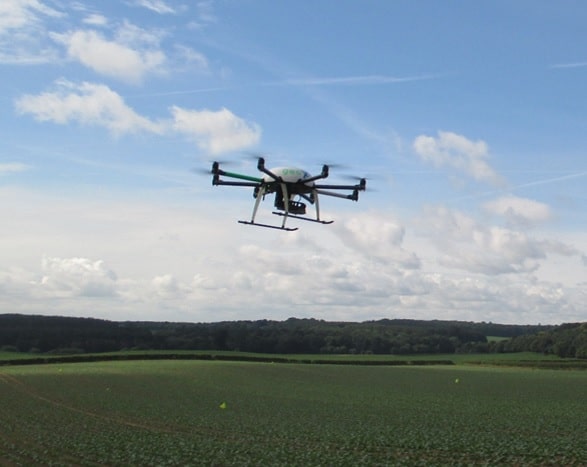
Weed pests are also targets of AI-driven mapping and targeting, as Rothamsted ecologist David Comont explained, using image automation from drone imagery to rapidly scale up the potential to monitor and manage blackgrass. “We shouldn’t rely on trained human-powered field surveys in future” he commented “Neural networks can recognise weeds using image segmentation for every pixel of a drone image, and use this to inform a “smart sprayer” capable of automatically detecting and spraying weeds patches and event individual weeds.”
So the pests have been eliminated, the weeds have been sprayed – but what about the decline in yield at the field-edges? The “EcoStack” project is integrating data sets from 59 farms across 19 crops from 13 countries around yields management schemes, crop type, local environment and landscape features. Project Manager Helen Metcalfe is part of the team aiming to “stack” the data sets to learn more about the “Edge Effects.”
The talks were topped off with a workshop around the so-called “10 Vs” of big data.
Hold on…….ten?!
V is for…vagueness!
For those still getting to grips with the 5 “Vs” – velocity, volume, value, variety and veracity – when considering data management, it came as a bit of a shock to discover there are 5 more. Particularly as no-one has truly can claim to have got to grips with the Big Five so far. The new ones to tax our brains are:
- Variability – is the data source dynamic and evolving, is it time-bound or seasonal, or does it have other types of non-static behaviour?
- Venue – Are data sources from multiple platforms, multiple owners with different access and formatting needs – should this sit in public or private cloud systems?
- Vocabulary – how to describe the structure, content, provenance concepts and models across an agreed language
- Validity – Linked to veracity, this is the need for quality governance, and robust systems for master data management.
- Vagueness – Still the term “big data” is used without an agreement understand of what this means, and around overall developments around the field.
As Benjamin Turner said – “It’s time for “Data Sharing 2.0” – which fuels technological advances over the next 30 years, leading to system level change.”
Rothamsted Enterprises, at the Harpenden campus, provides support for early-stage companies, some of whom have been spun-out from research by the institute. It has for several years sponsored the Start-Up Showcase at the REAP conference also taking place in Agri-TechE Week.
More about Rothamsted Research
Agri-TechE Week is a partnership initiative founded in 2014 by Agri-TechE with the Royal Norfolk Agricultural Association. The week features a mix of in-person and virtual events that are designed to showcase exciting developments in agri-tech. It is coordinated by Agri-TechE working closely with partners across the innovation ecosystem and aims to provide opportunities to attract new customers and partners and to broker collaborations and international connections.
Post Overview
Agri-TechE Related Posts

Real-time diagnostics high on Euro farmers wish list
INNO-VEG launches – chance to hear more at REAP
Ten ways agri-tech has changed agriculture
Work better together with agri-data feeds in ZENSIE

Gardin’s new device gives rapid insights into plant physiology