Belinda Clarke on most-seen start-up snafus, delivering the ‘Goldilocks’ of tech, and her Trend-Watch for 2027
 Agri-TechE
We sat down with Agri-TechE Director, Dr Belinda Clarke, to talk about what makes the Agri-TechE community special, how members can get more from their membership (spoiler – this includes attending the REAP Conference), and why bringing the right people together is so important for turning agri-tech innovation into real-world impact.
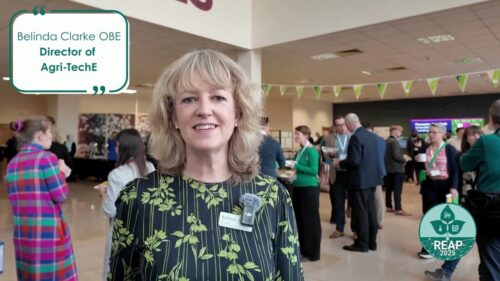
1. For anyone new to Agri-TechE, how would you describe what we do and what makes our community special?
We are a membership network, and we bring together different elements of the agri-tech “Innovation ecosystem” around various themes and topics. That could be via bespoke and curated introductions, or by providing the forum for people to meet each other.
The membership consists of those who want to have impact – whether that’s adopting a new tech, tool or service on your farm, seeing your research influencing on-farm decision-making, or starting and scaling your agri-tech business. Crucially, our network also has a lot of the “enablers” who are so important to making “the system” work – ranging from those who can advise on legal agreements and regulation, help you source talent, find investment, or support with press and PR activities – all vital to make the “innovation ecosystem” work effectively.
We design our events programme around topics we know are important to our members and hopefully keep the ecosystem slightly “ahead of the curve.” As well as the traditional conference, seminar / webinar formats, our event delegates this year have had access to on-farm Demo Days, taken part in “carousel networking” and been part of pitching showcases to investors. We also spend a lot of time giving industry insights and guidance for those who might be “agriculture adjacent” with new tech for the sector, or those wanting to gain insights into funding options, policy updates or even international connections.
Our community is truly representative of the key ingredients of the agri-tech ecosystem. It’s easy to build a “membership” with free or very low-cost subscriptions, but all our members have made the decision to commit financially to being part of this wider effort of advancing the state of knowledge and practice in agri-tech. That’s totally unique and has enabled us to have a sustainable commercial business model not reliant on public funding. So, our members know we are a sound and stable commercial proposition to support them in the long term.
2. What’s one thing you wish more members knew about their membership, or made better use of?
Part of the power of our community is the cross-linkages made between people and organisations. Our Member Discount Scheme contains a range of discounts and offers available to other members. Options include grant-writing support to venue hire discounts, website health checks and recruitment support. All members can both offer and use discounts in the scheme, everyone is welcome.
And to remind everyone that for a single membership subscription, everyone in the organisation can enjoy the member benefits, whether its discounted or free attendance at our events, access to exclusive weekly agri-tech content, including the option to watch event recordings on catch-up in the “Member Stash” on our website.
3. What makes REAP such a valuable conference to attend, and what can delegates gain from being part of the day?
The feedback from a delegate from REAP 2025 probably answers this best – ‘I love the REAP conference, it provides what no other conference does: a splendid mix of big picture futures thinking alongside detailed near to market innovation.’
The team works really hard to make sure REAP offers lots to learn, do and think about when it comes to agri-tech innovation, regardless of your background or experience in the industry.
We also know a lot of conferences talk about farmers, rather than with them (we’ve got a story on that here!), and with 30 % of last year’s delegates being farmers, (they get to enjoy an exclusive breakfast with the keynote speaker), and a Farmer Insights panel as part of the conference, so there’s no shortage of farmers with whom to stress-test ideas, make connections and learn from.
4. What’s your top tip for getting the most out of REAP, particularly when it comes to networking, making connections and turning conversations into opportunities?
We understand a lot of people like to prep ahead of the conference and work out who they want to meet and connect with. Obviously the Agri-TechE team is here to help with that, so please do reach out (even after the conference if there were people you missed).
We’ve built in a lot of networking time during the conference, and we know that’s one of the top reasons people come to REAP, so visit the exhibition stands (especially those offering a goody bag giveaway!), learn about their tool, tech or service, be curious and ask questions.
Plus, don’t forget to follow up – promptly – with people you really want to work with in future.
And of course, tell your network – if you’re a slave to the ‘gram why not record a short video from the conference for your followers, don’t forget to use the hashtag #REAP2026 (and tag Agri-TechE as well!).
5. As we look towards 2027, what new technologies and trends are you hearing about from our members?
Understanding more about managing soil health is going to be even more significant, given the challenging 2026 growing season which revealed that those who have invested in their soils, on the whole, fared better.
The unusual weather conditions also brought a whole new set of challenges around pests and diseases – crop and livestock husbandry is going to be focussed a lot on managing those. Regardless of how the UK-EU Summit discussions play out, it is clear the lack of chemical control is a challenge, so we predict increasing interest in biologicals.
We’re also seeing a lot of effort around trying to establish a link between food produced using “regenerative” agricultural practices and better nutrition and health – all very tricky (and expensive) when it comes to making claims on packaging and demonstrating true cause and effect.
And of course, AI is going to be ever more present in our businesses and on our farms, getting new insights from data and potentially changing the employment and skills and training landscape.
6. Agri-tech start-ups often develop exciting technologies, but commercialising them can be a different challenge altogether. What are some of the biggest mistakes you see start-ups make when bringing new technologies to market, and what can they learn from them?
We’ve seen a lot of mistakes made over the years.
In fairness, some start-ups probably did the right things based on the situation or evidence at the time, and some others have likely been the victims of over-eager investors hoping for a rapid and easy return on their investment. On balance, I’d say one of the biggest mistakes is not ensuring the “statement of needs” is crystal clear – and truly compelling to the end-user. Take a look at who else is doing what you are proposing and ensure your USP and business model survives a really good tyre-kicking.Scaling up is – as we know, and not uniquely to agri-tech – often a challenge, so an idea of that growth trajectory (and ensuring it is realistic) is also crucial.
Finally, it’s been interesting to see how early-stage ventures which have secured a lot of grant money are now being viewed – it used to be seen as a “credibility stamp” and a way of de-risking and leveraging private investment. Increasingly, having too much grant income now risks revealing the lack of a commercial business model (but an excellent ability to write successful grant proposals!).
Find the “Goldilocks” position when it comes to securing public money – not too much, and not too little, it’s there for a valid and valuable reason, but not as a long-term crutch for non-viable businesses.
Looking at those who are making a success of things can often give helpful insights. Examples of the successful models we’ve seen include partnering with those who have an established route to market, bundling your technology with others to make a wider, more compelling offer, or helping de-risk adoption by giving free trials and tasters – under-writing any yield penalties or opportunity costs always helps with farmer uptake.
Want to talk more? Book a meeting with our fabulous Membership Manager Laura Bouvet here
Post Overview
Agri-TechE Related Posts
Agri-tech cannot operate in a Research and Development silo

New specialist agency launches to help UK agrifood innovators commercialise great ideas
Plant, microbial and algal biotechnology for a clean energy future

Innovation is Only the Beginning. Why great ideas don’t always become real-world impact
The ‘Ambiguous Requirement’ calculator – tackling a key challenge in hiring