When the going gets tough are farmers getting biological? Five Take-Aways from the McKinsey report
 Agri-TechE
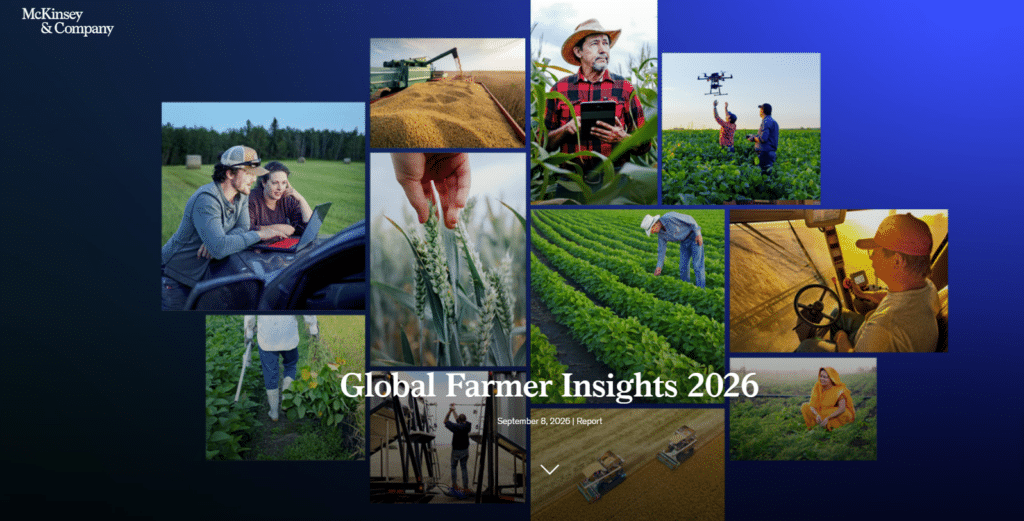
 Against the backdrop of the challenging global environment for farmers, a recent report has revealed the current and future spending habits by farmers on general “agri-tech,” plus biologicals and generative AI – with some surprisingly positive results.
Over 5000 farmers across Europe, North America, LATAM and Asia were surveyed as part of the biennial McKinsey & Co “Global Farmer Insights” report.
The top line picture is – unsurprisingly – one of farmers preserving their cash, delaying new purchases where possible, and a laser-focus on ensuring a short-term return on investment. But while the intent to spend has shrunk sharply since the last report, the resilience and indeed optimism of the industry is evident.
Here we share the Five Take-Aways from the McKinsey report.
1. Fertiliser and machinery – first to go… but first to return
When asked which parts of their cost base are most sensitive to spending cuts, fertiliser and farm equipment headed the charts. Yet they were also the first that farmers expected to reinstate when profitability returns.
When asked about their use of general “agri-tech” on farm, it’s mainly being used to support recurring farm decisions, or activities in the field. Digital agronomy, precision agriculture hardware and remote sensing are the most deployed solutions – but still adoption is concentrated in tools that fit into recurring farm decisions or field activities.
2. AI is arriving – but trust and context still matter
Contributors to our Back to the Future report a couple of years ago will have seen our first reference to “generative AI” and, of course, its growth has escalated since. The report found that 17 % of the farmers already using gen AI for farm-related tasks, (although only 4% appear to be actually paying for it) their top use is for planning (43 %) followed by 33 % who are using it for crop management. This, surely, will only increase…?
Interestingly, the study revealed that the most success comes with solutions that “bridge the final mile” of local conditions, accumulated experience, and judgment earned over seasons – aka the proverbially named “agronomist’s eye” and the “herdsman’s heart”.
3. The source of advice is changing
Our agronomist members will be pleased to know that they are still considered “highly influential” as a source of purchasing advice – as cited by 56 % of farmers questioned. Digital channels have democratised the potential for farmers to research and compare products, but AI is trusted by only 6% of farmers to help them make decisions. Company sales reps – historically one of the main sources of information – still score highly but are declining in the ranking.
Hopefully this means everyone is upping their game – with farmers being better informed through their digital research and having more nuanced conversations with their trusted advisors.
4. A message for tech developers
The report again reinforced the importance of tech developers and innovators demonstrating measurable Return on Investment to farmers and lowering the cost and complexity of adoption of innovation. Proving value is the “new competitive advantage” for a technology company.
The UK’s ADOPT programme is helping to lower the barrier to entry for farmers to take the leap into trialling a new tool, tech or services, but still more work is needed on how to help shorten the time to that all important ROI.
The report concluded that farmers increasingly need technology to show value reliably and rapidly, showing it works in the farm context, can integrate into existing work flows and “makes the path from data to action obvious.”
A salutary piece of advice for all those planning an ADOPT grant.

5. Booming biologicals
Most speciality growers surveyed use at least one biological product – either a biostimulant or biocontrol – and a third of those use biologicals on 100 % of their land. Perhaps unsurprisingly, the proportion is lower among arable farmers – but still a growing proportion.
As formulation and consistency improves, along with the ability to target particular pests and diseases, we expect this usage to increase. Interestingly, for the bigger agri-businesses, the survey revealed that cost, ROI and a proven track record of the product actually working, together drive purchases. It would appear brand reputation is less important and it is evidence and economics are becoming the adoption swingers.
Save the Date February 24 to discuss Biologicals in Practice: Evidence, Economics and Adoption. Keep an eye on our Events calendar.
Post Overview
Agri-TechE Related Posts
Foliar nitrogen fixing spray: what our first BactoStym Nitro results show

Can farmers afford (not) to trial biological tools this season?
SugaROx secures £2.5M investment from fertiliser multinational to accelerate its first product launch

A Well‑Adapted UK signals a shift in British farming
Plant, microbial and algal biotechnology for a clean energy future