How good is “good enough?”
 Agri-TechE
 “Our role as scientists is to provide the evidence that reduces risk and increases confidence, while recognising that real‑world decisions must be made long before perfect knowledge is available.” Prof Cristobal Uauy, Director, John Innes Centre
This tension sits at the heart of agri‑tech. Different people in the ecosystem – farmers, researchers, investors, funders – all make decisions under uncertainty, but the level of evidence they need varies dramatically. And that raises the question we’re exploring at this year’s REAP conference: how good is “good enough”?
We all know the so-called “80-20” rule, where 80% of outcomes are said to be influenced by 20% of inputs, and at this year’s REAP conference, we’re exploring how this applies in agriculture and technology adoption.
Originally coined by economist Vilfredo Pareto, who observed that 80% of the land in Italy was owned by 20% of the population, the ‘Pareto Principle’ has become a useful shorthand for recognising the point of diminishing return – that pushing for 100% perfection can demand disproportionate effort for marginal gain.
In other words, big outputs often come from a small number of factors.
This tension between “good enough” and “not enough” is something the agricultural sector knows well.
“Agriculture has always operated in a world of uncertainty, from weather and pests to markets and policy. Farmers, breeders, researchers and investors all make decisions under uncertainty every day.” Prof Cristobal Uauy, Director, John Innes Centre
Decisions only need to work on a real farm
Humans are constantly assessing their personal or corporate tolerance of the levels of acceptability. Farmers are no exception, but they also face high stakes, especially when it comes to adoption of new technologies, tools or services.
Similarly, researchers and tech developers need to judge “how good is good enough” when gathering data for a high-profile research paper or presenting their new innovations to potential investors or customers.
And from the investor perspective, the threshold for “good enough” is different again:
“Investors aren’t looking for perfect; they’re looking for proof that innovation delivers at scale. In agritech, that means demonstrating real-world outcomes: higher yields, lower costs, and more sustainable production. Judging when the evidence is “good enough” is often what separates an interesting pilot from an investable, scalable solution.”
Nicole Sadd, CEO, Rothamsted Enterprises
Where’s your place on the spectrum?
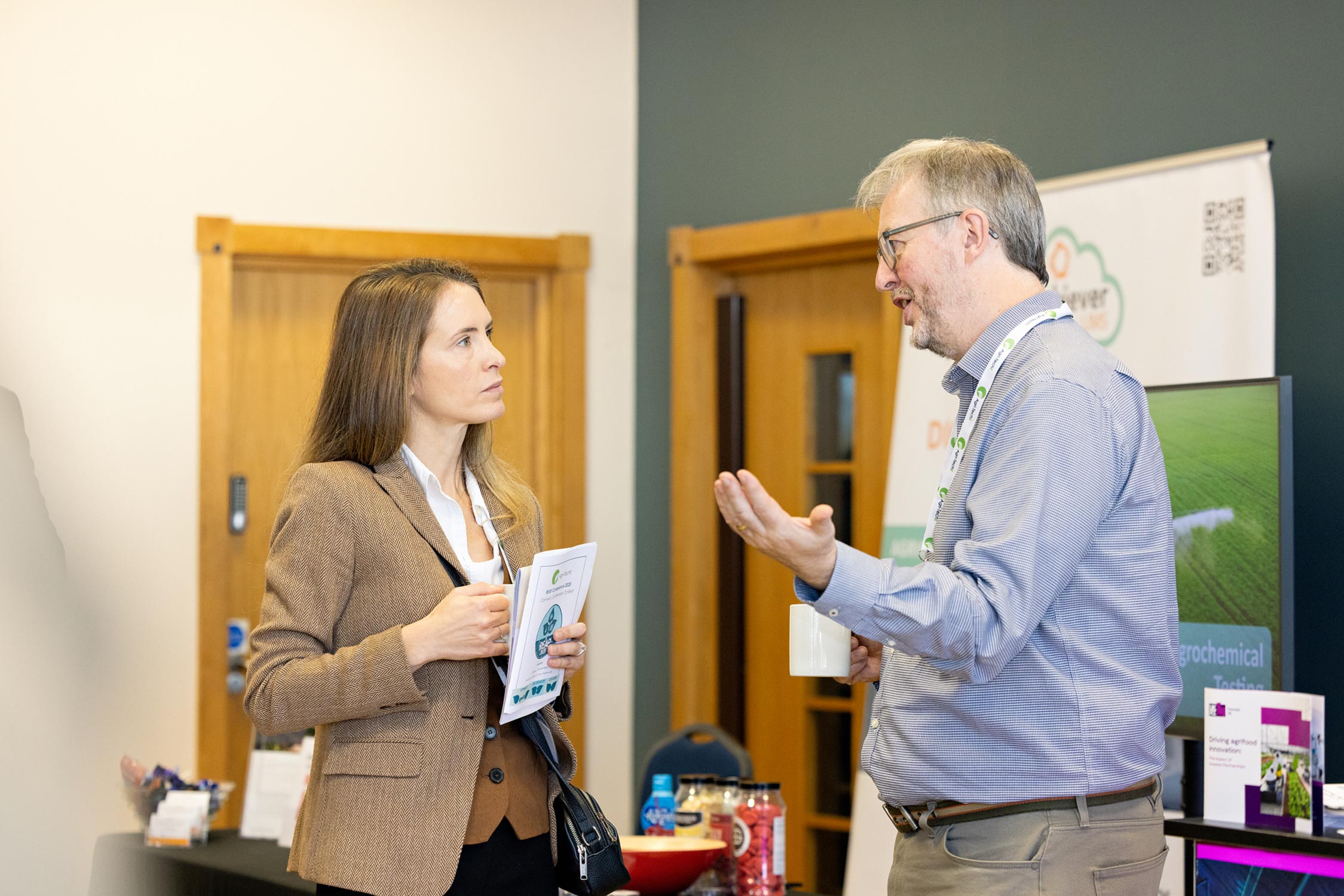
So what does this mean for the world of agri-tech and how do you decide how much evidence you need to present for a decision to buy, invest, publish to go in your favour?
We are interested in exploring the spectrum between needing lots of data, trials and scientific content to be confident in a replicable outcome, and a more empirical approach which is perhaps more common in commercial farming.
After a decade of working with our international communities of growers, farmers, tech developers, researchers and wider innovators, people and businesses probably move along that spectrum.
We believe, however, that they will also have a position of natural “comfort” which is probably linked to the attitude to risk, financial position, scale of the organisation and past experience. Understanding this is important when it comes to getting things ready for adoption but also to be able to triage and integrate new tools, tech or services into their business.
Funders are responding to this reality too. If farmers are to trust new technologies, the evidence behind them must be generated at the right scale and relevance.
“As the UK’s major public funder for commercially focused R&D, Innovate UK strives to support the best and most innovative agri tech projects to help deliver real impact for farmers and growers. We also recognise that ‘best’ is not a fixed concept – the most technically advanced solution isn’t always the one that delivers the most immediate or practical benefit on farm.
Farmers need evidence that is credible, repeatable and relevant to their own systems, and generating that level of confidence requires trials of a certain scale. The increase of the ADOPT ceiling to £200,000 is a direct response to this reality. It acknowledges that meaningful farmer led R&D must be funded at a level that allows for statistically robust, multi site experimentation, ensuring the evidence behind innovation is itself ‘good enough’ to drive uptake.
Innovate UK is committed to supporting this shift, and we’re excited to see REAP unpack the nuances of what ‘good enough’ means for different technologies and farm businesses.”
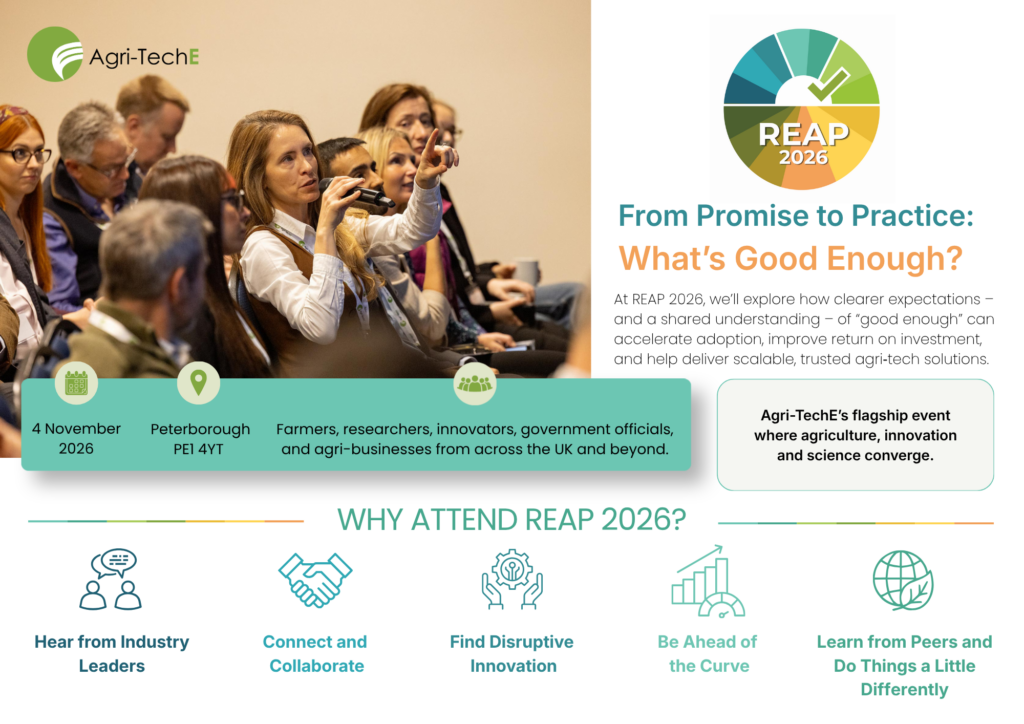
Join us at REAP 2026
So join us for REAP 2026 – and ask yourself – and others – what is good enough to inform your decisions?
REAP 26 tickets are on sale now. Early bird tickets are available until 5 July – the discount is for those willing to grab a ‘dark’ ticket, before our keynote and panel speakers have been announced. Buy REAP tickets here.
Agri-TechE members can attend REAP at discount rates – to become a member of Agri-TechE take a look at our tier options.
UK growers, farmers and those in full-time education in agriculture (or an agriculture-related discipline such as plant science, agri-engineering, environmental sciences etc.) are eligible to apply for a bursary which reduces ticket prices to around 1/3.
Post Overview
Agri-TechE Related Posts
ATW 2025: How can Agriculture Decarbonise the Supply Chain?
NatureTech: Supporting Businesses to serve both Profit and Planet
The first International Innovation Meeting for Pangaea and distributors
Visit AGROMEK in Denmark, November 2026
Agri-Tech Week 2026