Farming is hard to replace with AI. The admin around it is not.
 Dexlab Consulting Ltd
Most AI conversations start in the wrong place. They ask which jobs AI will replace. For farming, that misses the more useful point.
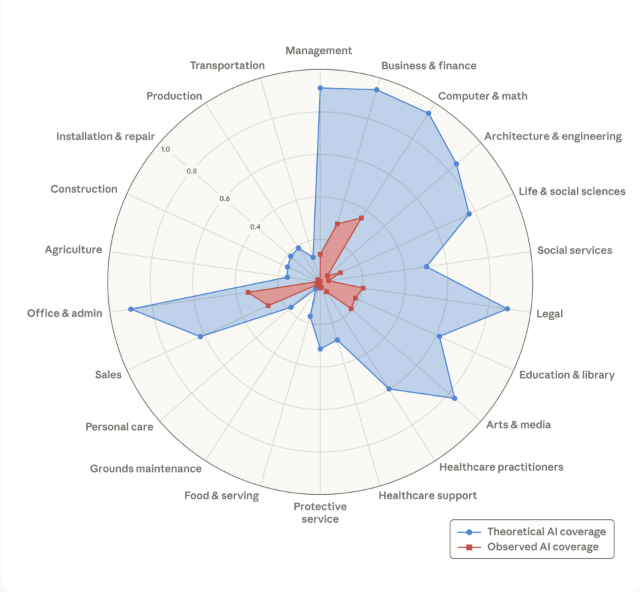
Anthropic’s latest labour market research compared theoretical AI capability with observed AI usage across different occupations. Agriculture sits low on theoretical coverage and almost at zero on observed usage. That should not surprise anyone who understands farming. AI is not about to replace the physical reality of working land, managing livestock, fixing machinery, reading weather, making field decisions and dealing with the constant judgement calls that come with running an agricultural business. Anthropic also notes that many agricultural tasks remain beyond AI’s reach, including physical work such as pruning trees and operating farm machinery. (Anthropic)
Farming is physical, local, seasonal and full of uncertainty. That makes it hard to replace. But the rest of Anthropic’s chart tells a different story. Management, business and finance, legal, office and admin, and sales all show much higher AI coverage. Every one of those functions exists inside agriculture.
That is the real opportunity. Not replacing farming. Removing the drag around it.
For many farmers, the problem is not a lack of effort. It is that too much time gets pulled away from the work that actually needs them. Paperwork, emails, supplier comparisons, meeting notes, staff rotas, compliance documents, grant applications, customer follow-up, invoices, reports, policy updates, health and safety documents and basic planning all sit around the core work of farming. None of this is why most people got into the sector. But it still has to be done.
This is where AI can help now. Not through an overbuilt six-month project. Not by buying the latest platform because a vendor said agriculture is being transformed. Not by starting with a tool before anyone has worked out the actual problem. AI can help a farm manager turn rough notes into a clear update, summarise long documents before a decision is made, draft routine emails, turn meetings into actions, compare supplier information, build first drafts of operating procedures and structure knowledge that currently sits in someone’s head.
That does not replace the farm manager. It gives them time back.
That distinction matters. An hour saved on admin is not just an hour saved. It is an hour that can go back into work that needs experience, judgement and presence. Better conversations with staff. Better decisions on the ground. Faster follow-up with customers. Less end-of-day paperwork. Less frustration.
This is augmentation rather than automation. Automation asks, “What can we remove?” Augmentation asks, “What can we make easier?” For most agricultural businesses, that second question is the better starting point.
I wrote recently about the difference between AI augmentation and automation. The core point was simple: the question is not what AI can replace, but what good people could do if AI took the work that does not need their judgement. That point applies strongly to agriculture because so much of the core work still depends on human context, experience and real-world decision-making. (Dexlab Consulting)
The risk now is not that farmers ignore AI. The risk is that AI gets made too complicated before they even start. As more tools appear, more vendors enter the market. More platforms. More claims. More dashboards. More promises. More consultants selling large programmes before the business has even worked out where the pain is. That creates confusion. It also creates room for exploitation.
A farmer who knows they should probably be doing something with AI, but does not know where to start, is easy to overwhelm. Sell them the vision. Show them the demo. Talk about automation. Skip the foundations. That is how businesses waste money.
The better route is simpler. Start with the work. Where is time being lost? Where is admin slowing people down? Where are decisions delayed because information is scattered? Where is useful knowledge trapped in one person’s head? Where are managers doing low-judgement work that AI could help with?
That is the first layer. Not the tool. The work.
At Dexlab Consulting, I take a vendor and tool-agnostic view of AI adoption. The starting point should not be a product catalogue. It should be the reality of how the business runs. The right tool might be Microsoft Copilot. It might be ChatGPT. It might be a specialist agricultural platform. It might be no new tool at all, just better use of something the business already pays for.
The point is not to make AI sound clever. The point is to make work better.
Agriculture is well placed to get this right because the core work is not easily replaced. That gives the sector a better starting point than many office-based industries. Less fear. More usefulness. Less replacement. More support.
The businesses that win with AI in agriculture will not be the ones chasing the biggest automation story. They will be the ones that ask the simplest question first:
Where are good people spending time on work that does not need their judgement?
Start there. That is where AI becomes useful.
- *I have permission from the copyright holder to publish this content and images.
Related Posts
Man vs machine: determining agri tech’s potential for agronomic decision making
Adrian Scripps – from cupcake machines to the UK’s Top Automated Fruit-Packing Facility

Innovative vets adopts agri-tech for early dairy disease detection
New decision support tool launched for making ‘sustainable yet profitable’ land use changes

AI Report 2025 | AI; Quantum Computing; Intellectual Property