Fertiliser Price Spike 2026: Practical Fertiliser Alternatives to Cut Nitrogen Risk
 BactoTech UK
A fertiliser price spike always triggers the same question on farm: what are my alternatives right now? Most farmers do not mean “zero fertiliser tomorrow”. They mean “how do I rely on it less, without losing yield”.
This post shares a calm playbook for spring 2026. It starts with efficiency and uptake. Then it adds biology as a measured support tool that complements fertiliser, not a full replacement.
What’s driving the fertiliser price spike
Disruption around the Strait of Hormuz has slowed shipping and increased risk across fertiliser supply chains. That matters because large volumes of fertiliser raw materials and finished product move through that route.
The immediate knock-on looks like this:
-
Urea and ammonia availability turns patchy
-
Quotes jump quickly
-
Delivery dates drift
-
Buying becomes reactive
Why farmers are searching for fertiliser alternatives
A fertiliser price spike does not just raise costs. It squeezes decisions and timing. It can also push farms into “insurance nitrogen”, bought under pressure.
So the goal is not to guess the market. The goal is to reduce exposure:
-
Make every unit of N work harder
-
Improve uptake so response stays reliable
-
Add biology to smooth performance when timing matters
The most realistic fertiliser alternatives focus on efficiency first. Next, they fix uptake blockers like cold roots, compaction, and residue tie-up. After that, they use biology to support steadier rooting and nitrogen response alongside fertiliser. A simple strip trial keeps it honest.
A calm 3-step nitrogen plan during a fertiliser price spike
Step 1 – Efficiency
Start with a clear base plan. Then tighten timing. Split where it makes sense. Cut waste first.
Step 2 – Uptake
Nitrogen only pays when roots work. Check rooting depth, root hairs, moisture at depth, and soil structure. Solve the limiter before you chase leaf colour.
Step 3 – Biology (as a complement)
Biology fits best when it helps you rely less on perfect deliveries and perfect weather. It should support steadier uptake and response. It should not replace nutrient planning.
Two biological tools we use for nitrogen resilience
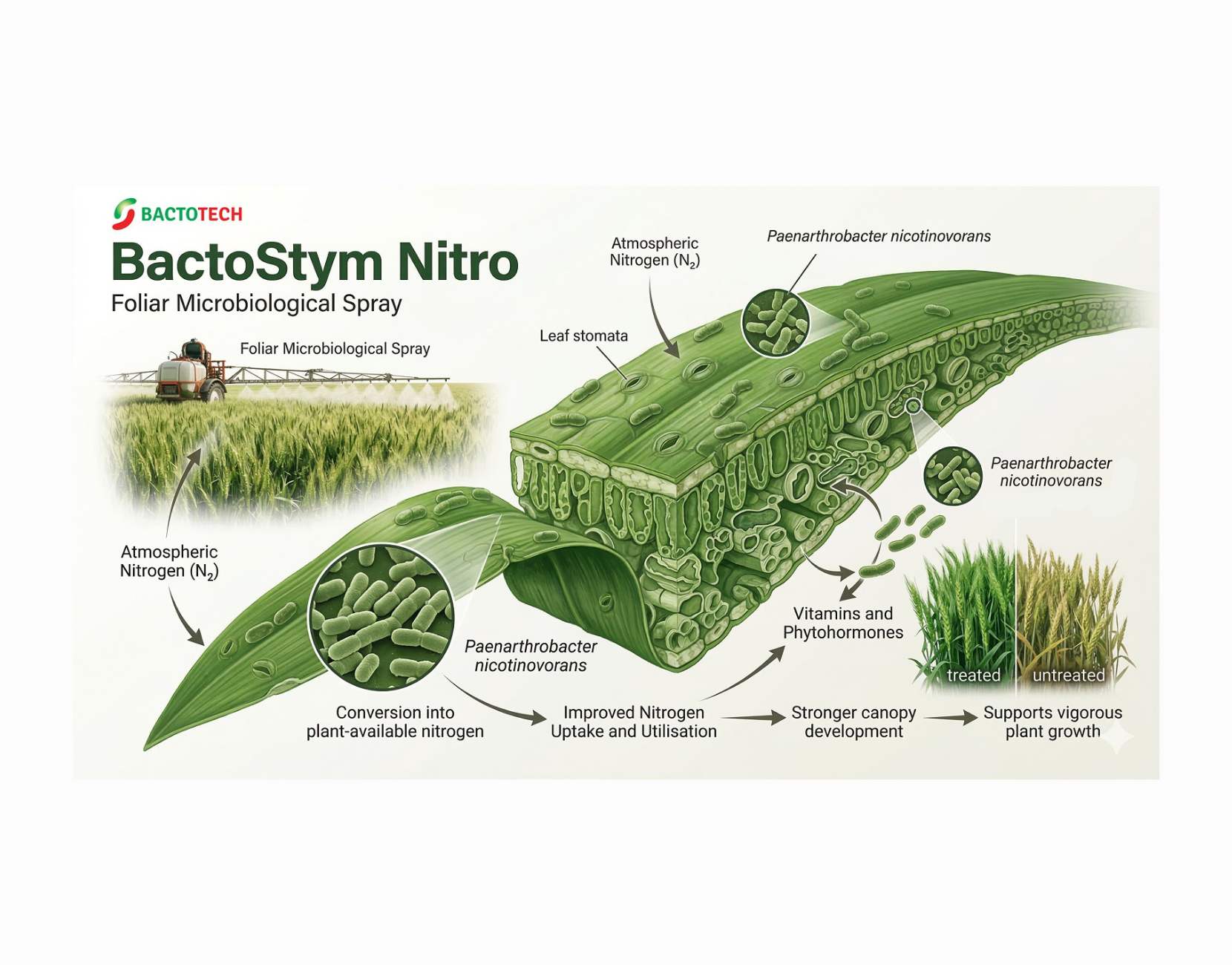
BactoStym Nitro (foliar)
Use it when timing matters but response feels patchy. Think: cold starts, dry spells, and “N went on but the crop did not move”.
What it contains: Paenarthrobacter (formerly Arthrobacter) nicotinovorans.
How it’s been tested: in a nitrogen-free lab medium, with weekly sampling and external lab analysis under ISO/IEC 17025 quality standards. Results showed a strong rise in ammonium nitrogen across the test period.
BactoRol Nitrogen (soil / rhizosphere)
Use it when nitrogen feels “leaky” and response varies by zone or season. It fits well as a base tool before key growth periods.
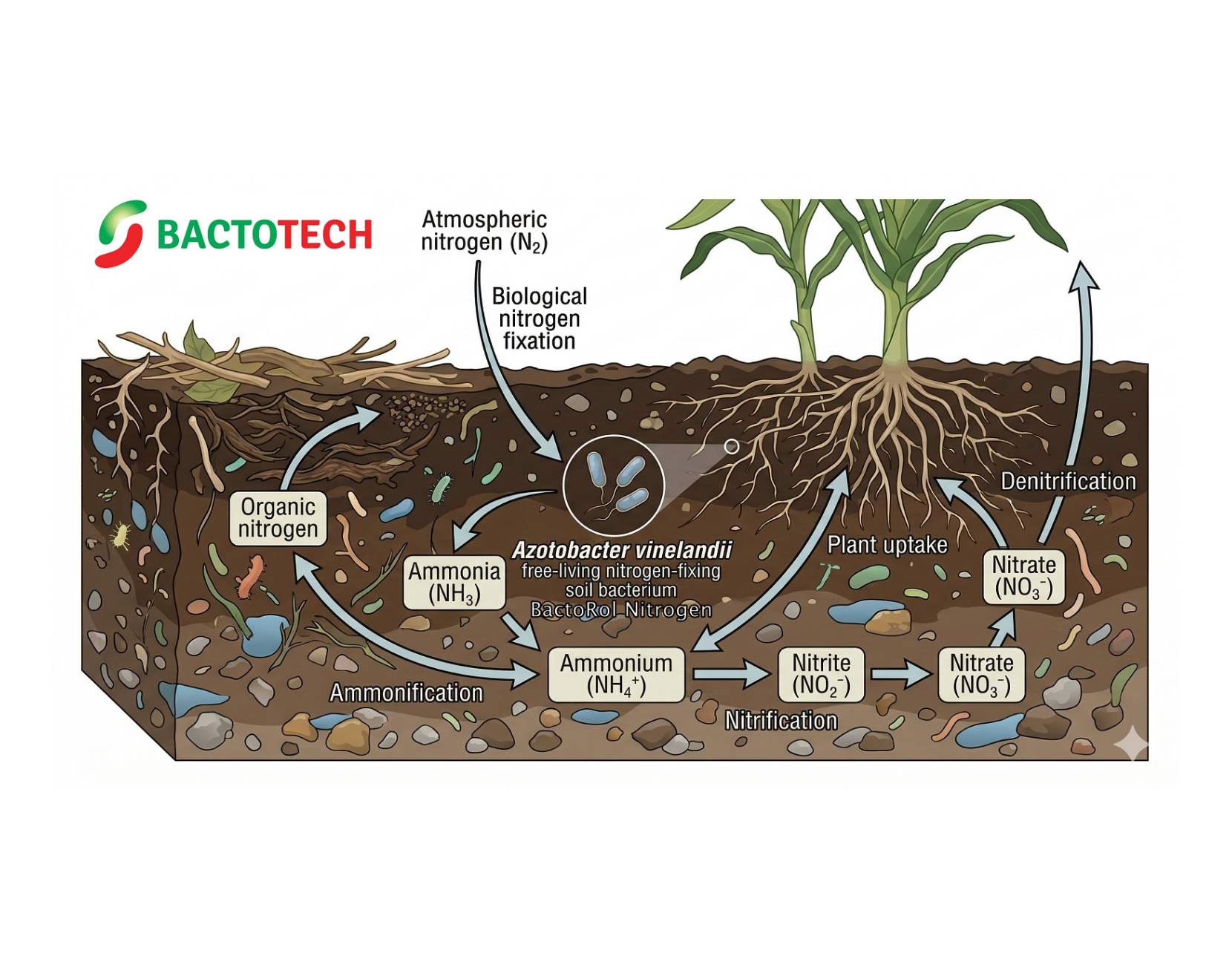
What it contains: Azotobacter vinelandii plus Bacillus partners (B. subtilis, B. amyloliquefaciens, B. licheniformis).
What we’ve seen in controlled trials: in maize grown with no mineral nitrogen (P+K only), treated plants reached 179 cm vs 166 cm at week 12, with improved growth traits. Cob performance also improved in the same trial set (fresh mass, dry mass, and grains per cob).
When to apply (simple on-farm calendar)
Autumn (post-harvest to pre-drilling)
-
Best for: building a steadier base and reducing next-season exposure
-
Consider: BactoRol Nitrogen
Drilling to early emergence
-
Best for: setting up uniformity so N pays later
-
Consider: BactoRol Nitrogen in the soil zone
Early spring restart
-
Best for: stabilising response when nitrogen feels unreliable
-
Consider: BactoRol Nitrogen
In-season foliar windows
-
Best for: “N is on, but the crop is flat”
-
Consider: BactoStym Nitro during active growth
Stress and recovery periods
-
Best for: helping crops pick up after cold or dry checks
-
Consider: BactoStym Nitro when leaves can take up product
How to trial any “fertiliser alternative” properly
Keep it simple:
-
Run one treated strip and one control strip
-
Measure plants/m² and tillers/plant at fixed points
-
Do quick root digs (depth + root hairs)
-
Track growth stage spread across the drill width
-
Compare at harvest (yield map or weighed loads)
Final thought
We can’t control global events. However, we can build nitrogen plans that stay calm when supply tightens. Efficiency and uptake come first. Biology comes next. Proof keeps it honest. READ MORE HERE.

- *I have permission from the copyright holder to publish this content and images.
Related Posts

New BioTransitions global scale-up programme launched at Norwich Research Park for agri-food biotech businesses

BugBiome wins Innovate UK grant to advance bioinsecticide against cabbage stem flea beetle
Plant, microbial and algal biotechnology for a clean energy future
Azotobacter vinelandii: a practical look at free-living nitrogen-fixing biology in crop production
Foliar nitrogen fixing spray: what our first BactoStym Nitro results show