Connecting Food uses Blockchain to secure food quality

Meet the Network

Agri-TechE

Connecting FoodConnecting Food is developing an authentication system based on block-chain technology that would allow food operators to get real-time insight into whether a given product meets End Product Specifications (EPS).
The company is developing an approach that would help detect issues at an early stage and allow the problem to be managed effectively potentially saving the industry millions by reducing contamination that results in product recalls.  (more…)

Wheat from seed to seed in 8 weeks

Research Digest
Agri-TechE

Speed breeding techniques would allow six crops of wheat in a year, intensifying food production.
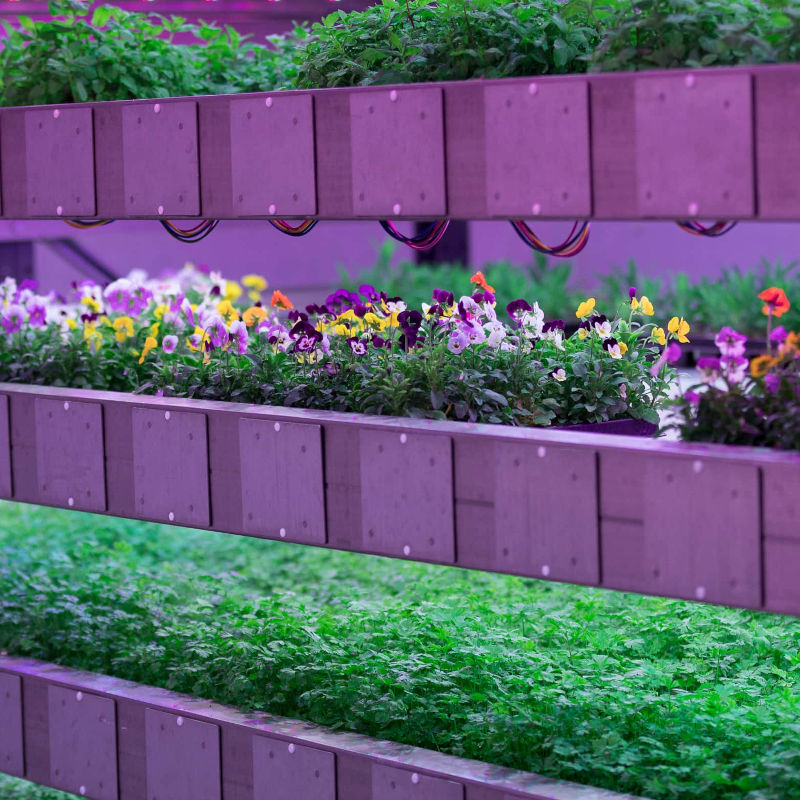
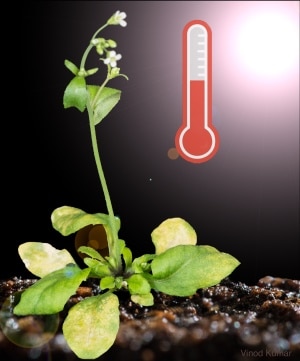
A speed-breeding platform developed by teams at the John Innes Centre, University of Queensland and University of Sydney, uses a glasshouse or an artificial environment with enhanced lighting to create intense day-long regimes to speed up the search for better performing crops.
Using the technique, the team has achieved wheat generation from seed to seed in just 8 weeks.
Speed breeding, says Dr Wulff, offers a potential new solution to a global challenge for the 21st century.
“People said you may be able to cycle plants fast, but they will look tiny and insignificant, and only set a few seed. In fact, the new technology creates plants that look better and are healthier than those using standard conditions. One colleague could not believe it when he first saw the results.”
The exciting breakthrough has the potential to rank, in terms of impact, alongside the shuttle-breeding techniques introduced after the second world war as part of the green revolution.

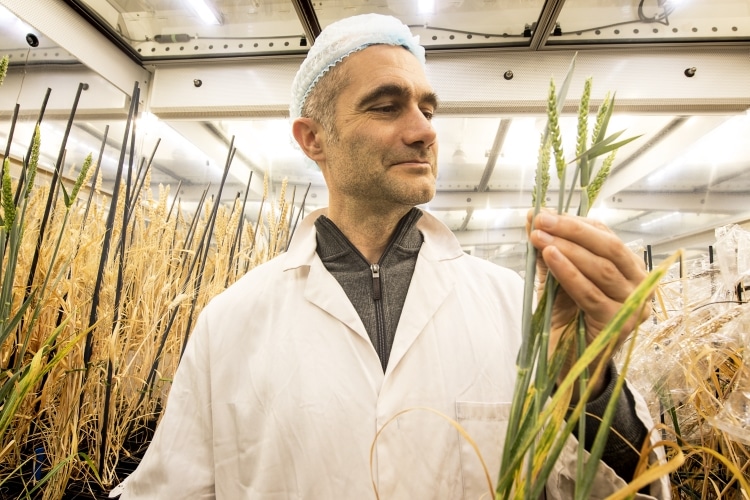
Dr Brande Wulff of the John Innes Centre

Dr Wulff goes on to say: “I would like to think that in 10 years from now you could walk into a field and point to plants whose attributes and traits were developed using this technology.”
This technique uses fully controlled growth environments and can also be scaled up to work in a standard glass house. It uses LED lights optimised to aid photosynthesis in intensive regimes of up to 22 hours per day.
LED lights significantly reduce the cost compared to sodium vapour lamps which have long been in widespread use but are ineffective because they generate much heat and emit poor quality light.
The international team also prove that the speed breeding technique can be used for a range of important crops. They have achieved up to 6 generations per year for bread wheat, durum wheat, barley, pea, and chickpea; and four generations for canola (a form of rapeseed). This is a significant increase compared with widely used commercial breeding techniques.
Ruth Bryant, Wheat Pathologist at RAGT Seeds Ltd, Essex, UK, said: “Breeders are always looking for ways to speed up the process of getting a variety to market so we are really interested in the concept of speed breeding. We are working closely with Dr Wulff’s group at the John Innes Centre to develop this method in a commercial setting.”
The full paper: Speed breeding is a powerful tool to accelerate crop research and breeding is available at Nature Plants.

Defra’s new farming rules for water drive need for valuing natural capital

Agri-TechE

DefraManaging the land to protect water quality will be one of the topics discussed at our January Pollinator meeting Counting the Cost, Value and Benefits of Natural Capital in Agriculture.

Speaker Professor Paul Leinster, Professor of Environmental Assessment at Cranfield University, is a member of the government’s Natural Capital Committee. Paul has been advising on how to value natural capital so that integrated farming systems that benefit both farmers and water companies can be incentivised.
The new rules, which come into force in April 2018, include a number of measures covering:

  • Usage – plan the use of manures and fertilisers and test for Phosphorus, Potassium, Magnesium, pH and Nitrogen levels in the soil at least every 5 years
  • Storage – organic manures must not be stored on land within 10 metres of inland freshwaters or within 50 metres of a well or borehole
  • Application – organic manures or manufactured fertilisers must not be applied if the soil is waterlogged, flooded, or snow covered or within 10 metres of water sources. Care taken to assess where there is a ‘significant risk of pollution’, eg slope of land, proximity to water courses, weather conditions
  • Protection against soil erosion – reasonable precautions need to be taken to prevent significant soil erosion and runoff from land management and cultivation practices (such as seedbeds, tramlines, rows, beds, stubbles [including harvested land with haulm], polytunnels and irrigation)
  • Positioning of livestock feeders – again should not be positioned within 10 metres of inland freshwaters or within 50 metres of a well or borehole within 10 metres of any inland freshwaters or coastal waters

If you can make an economic case for a change in land use, to reduce water pollution or minimise flood risks, then you can pay or charge an economic value for it.
For example, if a land owner agreed to accept flood waters this could protect residential properties. But how do you value changes in land management that provide benefits for other people? Would farmers be paid to provide this service?
Big data is now making it possible to do these types of calculations, creating a new way to assess the value of natural capital. David Burton of Natural England will be discussing this.
Our other speaker, Alice Midmer, IFM Manager at LEAF (Linking Environment And Farming), will be explaining new thinking in ‘Agro-Ecology’ which is focused on a more integrated approach that will take these issues into account.
Award winning arable farmer, Poul Hovesen, will also be talking about his experiences. Yields at Salle Farm are consistently and substantially above the national average, demonstrating how precision farming balanced with respect for the environment can also be profitable.
For more information see the event details.

Recommended Lists – chance to have your say

Agri-TechE

Recommended lists - have your sayAll breeders wait with anticipation for the launch of the AHDB Recommended Lists for cereals and oilseeds (RL) which are the result of extensive trials.  The presentation of the lists is continually being improved and the AHDB is seeking input on their clarity.
This year the Lists gained 22 new varieties including a new variety of biscuit wheat, Elicit, developed by Elsoms.  The Group 3 wheats have been under pressure in recent years with yields worryingly low. This has resulted in low supplies to the domestic and export markets, creating a competitive opportunity for producers.

New biscuit wheat

David Coop of Elsoms was delighted with the inclusion. He comments: “Elicit is new to the 2018/19 Recommended List and will help to fill this market segment. It offers a winning combination of high yields and disease resistance.”
The AHDB comments that of particular note is Elicit’s septoria rating, which is the highest of all the Group 3 varieties, and only exceeded by six varieties on the whole of the Recommended List. Additionally, Elicit has good resistance to other diseases, including yellow rust and brown rust. As a result Elicit also has the highest untreated yield of this group.
For winter barley, there were three new six-row winter feed varieties recommended for the advances they bring to this group. This includes one new conventional six-row feed variety, KWS Astaire, has been recommended. This variety combines good treated yield with a superb package of disease resistance and achieves the highest untreated yield, not only of the six-row feed varieties, but of the whole winter barley Recommended List.

Improving the RL

The AHDB is considering improvements to the way it presents its Recommended Lists and has a survey to gauge opinion of the current RL publications. For example the Winter oilseed rape varieties are presented on a single UK table for the first time with varieties differentiated by region.
AHDB Senior Crop Production Scientist, Dr Jenna Watts, said: “It is important to us that we listen to the people who use the Recommended Lists, to make sure that we continue to provide farmers, agronomists and industry with the best possible information and make the RL fit for the future.”
The survey can be found online at cereals.ahdb.org.uk/varieties
Summaries of the new AHDB Recommended Lists are available on the AHDB website at cereals.ahdb.org.uk/varieties.
A print edition of the AHDB Recommended Lists for cereals and oilseeds booklet will be distributed in Spring 2018