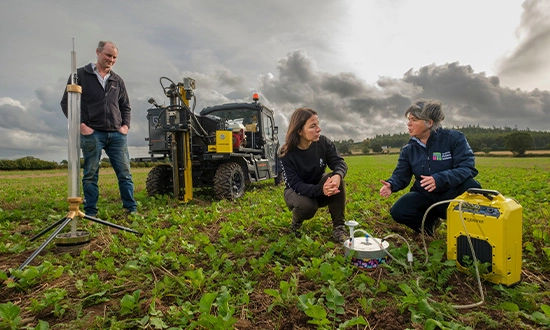
Trinity AgTech to discuss new sustainability support platform
 Agri-TechE
 To create Sandy, the team have drawn resources from the senior leadership of previous generation software solutions, including Cool Farm Tool and Agrecalc and the software algorithms are supported by a 35-member Scientific Board and a 12-member Industry Advisory Board.
Agri-TechE caught up with MD of sustainability Alasdair Sykes and Director of Business Development Anna Woodley for more information.
A baseline is vital to assess improvements – how does Sandy set a baseline?
Relating to carbon footprinting within Sandy, the user is able to benchmark against their own theoretical best using the Scientific Benchmarking module. If the user is engaging with Trinity Natural Capital markets, then the baseline against which the user measures improvement is based on an auditable 3–5 year baseline practice period.
We have a very strict data protection policy within Sandy which means that users’ data is never used to inform benchmarks that are shared between users; however, users have the ability to report on and share their data from within Sandy so can compare to one another directly if both parties agree to do so.
Current methods of physically measuring carbon in the soil can be inconsistent – how does Trinity AgTech overcome this issue?
As many farmers have found, Trinity’s view is that physical soil carbon measurements alone are inappropriate and insufficient to assess soil carbon improvement. The reasons have to do with (a) sampling uncertainty (depth, sampling strategy, timescale, natural fluctuations) and (b) the lack of a consistent baseline against which to compare the impact of the farmer’s practices against the counterfactual. To overcome this, Trinity AgTech uses a best-in-sector soil carbon model based on the IPCC (2019) Tier 2 methodology. The modelling approach is superior to measurement-based inference in that it is more accurate, more representative of the farmer’s practices, and provides the counterfactual. It also cannot to be biased by sampling frequency or strategy.
Even experts struggle to measure biodiversity down to species level – how does Sandy assess biodiversity?
Sandy assesses biodiversity via a proprietary modelling algorithm based on land uses and management practices across the farm. This algorithm has been developed in partnership with the Trinity AgTech scientific board, and in particular with 17 biodiversity experts from across the country. Ground surveys are expensive, time-consuming and inconsistent; the biodiversity module within Sandy provides a standardised scoring system across five separate biodiversity categories which directly represents the user’s management practices.

How does Sandy’s water protection module evaluate the water pollution?
Sandy’s water protection module provides the most comprehensive nitrate leaching and nitrogen uptake efficiency model available to farms and farmers.
Certainly, users may test for nitrates; this is not, however, a required input for the module, which focuses entirely on the user’s own land management, and on soil and climate data for the user’s fields.
At REAP 2021 there was a lot of talk about the new earth observation technologies that are coming through – is Trinity AgTech exploring the potential of this technology?
Sandy functions by combining the user’s own farm data with a variety of satellite-based and spatial datasets, including climate, vegetation, and soil data. This data is used throughout Sandy but is particularly important for the functioning of the Farm Management module which provides insights into crop health, field accessibility, soil condition, and more.
Trinity AgTech stresses that it is based on science – are you able to name any UK members of the advisory board?
Trinity AgTech’s Scientific Board is comprised of 35 members based at universities and research institutions around and beyond the United Kingdom. The Chair of the Scientific Board is Professor Simon Potts of the University of Reading.
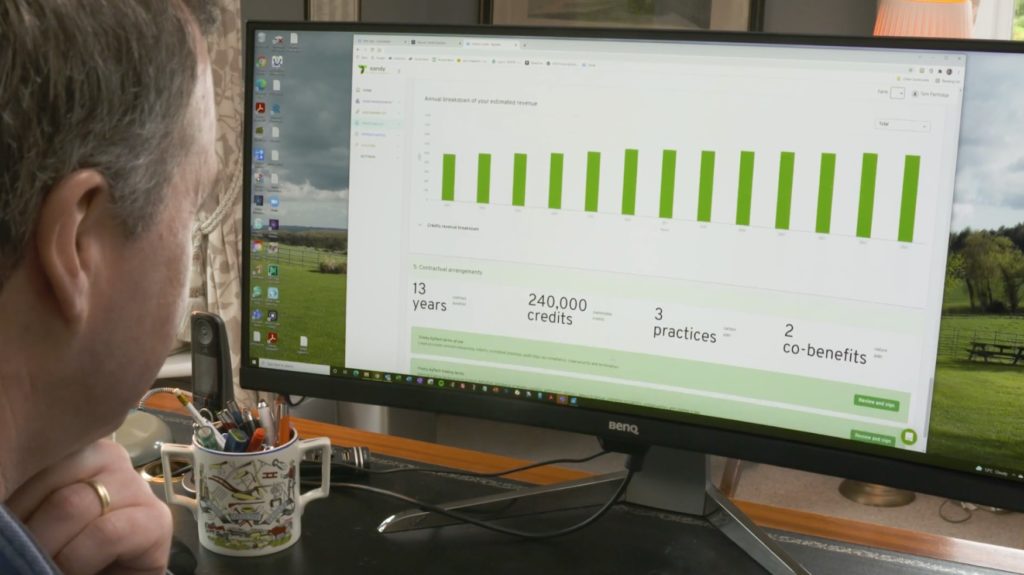
Sandy is set to gain ISO accreditation later this year and it is one of the technologies to be discussed at “Agri-TechE and ELMS – the Innovation Enablers” Tuesday 22nd March @ 10:00 am – 4:00 pm. Measuring, monitoring and getting paid are all challenges to be discussed, and the event will feature lightning presentations by innovators with a variety of solutions. Several farmers will be presenting at the event, which will be chaired by Andrew Blenkiron of Euston Estates.
Post Overview
Agri-TechE Related Posts
Brown&Co supporting farming businesses adapt to agricultural transition

Carpe diem, Global Agri-tech: Reporting from World Agri-Tech Investment Summit

Integrating Innovation with Existing Practices

Waitrose nature-friendly farming scheme has Reading support

Make agri-tech part of the solution at COP26