REAP 2024 Farmer Panel: Opening our minds to alternatives
 Agri-TechE
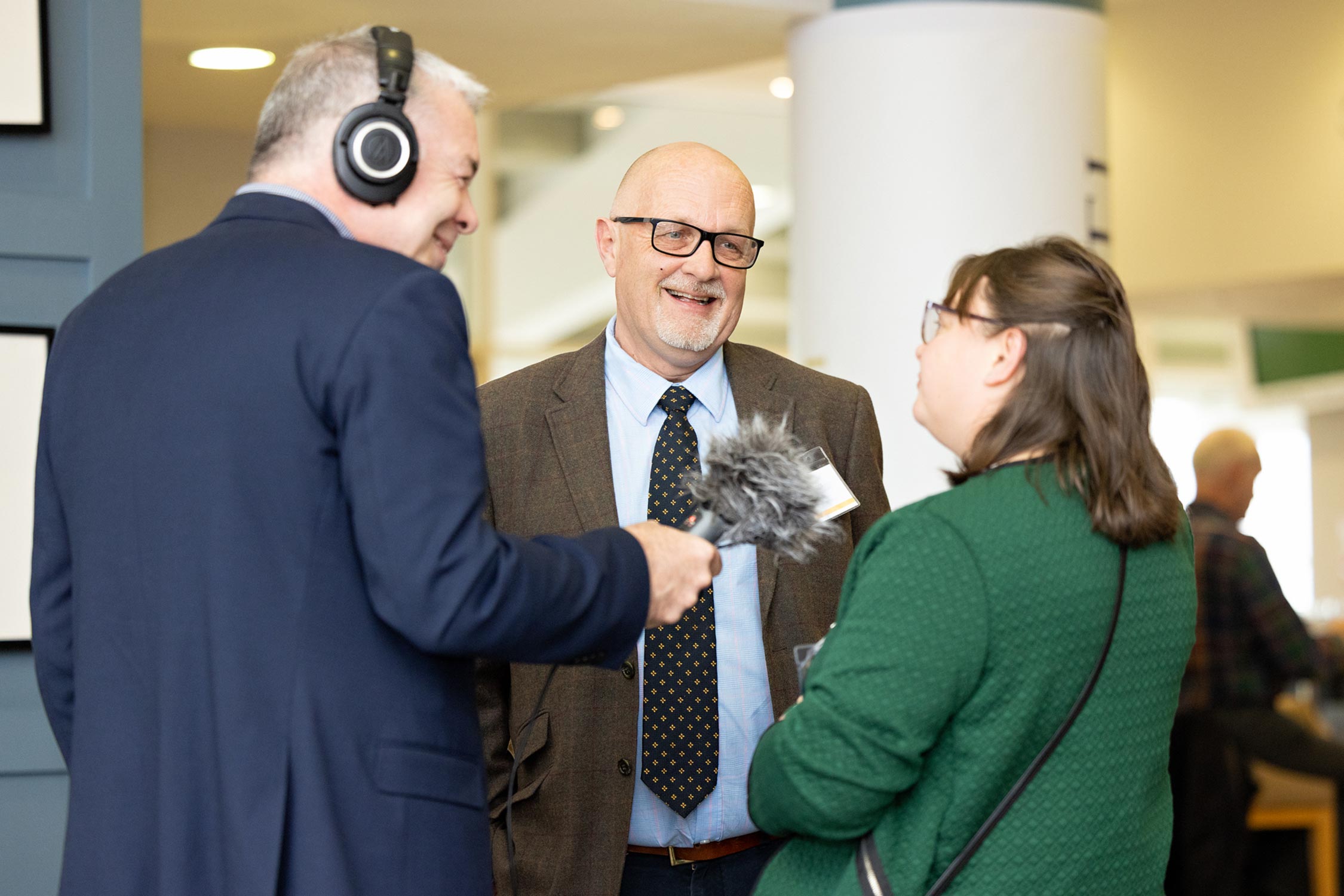
 Gaining the big picture view about emerging agri-tech and bringing together others with different perspectives are two of the benefits of attending REAP, according to Mike Gooding who will be chairing the Farmer Panel.
The future might look quite different
Mike is a farmer by background and has recently joined the AHDB as the Crop and Livestock Services and Farming Systems Director. He says that he learns something new every day: “At REAP we are all learning together so I don’t mind asking what might appear to be the ‘silly question’ – which is probably why I am chairing the session!
“Having a variety of perspectives creates opportunities to open up your mind and to challenge yourself to think more about how ‘the future may well look quite different’.”
Mike also understands the challenges of agri-tech innovation. He chairs a start-up in Cambridge called SmartBell. It is developing an ear tag for livestock that can predict illness through minute changes in the animal’s physiology and behaviour. They are working with other sensors and technologies to bring an in-depth understanding of what happens at different life stages to provide insights that will ultimately secure the animal’s full genetic potential.
Early trials suggest it can detect early indicators of pneumonia in calves enabling interventions before they require antibiotics.
Benefit from different perspectives
The two SmartBell founders are experts in data and sensor technology, and they see agriculture as an area of opportunity. Veena worked for Amazon in the United States, and Jose is a gas and oil engineer.
“Get somebody from Amazon, and data issues are solvable,” continues Mike. “Ask Jose about making the sensor more robust and he will say ‘well, this is how we do it in the oil industry’.
“What they are really progressing is a different attitude to data, and how it can be used and combined with other forms of data to advantage the livestock and farmer.
“They challenge me about decisions that farmers make – if we can’t justify it, we should open our minds up to alternatives.”
Mike gives the example of lameness which is an endemic condition in sheep but largely avoidable.
Multi-stranded strategy of technology and ideas reduces lameness
Working together with the team at FAI Farms in Oxfordshire a five-point lameness plan was developed offering a multi-stranded strategy of technologies and ideas. “By following this strategy, we reduced lameness to the point where I was able to go from 750 ewes on the farm to 1,250 ewes without any extra fixed costs and I started to make profit out of the sheep,” Mike explains.
“There was a straight economic benefit, a massive animal welfare benefit. And frankly, my staff were much happier because treating grotty, smelly feet is not a pleasant job.
“So, once we opened our minds up to being much more holistic, rather than simply the firefighting problem that’s directly in front of us, we brought around entire system change.”
The five-point lameness plan went on to be adopted across the sheep industry as a national strategy and is credited in reducing the prevalence of the disease in the UK from approximately 10% to 3%, a huge achievement.
“Having those different perspectives does build a much bigger picture. This is where I think the whole REAP conference should be about, not just the exciting technological opportunities, but how we apply them in practise.
Farm-centric innovation
Mike is keen to encourage as many farmers as possible to attend REAP and suggests these viewpoints would be good to discuss:
- The farmer perspective is vital – current on-farm challenges should be the key motivation for entrepreneurial development – solve that first and then expand. There is still a large group of people who are looking for the silver bullet scenario and it rarely exists and there can be unintended consequences. We do need that spirit and imagination – but arguably that should be financed with a different type of investment.
- New models are required for agri-tech investment – over the last 18 months it has been really difficult to access finance and increasingly we see investment funds holding the whip hand in what we can and can’t do in our agriculture and their time frames are different. If this country is serious about wanting to be at the forefront of innovation technology and to stimulate genuinely sustainable growth in our food production, then we need to find mechanisms and structures that encourage those agri-tech developments in practical ways and help overcome some of these key blockers.
- Need greater support from legislation – it’s not just small companies that are experiencing challenges gaining finance, it is a supply chain issue. A global food manufacturing business recently observed that their ability to adopt a more regenerative approach is limited by the requirement of their big institutional investors to deliver a level of return. If there was legislation to say, ‘you need to manufacture your food to X specification’, that would give them the leverage with their investors to say, look, this isn’t a commercial decision, this something we have to do.
The theme of REAP this year is the tipping point and this is multifaceted. We need solutions to on farm problems in the near term, but we’ve also got big challenges on the horizon that are coming closer. So where do you think the balance falls between precision and broad-brush?
“I see absolutely no practical reason why a wider viewpoint and precision are mutually exclusive. They should be together.
“The fact that I can identify individual animals’ problems is very relevant whilst I’m still trying to do things in a whole systems-based approach. And that’s where technology, offers real benefit.”
“However, I do think we need a much, much more engaged vision, politically, for what we want out of our food and our agriculture.”

“For salad potatoes the size of the potato is critical to the profit margin. We need to be selling more than a million tubers per hectare to make a viable return, but the goal is not just tonnes per hectare – we are after a particular size and quality.
“The size of the potatoes needs to be between 25mm and 47mm in diameter; potatoes larger than 47mm normally have little value and the tubers below 25mm fall through the harvest machinery and are lost. The difference in your returns can be significant if there are too many oversize or conversely too many under size.
“In terms of technology, we use hand digs entirely to monitor the tuber size and determine when to harvest.
“If it were possible to individually analyse the nutritional status of each plant and treat them so more of the tubers were ‘small potatoes’. Also, in real-time measure the quantity and size of the daughter tubers below the ground, then I could see real benefit in that type of technology.
“However, practically it would be difficult to do with a huge crop canopy up to a metre tall and a plant population of up to 100,000 plants per hectare, with each plant having up to six stems.
“Also, we do not currently use variable rate applications for the crops we grow, as we do not have the ability within the harvest machinery to accurately measure the yield per square metre. This information is needed to produce a yield map from which to base the variable rate applications of seeds, fertilizer or sprays etc.”
“REAP is a good place to exchange ideas with people you wouldn’t normally meet out on the farm, and I am looking forward to joining the Farmer Panel this year.
“As a farmer, you need to be innovative and always looking at ways to improve productivity and REAP is a good place to see the science and the technology that is in development.
“It is vital that technologists gain the farmer perspective and I would suggest the following to them:
- Technology must be accessible and fit in with the way that farmers work, as every farm is different.
- Technology won’t replace the skills of a stock person – but it will improve the way that they work.
- If technology improves productivity, it will be quickly adopted – nearly all the cows in our region now have the heat collars as the benefits are clear
“The transition to regenerative agriculture is a steep learning curve and it can take a while to see the benefits. We invite other farmers to come on to the farm and see what we are doing and then help them to do soil testing, baselining in preparation.
“Working together and being part of a cooperative, adds a degree of protection and an opportunity to share experiences and benchmark performance.
“We are looking to further evolve our cover crop policy and introduce more SFI options into the system but essentially the vision remains the big picture view ‘using botany, limited cultivation and soil biology to build healthy soils and crops’.”
Post Overview
Agri-TechE Related Posts
The future of AI in agriculture: the keynote address at REAP 2024
Five reasons for a farmer to attend REAP

Agri-Tech’s Business Model Maze
How one student found their future employer with the REAP Bursary
Could open innovation across the supply chain unlock agri-tech of the future?