Oxford Real Farming Conference – some highlights
 Agri-TechE

From “Rotation Rebellion’ to ‘circular farming’, new carbon calculators and the future of bread and wheat, discussions at the Oxford Real Farming Conference were wide-ranging, diverse and conducted in the historic setting of Oxford Town Hall.
A National UK Food Strategy
While many of the sessions were standing room only, the main hall overflowed to hear Henry Dimbleby update delegates on his current work on the National Food Strategy.
Unintended consequences
Working across Government departments, Dimbleby’s starting point was to look back at the food system, reflecting on the human ingenuity to solve a problem (food shortage) and the unintended consequences of those historic decisions.
Post-war years saw a focus on increasing food production in the UK, coupled with Borlaug’s famous research underpinning the Green Revolution, leading to increased use of genetics, application of synthetic nitrogen, and irrigation practices.
“Focus on calorie production led to humans getting fat and sick, and drove out Nature.”
Fast forward several decades, and the immediate problem of hunger was solved, but the increased calorie consumption has led to obesity and diet-related disease, as well as the unintended consequence of these farming practices generating carbon emissions. As agricultural yields increased, the wildlife inhabiting the land decreased.
Dimbley’s mission, therefore, is to recognises what has gone wrong, and devise a plan to rectify it. Echoing themes we discussed at REAP 2019, he highlighted the challenge of reconciling the scientific “reductionist” approach with the integrated systems approach, and recognising that Nature is a not a well-designed machine consisting of predictable parts, but a complex, dynamic inter-dependent system.
Work on the Strategy is ongoing, with an interim report due in Spring 2020 and Government White Paper promised six months later.
Food and Drink Sector Council – Agricultural Productivity Working Group (Defra)
Tim Morden, Defra’s Deputy Director of Farm Productivity, discussed a report presented by a Sector Council sub-group chaired by Sir Peter Kendall of the AHDB.
Recommendations include:
- Drive effective use of data
- Transform knowledge exchange
- Collaborate around mission-led approaches to research
- Drive uptake of professional training and development
- Enable rural infrastructure
Defra is currently planning how to align these with its priorities for the sector which include:
- providing investment – grants for farmers
- supporting R&D – to enable science-based approaches to innovation
- building capability and skills – to improve business performance
- structural changes – to improve flexibility and fairness for farmers in the supply chain and tenancy agreements
Counting Carbon, Not Calories
It was a rare talk at the conference that didn’t include the word “carbon” and the Holy Grail of how to calculate and value carbon on farms was much discussed.
With an agreement that more research is needed, some practical measures are underway to help farmers get a handle on this tricky metric.
The Farm Carbon Cutting Toolkit is a farmer-led programme, working with scientists to provide the underpinning data.
A new functionality was launched at ORFC – to calculate sequestered carbon as well as calculating carbon emissions from across the farm.
With some clever tools to also calculate methane from carbon dioxide equivalents, this can at least start to provide a baseline for where the major carbon emitting and sequestering activities are on farms, and the balance between them.
The Transition to the Circular Farm
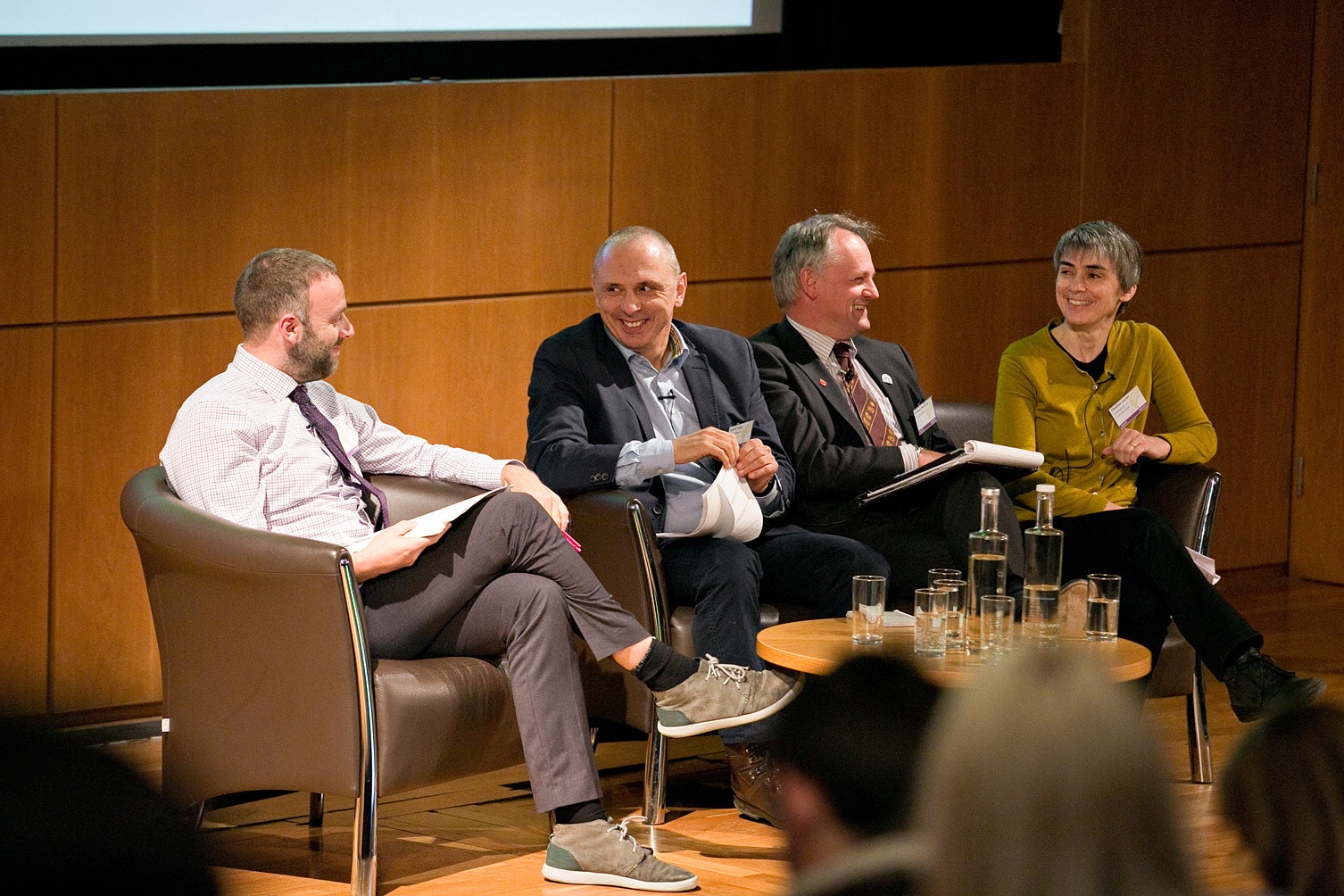
Trail-blazing farmers from the east of England were out in force at the conference, in a session around Circular Farming – featuring
- Callum Weir (Wimpole Hall Estate, Cambs),
- Nick Padwick (Ken Hill Estate, north Norfolk),
- Martin Lines (Nature Friendly Farming Network, Cambs)
- George Young (Fobbings Farm, Essex).
As well as hearing the inspiring stories of how these farmers are making a “circular farm” a practical – and profitable – reality, delegates also heard about the FABulous Farmers programme. This is a €4m programme with 12 pilot regions across 5 EU countries. The UK pilots are in the East, South West and Pembrokeshire and is free to join.
Support for move to regenerative agriculture
Financing transitions to a more regenerative, circular agriculture is a key part of the conversation.
Structures such as community shares , loans and grants are available, but speakers in this session advised not assuming a big upfront injection of capital would be needed.
Strategic planning and sweating existing assets, coupled with a willingness to take a more knowledge-intensive approach to understanding soils, biological pest control and the holistic system means that new capital may not necessarily be needed.
Reform of the UK tax system will also help. At present, delivery of ecosystem services and management of land in countryside schemes doesn’t qualify as a trading business, hence can’t benefit from tax relief.
Evidently these conversations are ongoing to try and simplify the complex current system.
Bigger Picture Conclusions

The sentiment emerging from the ORFC was that the UK is facing an opportunity to rewrite the rulebook.
Measuring “what matters”, and devising new metrics for “success” are going to be the new normal.
Wellbeing – Globally, consumption and increasing GDP are the traditional economic growth indicators, but some countries (such as Iceland, Scotland and New Zealand) are starting to consider health and wellbeing as targets as well.
Carbon storage – Policies to help maximise carbon storage and the financial models around these are likely to be key, and encouraging use of government levers such as public procurement to create new markets is underway.
Resilience – Geo-political disruption, leading to issues such as fires, drought and flooding, are likely to potentially affect trade deals and could drive a need for greater resilience in food production. This creates new opportunities for farmers and the food system.
Business efficiency – Public investment to help improve land management, and a functioning marketplace are going to be key to deliver changes in the way food is produced.
Social change – Finally, the mental wellbeing of those in the industry mustn’t be overlooked. With such unprecedented change and uncertainty, the rhetoric being played out over social media, and the transition into a new structure of the industry may not be without its casualties.
This is a conversation that affects all parts of the agri-food ecosystem – and we all have a responsibility.
Quotes of the Conference
“Fertiliser is better out of a bum than a bag!”
“We need to generate value not volume as farmers. Nourishment, not tonnage should be the goal.”
“‘Less but better’ is the way forward with meat and dairy.”
Post Overview
Agri-TechE Related Posts

Up-skilling agri-tech
REAP 2017 report: Today’s knowledge meets tomorrow’s technology

Agri-tech missions, conferences and events for 2021
Triple helix approach to agri-tech innovation underpins UK farming future

Cereal killer samples taken directly from the field to improve the Recommended List