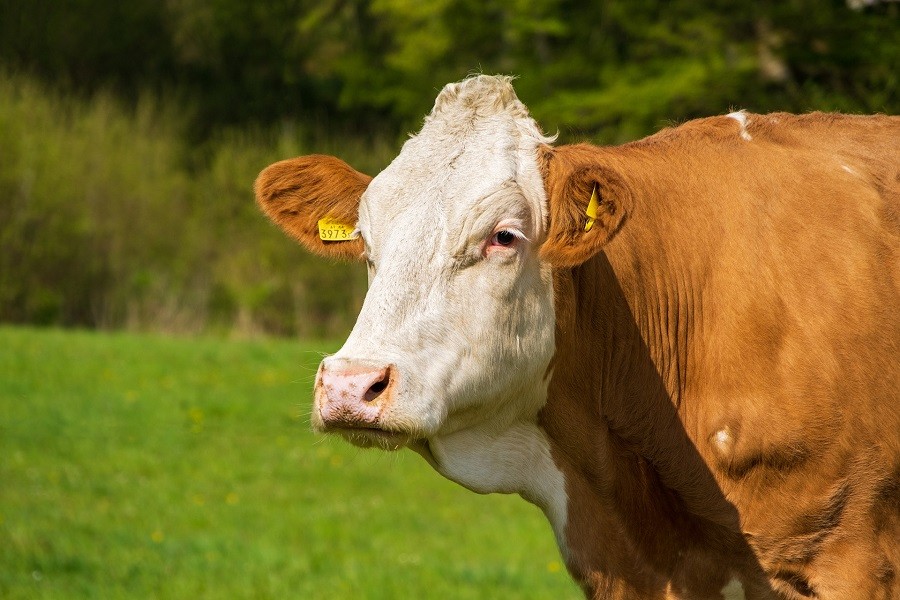
No more lost sheep with Movetech sheep tracker device
 Agri-TechE
 Losing sheep in a snowdrift or when about to give birth creates a severe economic loss to upland farmers, but now a new ultra lightweight tracking device offers a cost-effective way to monitor animal behaviour.
The device was originally developed for tracking wild birds for research into migration, however the insights it offers into animals’ behaviour suggested that it might be of interest to livestock farmers.
The researchers from the University of East Anglia met with Jamie Lockhart, former Farm Manager at Honingham Thorpe Farms, to discuss potential applications. These included detection of eating habitats to provide early warning of ill health or food shortage; detection of lameness; unusual heart movements providing indication that the herd is being worried by a dog or locating the sheep in poor weather.
Stealing of sheep and deer is not uncommon so the device might provide early warning of a crime and the ability to track the animal if the device is undetected.
Aldina M.A. Franco is part of the research team; she comments: “There is a need to train the system before it can identify what is abnormal. This is achieved by collecting data and looking for patterns; if the animal behaves in a certain way for sometime and then changes this behaviour it can indicate stress or change in circumstances.”
Data management
Movetech devices use the mobile phone network to transmit the data. Where access to a network is not possible, they can store up to 60,000 records and will transmit these when network access is restored. The devices are network agnostic and will switch between networks depending on the strongest signal. In the UK, for example, they can access all the main carriers.
The information from the tag is sent to the Movetech server where it is stored and it can be simply accessed via a standard web browser. There is also opportunity for the processing of the data and to determine various metrics from it – this can be tailored to each application. The standard device includes a GPS, accelerometer and temperature sensors. A barometric (pressure) sensor is also available. Accelerometers measure the change in movement (acceleration) of the tag and this can be used to infer aspects of the animal’s behaviour. It can be used as a mortality sensor (e.g. sudden decelerations such as when a bird is shot from the sky, or long periods of total inactivity).
Movetech experts in solar
Movetech are experts in wild animal tracking and use these devices in their research and sell them to other uses in the wildlife market. The devices are reliable and efficient and can be used in solar-powered versions (from 12 grams upwards) or using primary batteries. They can be easily integrated into other systems.
Movetech are expert in small solar-powered energy management systems and can use standard solar panels or very high efficiency (30% efficient) panels. The energy-harvesting system allows power to be generated, even in low light situations.
Future plans
Phil Atkinson of the British Trust for Ornithology, one of the collaborators, says: “Whilst we know the wild animal market, and are users of this technology ourselves, we are looking for partners to licence and develop the technology in other sectors in other markets. “Livestock, pet and other asset tracking (e.g. drones) are all large markets and our devices would be suitable for all of these. The electronics in our smallest device weigh under 4 grams and these would be suitable for small animals and drones. Moving upwards we have larger devices that would be perfect for tracking larger animals.
“We of course do not lack ideas! We have a road map of what we want to achieve moving forward and this includes expanding the communications options to include download to local base stations, satellite data transfer to ensure truly global coverage and the development of ‘smart’ tags that process data on board and make decisions about how to respond based on this. We would be delighted to discuss and explore funding opportunities to make these ideas a reality.”
Find out more information about the Innovation Hub at the 2018 Royal Norfolk Show.
Read more articles on livestock technology in our Knowledge Hub.
Post Overview
Agri-TechE Related Posts
AgriSound launches timely pollination monitor at REAP 2021
Sustainable agriculture has important role in One Health
ATW 2025: ‘Making the Most of Organic Materials’

eFeed: Cattle and Climate – A Comprehensive Review on Feeding Strategies to Control Enteric Methane Emission from Cattle
Breedr’s virtual value-chain for livestock production supports NFU’s targets