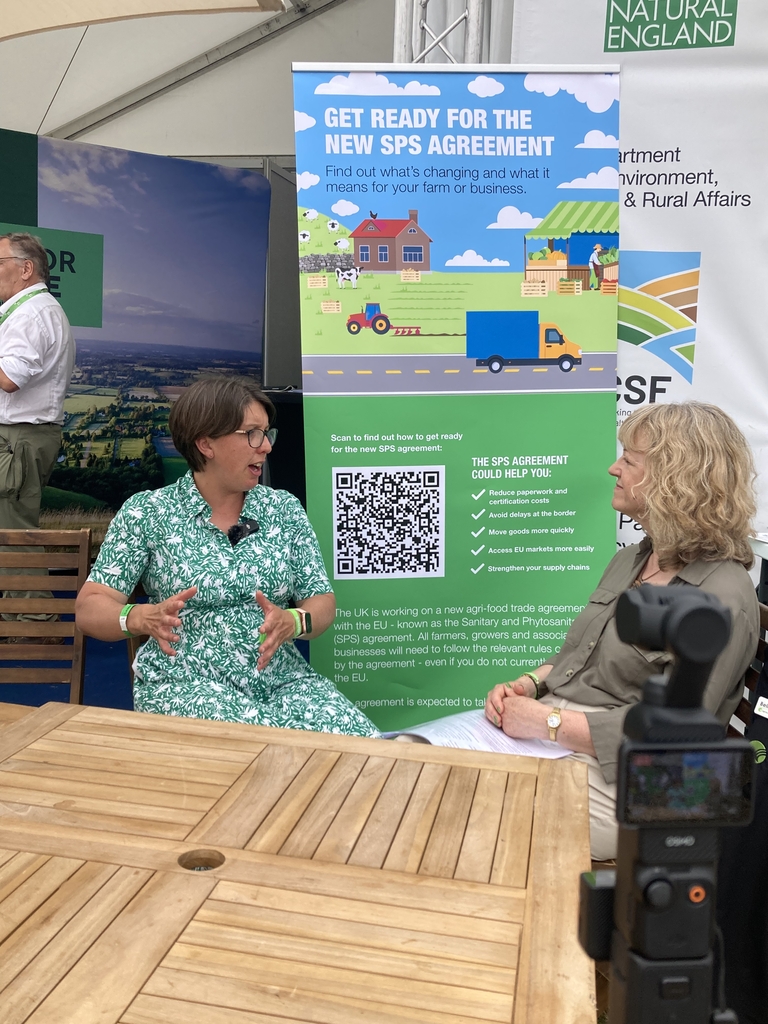
The Farming Roadmap 2025: A new government but the same farming blueprint
 GK Strategy
The Department for Environment, Food and Rural Affairs (Defra) published the Farming Roadmap 2050 – a first of a kind framework that articulates the government’s long-term vision for the farming and agriculture industries. Its long-waited publication in June 2026 was one of the final acts of Starmer’s second ministerial team at Defra since Labour’s election victory in 2024. It provides Burnham’s new government with a ready-made blueprint for English farming.
The roadmap will benefit from a strong degree of ministerial continuity as Burnham’s Defra secretary Angela Eagle previously served as Starmer’s farming minister and was responsible for its development. For a government department that has been plagued by ministerial churn, Eagle’s appointment offers a welcome degree of continuity for a sector that has called for greater policy stability, long-term certainty and a sustained focus on delivery.
At the heart of agricultural policy is the challenge of reconciling the need to improve levels of environmental sustainability with a food security priority to increase domestic production and farm productivity. Rather than treating these as competing policy objectives, the roadmap seeks to reframe the policy debate, arguing that long-term food security depends on nature restoration.
Farming has evolved
Farming in the UK has experienced significant change since Brexit. Farmers continue to navigate changing support schemes from the EU’s Common Agricultural Policy to the UK government’s Environmental Land Management (ELM) schemes. Productions trends have evolved with the economics of livestock farming becoming more favourable than arable. While the sector has not fundamentally shifted away from crop production, recent trends have seen livestock account for a growing share of agricultural output by value, reflecting stronger market prices alongside persistent pressures on arable profitability.
Defra’s farmgate price index reports that farm produced goods have increased by 60% from 2016 to 2026, which compares to 38% in the previous decade. UK agriculture has been hit hard by the effects of successive global shocks: supply chain disruption following the Covid-19 pandemic; Russia’s invasion of Ukraine, a country known as the ‘breadbasket of Europe’; and sharp increases in energy, fertiliser and animal feed costs. This directly impacted consumers with elevated levels of food price inflation, driving broader inflationary pressures experienced across the UK economy. This led to an important shift in the UK agricultural policy debate. Policymakers are talking more boldly about domestic food security and improving the sector’s long-term productivity and resilience.
It is against this backdrop that the Farming Roadmap 2025 seeks to provide a coherent framework setting out how agriculture can strengthen food security, enhance productivity and deliver improvements in tandem.
The Batters review recasting the value of agriculture
Central to the development of the government’s roadmap was Baroness Batters’ independent review into farming profitability published in December 2025. The Batters review sought to recast the value of farming. While the direct gross value add of farming is roughly 0.6% of GDP (£10.5 billion), this is a critical domino across a wider agri-food supply chain that generates £150 billion gross value add to the economy – equivalent of 6% of GDP.
The independent review argued that all too often policymaking has undervalued the role of agriculture. Batters stated that the ‘£2.4 billion figure for farming in England has been almost the same since 2007… [and] given the enormous strain public finances are under, there is no guarantee that future funding will remain at the existing level’.
Implicit in Batters’ analysis is the argument that successive governments have been too relaxed about agriculture and food security since the financial crisis, despite being one of the few industries with an economic footprint in every local area across the country. Batters made a total of 57 recommendations that cover matters from regulations, energy and connectivity, to tax incentives, grants and investment.
The review is far greater than the sum of its recommendations. It provides a strong strategic rationale for a long-term agricultural policy that places productivity, food security and environmental stewardship at the heart of government decision-making.
The Farming Roadmap
The Farming Roadmap 2050 is intended to provide a single, coherent framework for agricultural policy over the next quarter century. Rather than introducing an entirely new policy agenda, it brings together existing statutory obligations and strategic commitments into a unified long-term vision for English farming including the Climate Change Act 2008, the Environment Act 2021, the Environmental Improvement Plan, government carbon budgets, the Land Use Framework and the Good Food Cycle.
Looking ahead to 2050, the roadmap envisages a farming sector that is more integrated, productive and resilient. It proposes a more diverse agricultural system in which livestock and arable production are better integrated both within individual farm businesses and across regions, alongside increased domestic production of fruit, vegetables and wholegrains.
The roadmap anticipates the widespread deployment of methane reduction and capture technologies, precision farming techniques and renewable energy to improve both productivity and environmental performance. It places considerable emphasis on strengthening the long-term resilience of farm businesses through more diversified income streams and by aligning agricultural production more closely with changing consumer demand and healthier dietary patterns.
The government’s approach is structured around seven key themes reflecting a whole supply chain view of profitability and a wide-ranging set of actions to be delivered over the quarter century period. Chief among these is the creation of the Farming and Food Partnership Board, which is intended to provide a permanent forum bringing together government and senior representatives from across the farming and food supply chain to oversee implementation of the roadmap, develop sub-sector growth plans and ensure policy is informed by industry expertise. It represents an important shift toward a more collaborative model of policymaking, with government seeking to work alongside industry to improve productivity, unlock investment and strengthen the competitiveness of the farming and agriculture industries.
The creation of the Farming and Food Partnership Board demonstrates the government’s willingness to reset its relationship with a sector whose confidence was shaken by the fallout from Starmer’s eventual U-turn on inheritance tax relief for agricultural assets. The roadmap signals a more mature and collaborative approach to policymaking, with government recognising that long-term agricultural reform cannot be delivered without sustained engagement with farmers, food producers, investors and the wider supply chain. The roadmap provides greater visibility over the government’s strategic direction and a clearer framework against which to make long-term investment decisions.
The new governance arrangements through the Farming and Food Partnership Board create meaningful opportunities for industry to shape the design and implementation of policy and the development of sub-sector growth plans. For investors and businesses willing to engage constructively with government, the next phase of agricultural policy is likely to be defined less by reactive lobbying and more by strategic partnership in delivering a more productive, resilient and competitive farming sector.
- *I have permission from the copyright holder to publish this content and images.
Related Posts

A refresh for the Niab name and logo
Strategy needs stewardship: Who Owns Strategy When Everyone Owns Strategy?

Patent Box tax reduction scheme
Succession or Stagnation: What really happens when succession planning is avoided

The King’s Speech 2026: State Opening, Political Unravelling