Proving What’s in the Ground – The Analytical Case for Peatland and Woodland Carbon
 Pennine Analytical Laboratories Ltd
The UK’s most significant terrestrial carbon stores are peatlands and woodlands. Unlocking their value for carbon markets and green finance demands something that good intentions alone cannot provide — independent, rigorous, and repeatable soil data.
- 2bn tonnes of carbon estimated to be stored in UK peatlands, more than all UK forests combined
- 80% of UK peatland is estimated to be in a degraded state, releasing rather than sequestering carbon
- Both the Peatland Code and Woodland Carbon Code require independent verification before credits can be issued
Peatlands are the UK’s most carbon-dense landscapes. Woodlands, planted and ancient alike, are the most visible symbol of the nation’s net zero ambitions. Both are receiving significant investment, from government schemes, private green finance, and voluntary carbon markets. And both face the same fundamental challenge: proving, with defensible data, that the carbon claimed is the carbon delivered.
That proof begins in the soil. Carbon sequestration is not visible from the surface, cannot be inferred from vegetation surveys alone, and cannot be estimated with sufficient precision for credit schemes and investor due diligence. It must be measured — rigorously, repeatedly, and independently.
For Peatland Restoration Projects & Land Managers
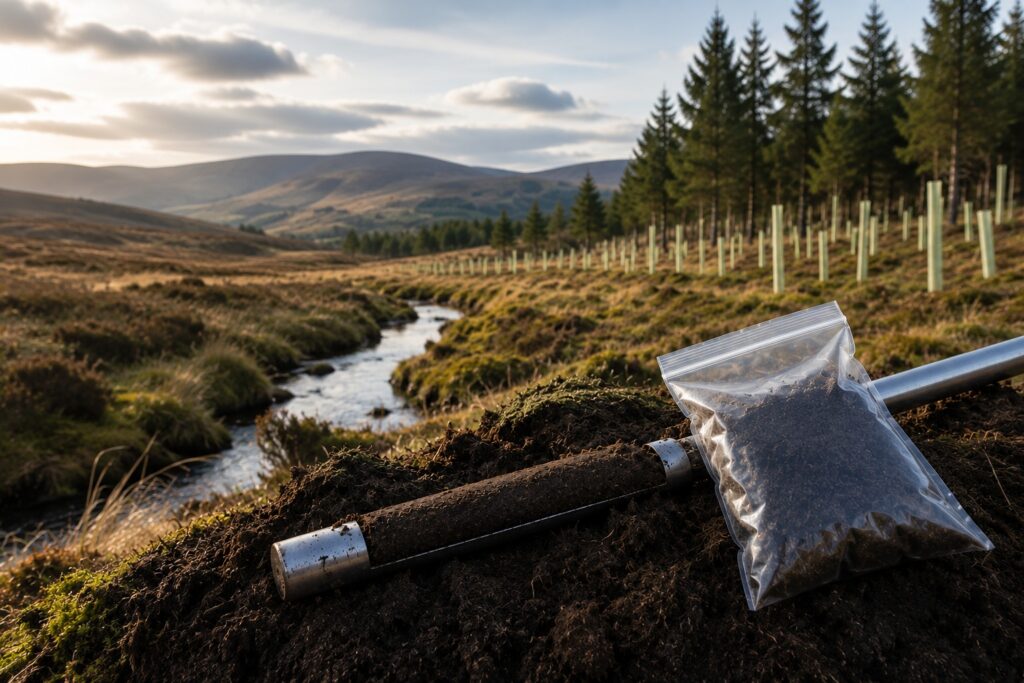
Peat is not a straightforward material to analyse. Its high organic carbon content, heterogeneous structure, and variability across depth and location demand a specialist approach that general-purpose contract laboratories are rarely equipped to provide consistently. For projects operating under the Peatland Code, where verified carbon units depend on credible baseline and monitoring data, the quality and repeatability of laboratory analysis is not a peripheral concern. It is what the entire financial case rests on.
PAL’s Total Organic Carbon (TOC) analysis is well-suited to the demands of peat matrix testing, providing the high-precision carbon determination that baseline surveys and multi-year monitoring programmes require. Equally, tracking the carbon-to-nitrogen ratio across a restoration timeline gives project managers the evidence to demonstrate that hydrology restoration and vegetation recovery are translating into genuine soil carbon improvement, the kind of data that satisfies both scheme assessors and impact investors.
For woodland creation projects operating under the Woodland Carbon Code, the requirement is similar: credible soil carbon baselines established before planting, and consistent monitoring data across a long-term verification timeline. PAL’s express three-day turnaround is available where project or funding milestones demand speed without compromise on precision.
For Ecological Consultancies & Carbon Scheme Developers
Consultancies building and managing peatland and woodland carbon projects on behalf of landowners need a laboratory partner whose data will withstand external scrutiny. Scheme verifiers, auditors, and institutional investors are all asking harder questions of the analytical evidence underpinning carbon claims — and the bar for what constitutes acceptable independent verification is rising steadily.
PAL’s specialist focus on elemental analysis means consistent methodology, sample-to-sample repeatability, and results that carry the credibility of a dedicated laboratory rather than a general testing facility. For consultancies managing multi-site or multi-year monitoring programmes, where data consistency across the full dataset is as important as any individual result, that focus matters considerably. Whether the project is a single restored peat bog or a portfolio of woodland creation sites, PAL can provide the analytical backbone that a commercially credible carbon project demands.
Specialist Analysis for High-Stakes Carbon Projects
Pennine Analytical Laboratories (PAL) is an independent elemental analysis laboratory based in Greater Manchester, working with land managers, restoration projects, ecological consultancies, and carbon scheme developers across the UK. PAL’s specialist focus on carbon and nitrogen analysis makes it a natural analytical partner for peatland and woodland projects where the integrity of the data is inseparable from the integrity of the project itself.
PAL Services for Independent Analysis for Evidence-Based Restoration
If you have an analytical requirement not listed here, get in touch. PAL welcomes enquiries across a wide range of sample types and testing needs, including:
- Total Organic Carbon (TOC) – High-precision carbon determination for baseline surveys, credit verification, and long-term monitoring
- Nitrogen & Carbon (C:N) ratio analysis – Track decomposition dynamics and nutrient cycling as restored peatland and woodland soils recover
- Nitrogen & Protein Analysis – Characterise plant material and vegetation recovery to support ecological monitoring alongside soil data
- Full elemental carbon, hydrogen, nitrogen, sulphur and oxygen (CHNS/O) profiling of complex peat and woodland soil matrices for detailed carbon accounting.
Fast Turnaround. No Compromise on Precision.
- PAL offers a 10-day standard turnaround service.
- Customers across the UK simply courier samples to our laboratory and receive their data wherever they are.
- Results are reported direct to your inbox.
PAL is delighted to be a member of the Agri-TechE community supporting growers, researchers, and innovators with the analytical foundation that good decisions require.
Samples can be couriered from anywhere in the UK, with results returned digitally and a three-day express turnaround available for time-sensitive project milestones. PAL is experienced in working with heterogeneous, high-organic matrices, the kind of samples that require more care and consistency than a standard agricultural soil. PAL supports the peatland and woodland community with the independent analytical rigour that serious carbon projects demand.
Talk to PAL About Your Carbon Project
Whether you need a one-off baseline or an ongoing monitoring programme, PAL can help. Get in touch at [email protected] or visit www.pennineanalyticallaboratories.co.uk — we’d be happy to discuss your requirements.
-
- *I have permission from the copyright holder to publish this content and images.
Post Overview
This story has been submitted by an Agri-TechE member.
Related Posts
Data-driven environmental monitoring highlights significant variations in bird biodiversity

We reveal the Top Eight Innovations in the REAP 2025 Start-up Showcase

How open collaboration in agri-tech could help solve the farm profitability puzzle
NatureTech: Supporting Businesses to serve both Profit and Planet
ATW 2025: How can Agriculture Decarbonise the Supply Chain?