Bringing Roboverse to the UK, turning promising robots into practical farm systems
 Roboverse Reply UK
Agriculture has no shortage of promising robots. The problems they address are clear: labour shortages, rising costs, pressure to reduce inputs and repetitive work in difficult environments.
What has proved harder is turning a promising machine into an affordable and dependable part of a working farm.
This is a problem I have seen from several sides. Before leading Roboverse Reply UK I was Head of Robotics and AI at the UK Agri-Tech Centre, where I worked directly with many of the companies developing robots for British farms. Earlier in my career I worked on robotics in the defence and automotive sectors, where development and validation processes are considerably tighter. The contrast between those industries and the way agricultural robotics is funded and developed explains a great deal about why so much good technology has struggled to reach the farm.
By Eliot Dixon, Technical Director
Why good technology struggles to reach the farm
Much of agricultural robotics has followed a vertically integrated model in which one start-up develops the robot, autonomy, sensors, artificial intelligence, data platform and commercial service for a particular task. The funding environment plays a part in this. Public programmes tend to reward technical novelty, while investors generally want defensible intellectual property. Both can encourage developers to own more of the technology stack, even where combining proven components would produce a more pragmatic solution for the farmer.
The recent history of UK agricultural robotics illustrates the difficulty. Small Robot Company, Xihelm, Fox Robotics and Muddy Machines all ceased trading between February 2024 and May 2025. Between them, these companies had attracted well over £20 million in private investment and public grant funding.
To be clear, this is not a story of failed companies. Having worked alongside several of these teams, I know the skill and commitment they brought. They proved that extremely difficult agricultural tasks could be automated and created knowledge from which the industry continues to benefit. What was lost was the investment, and it was lost largely because of the way the market works: funding has generally been easier to find for a new idea or a technical breakthrough than for the slower engineering needed to turn it into a dependable product.
That imbalance shapes what gets funded. Investment is rarely interested in design, validation and the deeper engineering process that shows little visible progress, yet this is exactly the work that takes a robotic system to the point where it is highly attractive to the end user. Each round therefore pays for a further demonstration of novelty, because that is what the market rewards, and the work that would make the product dependable is rarely directly funded, so lessons have to be learned through iterative development instead. This is the transition from innovation to product, and it is where the funding usually falls short.
Agriculture makes this harder than most sectors. Software can be iterated continuously, and most hardware industries can test year-round on a production line or a proving ground. Even then, as in automotive, much of the development effort goes into design rather than implementation. However, an agricultural robotics developer may have only a handful of short seasonal windows in which to test in real conditions before the funding runs out, and a missed window costs a full year. Iteration in the field therefore must be mitigated through a far greater share of the work being done up front, through design, analysis and simulation. Scarce field time is then spent confirming expected behaviour rather than discovering requirements, or finding issues that a properly funded design and controlled testing phase could have caught long before the machine ever reached the field.
Three questions to ask during the project
Given the experience of past projects, at Roboverse Reply we do not enter an engagement assuming that a robot is the best answer. We expect the case for development to be proved by answering three questions: will it create enough value, how will it fit into the farm, and is there a credible route to proving that it works reliably? These questions may also be useful for funders and investors to expect projects to answer in detail.
The work needed to answer them should form funded stages within the project. Small and medium-sized robotics companies cannot reasonably be expected to complete a detailed value assessment, system design and validation plan at their own expense before they are eligible for support. Funding the work in stages allows each answer to be developed with the right evidence, followed by a decision on whether further investment is justified.
Question one: will it create enough value?
Innovate UK and similar programmes already ask applicants to explain the market need and commercial opportunity. In practice, developers are rarely funded to investigate these questions in much depth before technical development begins. The initial business case can therefore remain an informed estimate when it needs to become an engineering requirement.
A value assessment should be the first funded phase of the project, carried out closely with farmers and other end users. It should examine how the operation currently works, where value is being lost and what improvement would be large enough to justify changing the existing process.
This phase should end at an explicit decision gate. If the evidence shows that the value is not there, because the task will not support the cost of automating it or because a simpler change would capture most of the benefit, then the right decision is to stop. A project that stops at this gate for the right reasons should be treated as a success of the process, not a failure of the team. Discovering that an application is not viable before the machine is designed costs a fraction of discovering it afterwards.
The gate should not be limited to a binary choice between continuing and stopping. A value assessment will often show that part of the core proposal is sound but aimed at the wrong task, crop or point in the operation. Funding structures should allow a project to be redirected in these cases, so that the good work is carried forward rather than discarded. I have supported companies through this kind of redirection in the past, and the redirected projects were stronger for it. Where the case is proved, the assessment should continue alongside the design as it develops, rather than being confined to the funding application.
Question two: how will it fit into the farm?
It is easier to match the machine to the farm than to expect the farm to reorganise itself around the machine. The more complete approach is to design the robot as part of a system that includes the rest of the farm. This means accounting for how it will fit into existing physical operations as well as how its data will move through the systems already used to manage the business.
For most farms, the farm management system should be the main point of integration. Platforms such as Omnia and Gatekeeper already hold the operational context a robot needs, and can receive in return a useful record of what it observed, what action it completed and where attention is required. This is why our approach is to integrate with whatever data management system the farm already uses, through an open interface, rather than arriving as another standalone system. Farmers should receive information through the tools they already work with, in a form that supports a decision, rather than being given another isolated dataset or interface to manage.
A funded system-level design stage should define these processes, interfaces and support requirements before the robot architecture is fixed. This reduces late technical changes and exposes costs or adoption barriers while there is still time to address them. It also prevents a capable machine from becoming an isolated piece of equipment that creates extra work elsewhere on the farm.
Question three: how will reliable operation be proved?
A proof of concept is an important milestone, but it is a long way from commercial readiness. The distance between a controlled demonstration and a product that can cope with a real outdoor environment, season after season, is where most of the engineering effort actually lies, and it is where funding most often runs out. In the defence and automotive industries this is well understood: validation is planned and resourced from the start.
Robust testing and validation should therefore be planned and funded as a serious phase of the project. The plan needs to define what evidence a farmer, distributor or investor will require before adoption, and the conditions under which that evidence must be gathered. Measures of productive work, human intervention and total operating cost are generally more revealing than a successful demonstration on a single day.
Stage gates can then be tied to evidence from increasingly representative operation. This gives funders a way to control risk without withdrawing support at the point where the less visible engineering work begins. It also gives developers a clear route from proof of concept to a product that can be supported commercially.
Reaching that standard requires a substantial engineering base. Reliable software, safety processes, test capability and support systems are expensive to create for one narrow application. The robotics capability can be provided more economically by an organisation that reuses this engineering base across several markets. This is a collaboration rather than a replacement: the detailed knowledge of the agricultural problem and the route to farmers comes from a specialist company already working in the sector, and the complete product depends on both.
Horizontal integration changes the engineering challenge
Selecting proven components from different suppliers changes the nature of the project. Less effort is spent creating a robot and its underlying technologies from scratch. More can be spent on product design, integration and testing for the particular farm operation. The technical challenge remains significant, but it is concentrated on making the complete solution useful and dependable.
This approach is practical now in a way it was not five years ago. Robust, lightweight platforms suitable for agricultural work are commercially available from manufacturers in the UK, Europe, the USA and China, at price points and durability standards that make sense on a farm. The scarce capability is no longer the platform itself. It is the software, integration, safety and support engineering that turns a platform into a product a farmer can depend on, and that engineering is largely reusable across applications.
Reply already applies this horizontal model across infrastructure, energy, agriculture and
industry throughout Europe. We work with multiple robots from different manufacturers,
including ground platforms and drones, supported by a reusable base for coordination,
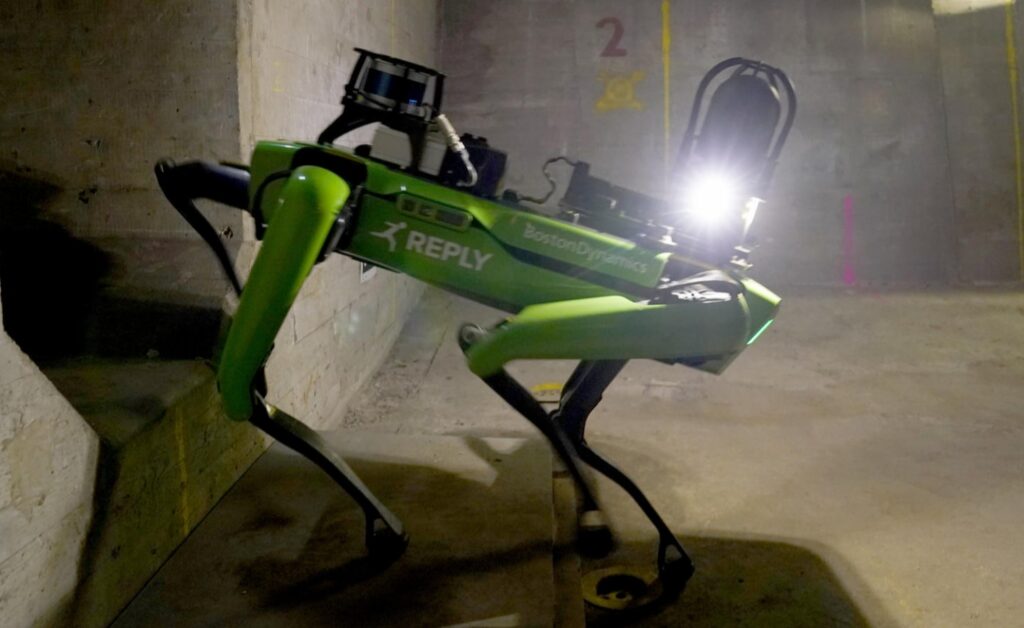
autonomy, remote operation and data management. For a major European port authority, we
used an autonomous robot to inspect the four-kilometre internal structure of a strategic bridge,
collecting consistent inspection data in a difficult and potentially hazardous environment. Other
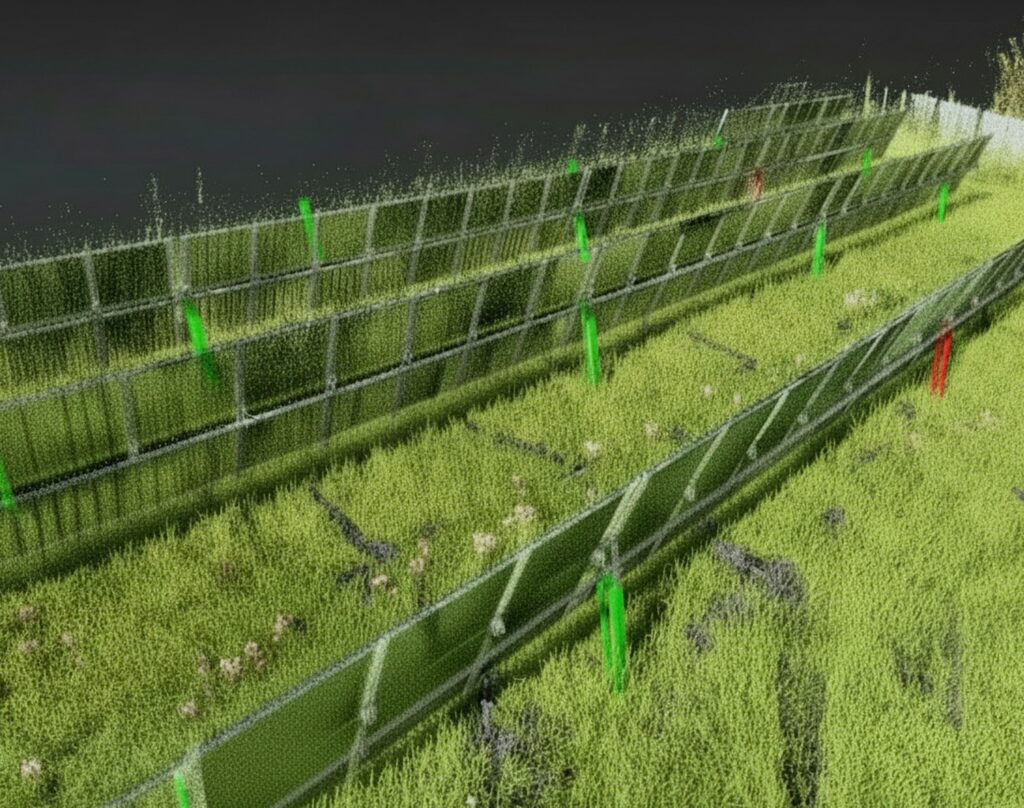
deployments have included railway-tunnel reality capture, autonomous inspection at energy
and industrial sites, and drones collecting imagery across large areas of agricultural land. In
these deployments the high-level control, data and support systems have been exercised across
a broad range of indoor and outdoor environments, and that proven base makes solving
agricultural challenges significantly faster.
A farm may eventually use scouting robots, drones, autonomous tractors and specialist machines from several manufacturers. CASCADE, the Roboverse Reply platform, has already coordinated mixed fleets of aerial and ground robots from different manufacturers within a single operational view, and can provide the same common coordination and data layer on the farm, while the farm management system remains the farmer’s point of contact with those machines.
Horizontal integration still depends on the phases of a well-run project. Components should be selected only once the value has been understood, assembled through system-level design and accepted on the strength of testing in representative conditions. Otherwise, integration risks becoming another technology demonstration rather than a route to a usable product.
Working with the people farmers already trust
Over the coming months, Roboverse Reply UK will demonstrate how this approach, and
capabilities already proven across the Reply group, can create value in UK agriculture. Farmers will always be less likely to buy robots from a company they have never dealt with. The machine should come from an organisation that understands the farm and that the farmer already trusts: a machinery dealer, an agronomy service, a grower group or another established supplier. We are looking to work with exactly these organisations. They bring a detailed understanding of the problem, credibility with farmers and an established route to market; we bring the reusable robotics engineering base needed to turn that knowledge into a product farmers will find genuinely useful.
The next step for agricultural robotics is less glamorous than another technical leap. It is to fund the work needed to understand the value, design the whole farm system and prove it in use. That is how robots become equipment on which farmers can depend.
-
- *I have permission from the copyright holder to publish this content and images.


Related Posts

Back-to-Back Awards for Burleigh Dodds!
Farming is hard to replace with AI. The admin around it is not.
The Inevitability of AI Quality Control
We reveal the Top Eight Innovations in the REAP 2025 Start-up Showcase
The future of farm machinery isn’t about bigger tractors – it’s about better systems