ATW 2024: Surveillance and Monitoring in Plant Protection
 Rothamsted Research
Agri-TechE Week 2024 celebrates its 11th year – our largest yet, featuring nine events curated by Agri-TechE and hosted by our incredible member community. This week exemplifies innovation, collaboration, and forward-thinking in agri-tech.
Each event reflects the strength of our ecosystem, fostering vital connections between growers, researchers, and technology developers. Thank you to our members for hosting and making Agri-TechE Week possible and showcasing what our community can achieve.
Rothamsted Research were our hosts for Thursday’s Agri-TechE Week event looking at the science behind pests, diseases and weeds. With project updates from PhDs and industry collaborations, to start-up pitches and an interactive workshop, we covered a lot in a small time!
SporSenZ, developed by Rothamsted spin-out FA-Bio uses a small, in-field device that mimics root compounds to measure the bioactive microbes in soil. As well as providing tailored insights to growers about the active microbes affecting their soil, this technology can also help us identify useful strains of fungi for biostimulants and disease control. This technology deepens our chemical understanding of soil environments and how they shape broader ecological interactions.
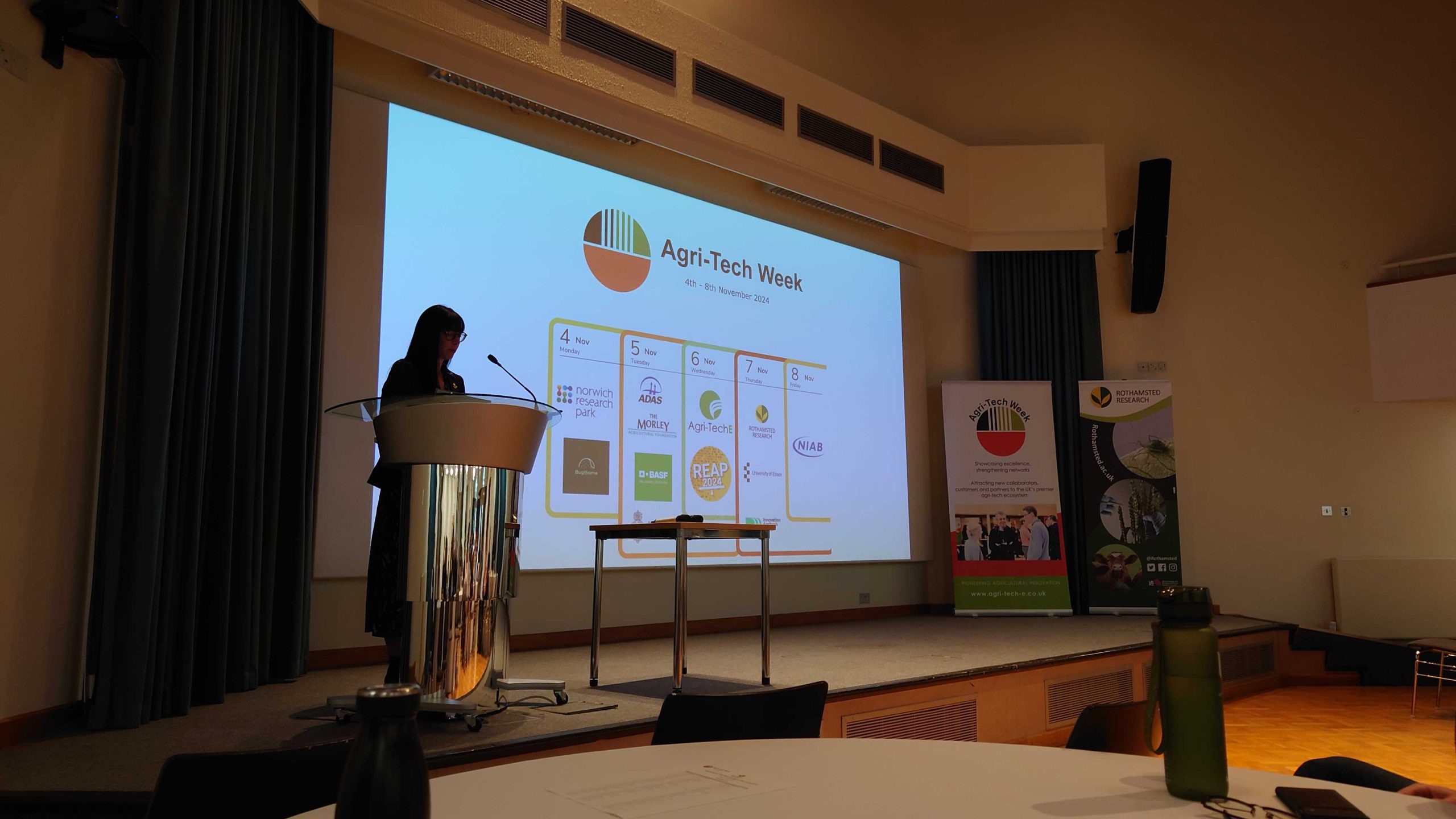
Professor Jon West gave a comprehensive analysis of the different crop disease surveillance and monitoring tools available – from early warning predictions to visible signs in-field. Whilst there’s no single solution, new technologies are allowing for earlier diagnostics on a much wider range of issues.
A case study of the usefulness of predictive tools showed that uncovering crop fleece just a few days later might avoid fungal infection, by detecting levels of spores in the days preceding. More frequent DNA sequencing might also help us reveal unexpected challenges – such as genetic mutations leading to new strains of disease.
Dr Dion Garrett walked us through his work with G’s Fresh to monitor pests. Rothamsted’s Insect Survey provides open data and text bulletins to growers on aphid and moth populations.
Working in collaboration with Jackie Stroud, at Warwick University, bioacoustics are being used to assess stem flea beetle load, replacing the usual destructive method of breaking crop stems. Automated pop-up suction traps (TrapView) are added into the high tech/lo-tech combination to analyse and forecast the pest situation on farm.
Looking to the future, Dr David Comont talked us through SmartSprayer – a collaboration with Bosch and BASF to enhance their One Smart Spray sprayer technology to combat blackgrass.
The project uses artificial intelligence to recognise blackgrass in four different scenarios, with the ultimate goal of enabling targeted spot-spraying of this notorious weed. The primary challenge lies in distinguishing blackgrass, a grass weed, within a grass crop – making accurate early detection difficult and complex.
While initial results show promise in identifying the weed within tramlines and during early growth stages, detection becomes significantly more challenging as crops mature, partly due to the need for accurate labelling from human annotators.
After a coffee and a good browse of the exhibition, we turned to breakout groups to discuss what innovations we wanted to see in the next 5 years to improve Integrated Pest Management. Rapid diagnostic tools and innovative commercial models for solutions both ranked highly!
Considering beneficial weeds alongside the destructive was also a key concern for our table – some weed seeds are important bird and wildlife food, while others host pests that would migrate to crops in their absense.
We wrapped up the morning with a look at AquAffirm, rapid water contaminant testing in a lateral flow sensor. The vision for agriculture applications is to detect sources of pollution and track changes in chemical levels over time to assess risk. Elements will include phosphate and nitrates as well as salinity.
Related Posts

Trust & Transformation – takeaways from REAP 2024
ATW 2025: You have to start somewhere
Northern lights phenomenon inspires chemical-free seed treatment

Get ready for Agri-TechE ‘s Connections Week 2025!

Agri-TechE mission to AGRITECHNICA