Are TRL’s “Tailored for Real Life” agriculture – or is it time for a change?
 Agri-TechE
 “Breakthroughs don’t happen by asking farmers what they want. The come from improving things people think are already fixed.”
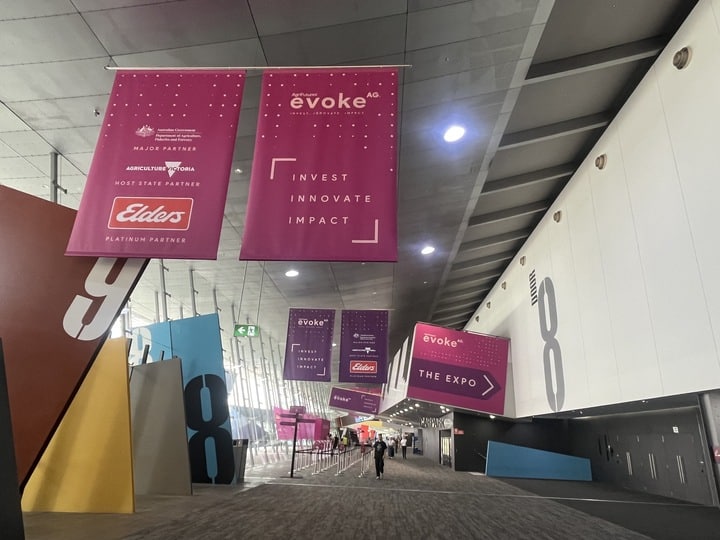
Provocative words from Andrew Bait, farmer, CEO and founder of SwarmFarm Robotics, the keynote speaker at the AgriFutures evokeAG conference in Melbourne, Australia.
The conference has seen many familiar discussions – including the oft-repeated lament of research excellence failing to translate to commercial on-farm improvements. So maybe it’s time to challenge the orthodoxy of Research and Development being part of the same continuum.
But more of that later.


Going beyond R & D
Many of the conversations have referred to the need for not just R (Research) and D (Development) but also E (Extension), A (Adoption) and S (Scale). All have different drivers, motivations and require very different expertise and levels of support. When lamenting the lack of academic spin-outs that have reached commercial viability, to expect everything to sit within a University or research institute are, to say the least, ambitious.
Currently the UK government is supporting the “A” through its ADOPT programme and the pilot Agri-Scale initiative is an acknowledgement of the challenges encountered in growing a business. So that’s the “S” (hopefully) taken care of – at least in agri-automation.
But why has the “E” – Extension – become, at best, an old-fashioned word in UK agriculture? Internationally, it’s often the bridge between an evolving innovation and building confidence among farmers to adopt a tech, tool or practice.
Hence the need for the joined-up agri-tech innovation ecosystem. It is a big ask to expect the Research – which is about generating knowledge – to seamlessly segue into the Development – which is about finding a market fit to address customer needs bringing in the farmers’ views and input.
And arguably there’s another initial-based problem to contend with.
Is it time to move beyond TRLs in agri-tech?
The “Technology Readiness Level” (TRL) system was originally developed by NASA in the 1970s for space hardware. It gives a simple, standardised, and structured scale of 1 to 9, from early research (1), to proven in an operational environment (9). Usually Research is TRL 1-3, and Development can be anything from 4 to 8.
It has come to be the universal mechanism by which governments, research institutions, funders and innovation systems have described technology maturity and potential proximity to market.
But does it really apply in the diverse, biological systems within which agriculture operates? It works best where systems are engineered, controlled, and predictable and testing environments can be replicated. It also assumes that an innovation moves in a linear way from the lab to a prototype which is then validated and deployed. And going back to Andrew Bait’s point – the TRL system doesn’t take into account farmer trust, behavioural adoption, or the economic variability under seasonal, real world conditions.
Nor does it consider regulatory risks.
Admittedly it provides a helpful common language for the innovation community to understand and simplifies cross-sector comparisons. It also demonstrates the likely time (and money) needed for commercial deployment and can also give a sense of the number of validation hurdles that have been overcome.
But increasingly it seems a less-than-ideal way of describing the evolution of technologies being developed for agriculture.
If not TRLs – then what?
Should we be considering a system that considers farmer adoption metrics, or some indication of industry validation? TRLs feel more about “technology push”, when we know in agri-tech it’s really about demonstrating market pull.
“Market readiness” may be more helpful – it’s a term used in the defence and aerospace industry which sees the value proposition validated, secures early customers and confirms scaleable demand.
A “Commercial Readiness Index” was developed by the Australian Renewable Energy Agency and evaluates other important parameters, such as bankability, regulatory readiness, and supply chain maturity. Especially in a complex system such as agri-tech – this feels very relevant.
“Adoption Readiness” is also crucial – this could measure parameters such as awareness among farmers, the level of interest in participating in trials, the use of demonstration plots, and the number of early adopters who go on to become customers.
Finally, “Ecosystem Readiness” would be a good indicator as to whether a supporting and enabling ecosystem exists to bring the innovation to commercial scale. These could include factors such as the availability of local farmer advice, the level of government support, access to finance, the skills and labour markets, and even parameters such as access to cold chain and logistics.
No easy answers
It’s easy to plead special cases for agriculture and argue why it doesn’t fit within the usual rules of engagement. But if we are to really become effective in R, D, E, A and S, as Andrew Bait pointed out in his talk, “The future of agriculture won’t come from those who think outside the box, but from those who realise the box was optional.”
Post Overview
Agri-TechE Related Posts

Stop press! Missouri Agri-TechE Connect announces companies off to St Louis

North Carolina a richly diverse agriculture and home to the Research Triangle Park
Tremap gives citizen scientists access to first global platform for tree recording
Irrigation as a service to unlock African potential

Opportunities in the US Midwest – April mission announced