
Is animal welfare on your Christmas menu?
 Agri-TechE
 From the roast turkey to glazed hams, pigs in blankets and joints of beef – as well as the cream (or custard, or brandy butter) with Christmas pudding, and even smoked salmon for a special breakfast, the festive feast relies heavily on livestock and their producers.
While most people (hopefully) prefer that the animals and fish providing their seasonal meals had a happy, comfortable life, and a rapid, pain-free death, we’ve been exploring how technology is helping to improve animal welfare standards.
A Low-Stress Life
We all need less stress in our lives, including livestock. Automated milkers enable cows to offer themselves for milking at will, which improves comfort and provides a bespoke feed ration to optimise the health and nutrition of each animal.
Virtual fencing (using collars that recognise GPS boundaries) reduces the risk of injury, and being able to remotely change the grazing area reduces stress to the animals of being moved with quad bikes or other vehicles. Drones are also being deployed to move and monitor sheep at (far) more than arms-length.
Hydraulic chutes and automated handling systems have also been designed to help make moving and treating animals and fish less stressful, minimising their contact with humans.

Monitoring for Malaise
Trackers and collars, enrichment solutions and environmental monitors are now able to identify changes to animal health and behaviour and provide the opportunity for action.
Computer vision and machine learning is permitting earlier identification of lameness in cattle and the onset of mastitis can be detected by changes in the electrical conductivity in milk around 24 hours before the cow starts to show symptoms.
And a healthy environment makes for better welfare. Detection of volatile organic compounds in the breath of calves and in the air of poultry sheds can reveal pending illness (as in the case of technology by Roboscientific).
Plus, underwater sensors and drones are being used to monitor water quality and analyse behaviour of farmed fish.
Multi-disciplinary Moooves
But what does “well-being” mean for animals?
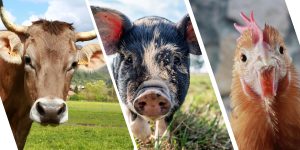
It is easy to be anthropomorphic about what makes a “happy” animal or fish. Of critical importance is the need for data-based benchmarks as to how a “normal” cow, pig, sheep, chicken or fish behaves. And behavioural ecologists are critical to helping understand behaviours under different states of stress, in order to learn to monitor and reduce them.
Increasingly we are seeing vets either working alongside tech developers (as in the case of Nantwich Farm Vets) or starting their own companies (such as AgSenze and Vet Vision AI) to ensure a sensible correlation between behaviour and health and well-being.
One of the best pieces of advice even given to me about animal welfare was: “just watch your animals. You’ll know when something is wrong.” That’s easy to do with just a few individuals, but at industrial scale we need to deploy the tech to do the watching for us – and then advise on those all-important actions.
Perhaps nowhere is the need for a multi-disciplinary approach stronger than when trying to develop, integrate and adopt new innovations to enhance livestock welfare, alongside the productivity and profitability agendas.
The UK has one of the highest welfare standards in the world. Let’s get technology rolled out globally to ensure all livestock has the happiest, healthiest life possible.
If you are developing or using new technologies to improve animal, welfare, why not join our online event on Jan 27th – “Moooving the Oinkspiration” and be part of the conversation.
Post Overview
Agri-TechE Related Posts

AbacusBio believes the Precision Breeding Act presents a ‘huge opportunity’
ATW 2025: ‘Making the Most of Organic Materials’

‘Speed carousel’ brings a new spin to the technology showcase

How open collaboration in agri-tech could help solve the farm profitability puzzle

Connect, Co-Develop, Co-Exist: the REAP Report 2025 is launched
