Hutchinsons research reveals a digital transformation on-farm, defying the investors
 Holdsworth Associates
“Investors don’t believe farmers will adopt digital technologies,” said George Marangos-Gilks, CEO of Messium. The City evidently hadn’t spoken to the hundreds of farmers that attended the Hutchinsons and Agri-TechE Connected Farming Conference 2024, observes Rachel Holdsworth.
A Slido poll quickly showed that George was in the right room.
53% of the delegates described themselves as ‘early adopters’, ready to be within the first wave. A further 29% were ‘innovators’, keen to try anything new at the first opportunity, and the remainder were ‘followers’, happy to let others try it first.
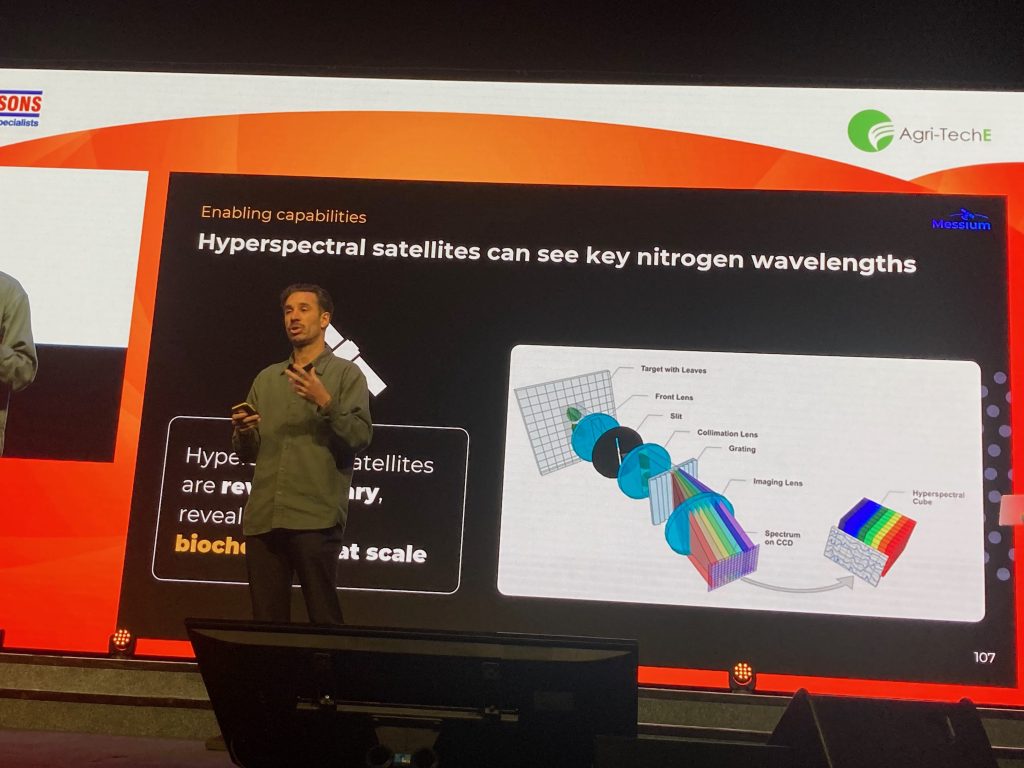
Messium’s satellite technology uses hyperspectral imaging to deliver improved yields with lower nitrogen inputs. Farmers contributing £300 to take part in the Messium trial will receive regular reports on the status of their crop, recommendations of when and how much nitrogen to apply, a discount on the service in the future, and a money back guarantee if not suitably impressed.
Trials on commercial farms in the UK and Australia have demonstrated that yield performance can increase with accurate knowledge of the plant health and weather forecasts. The pilot next summer is to further train the AI models, ground-truthing the satellite information against lab tests.
“Please have a look at the website and answer four questions while you are there,” George appealed to the room. “Investment is a massive issue; I need to show I have your support.”
The need for digital technologies to manage the challenges facing the industry was further supported by a Communagator survey commissioned by Hutchinsons. It gave a snapshot of the views of 200 growers on arable or mixed farms of over 100 hectares across the country.
The survey revealed significant penetration of digital technologies.
Half of respondents said digital technology is of increasing importance, rising to two thirds among the largest farms, with potential cost savings being a major driver, followed by yield improvement and efficiency. Three quarters were using autosteer technologies, whilst 40% were using variable rate fertiliser and seed applications.
John Deere’s platform GreenStar was the most widely used digital precision agricultural tool by some margin, with weather apps and What3Words also being used by the majority of farmers.
The desire to increase the accuracy and targeting for nutritional inputs, particularly nitrogen, was supported by the popularity of the AHDB Nutrient Management Guide and Hutchinsons’ Fieldwise Pro, both of which featured highly. 37% of respondents were using variable nitrogen applications.
Also apparent was the extent of the challenges facing farmers, with 72% citing concerns around climate change and a significant proportion anxious about profitability, with issues around end market prices, high cost of input, labour and economic uncertainty.
Three quarters of the farmers felt confident in using technology, but many said they were insufficiently aware of what is available, citing time needed for research and training as a major limitation.
Dr Belinda Clarke, Director of Agri-TechE , addressed this, describing how its Farmer First programme provides a useful introduction to the emerging technologies.
For the field view, farmers Richard, Will and Tom expanded on their use of precision agriculture – describing the smartphone as a ‘digital toolbox’.
Of increasing value is the ability of tools to calculate the ‘cost to grow’, which provides information needed to know when it might be more preferential to release land from food production to SFI or indeed to diversify (one of the farmers had set up a profitable dog park and started an olive grove).
Managing green energy was another rich source of income generation/cost reduction, with digital technologies enabling a fine degree of control over how and when to use the grid to access cheaper energy.
With environmental legislation deluging the industry, a switch to renewables to reduce GHG emissions is becoming attractive on many levels – both to retailers and brands wanting to reduce their Scope 3 exposure by selecting suppliers with lower carbon footprint, and also, more recently, for farmers wanting to access a lower rate of interest on finance.
HSBC has introduced a new initiative that rewards companies reducing their environmental impacts with preferential interest rates.
The speakers accurately reflected the views of the delegates, with 38% of those at the event saying the prospect of better phone signal was getting them excited, followed by 22% who were anticipating driverless tractors and robots for planting and weeding.
David Hutchinson, Chair of the Hutchinson Group, concluded the event talking about how farmers don’t need complexity – the ability to enter data once and link it to an animal, crop, or field is in itself a major breakthrough. He accepted there are still real concerns over data ownership and sharing, but these are being resolved, and he looked forward to the next era of the digital journey.
- *I have permission from the copyright holder to publish this content and images.
Related Posts

Antobot expands expertise in Viticulture through Project VISTA

Embracing Game-changing Technology
New hyperspectral satellite imagery crucial for lowering nitrogen use amid rising fertiliser costs
AI to improve yield forecast accuracy
Yagro connects farmers and suppliers with ease