ATW 2024: Exploring the route to net zero; what role regenerative agriculture?
 Niab
NiabAgri-TechE Week 2024 celebrates its 11th year – our largest yet, featuring nine events curated by Agri-TechE and hosted by our incredible member community. This week exemplifies innovation, collaboration, and forward-thinking in agri-tech.
Each event reflects the strength of our ecosystem, fostering vital connections between growers, researchers, and technology developers. Thank you to our members for hosting and making Agri-TechE Week possible and showcasing what our community can achieve.
The regenerative agriculture movement has largely grown as a result of a focus on the importance of soil health to support farming system resilience. The focus has widened to include regeneration of biodiversity as well as a rediscovery of the role of biological cycles, alongside more targeted use of inputs to support high quality food production. It was therefore timely for this workshop to explore the role of regenerative farming in the UK in the context of both adaptation of food systems to climate change; and encompass the potential role of farms in the bioeconomy and the potential to achieve net zero.
Dr Lydia Smith welcomed all to Niab and the workshop; handing over to Dr Belinda Clarke (Director of Agri-TechE ) to highlight its place in the week of Agritech events across the region. Belinda noted that the event was well supported, as were all over the week. She encouraged join in discussions during part two, to identify possible next steps needed.
Dr Smith introduced the Centre for High Carbon Capture Cropping (CHCx3). This four-year, multi-partner project, led by Niab, aims to help UK farmers and growers target Net Zero through carbon capture and reduced emissions. Looking at building farming resilience through diversifying arable and forage cropping. It will contribute to considering revenue sources through carbon marketplaces and supporting enhanced value chains for industries such as textiles and construction.
The purpose of the day was to explore the potential for regenerative agricultural strategies that might provide a route to Net Zero.
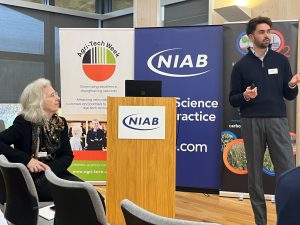
Liz Bowles (Farm Carbon Toolkit) highlighted actions needed, both to increase soil carbon sequestration and to reduce carbon emissions on farm. She highlighted the importance for agriculture and food systems of considering all greenhouse gases (GHG, including carbon dioxide, nitrous oxide and methane). Liz summarised the evidence base for a range of regenerative farming practices and their impacts on farm finances, GHG emissions, and ecosystem services; highlighting that evidence was often patchy, but that key principles can allow farmers to make a difference. Liz highlighted some positive benefits of transition to regenerative practices but that these were site and system specific.
Andrew Ferguson (Leckford Estate, supplying Waitrose) gave an absorbing case study describing how he and his team have been using evidence from their own farming practice and its impacts to drive forwards more regenerative practices. They aim to improve farm resilience and help Waitrose meet net zero commitments, whilst providing financially viable farming. In the dry summer of 2023, they saw many benefits from using herbal leys, compared to grass leys in giving more durable forage supply. These fields with higher soil organic matter levels then gave higher cereal yields, partly due to better soil moisture retention.
Dr George Crane (Yara Growth Ventures) described the role of investment in start-ups and in venture capital funds in bringing new science and technology to the food and agriculture industry. He highlighted how investments can make new products and services available (e.g. biological soil improvers, methane-reducing feed supplements, autonomic machinery, etc). He discussed how new monitoring and verification systems would be needed to make Carbon Trading affordable and accessible. He highlighted the importance of developing clear Supply Chain Traceability e.g. products coming from regenerative farm systems for consumers.
Miha Pipan (Better Origin Ltd) described how insect farming can provide one circular approach can providing new opportunities in waste valorisation. He explained how certain waste produce can be converted into black soldier fly larvae; which can be used for feed and potentially food. He highlighted the sustainability benefits of a circular food waste system, but also considered challenges encountered in scaling up, accessing capital, and navigating very difficult legislation.
Dr Stéphanie Swarbreck (Niab) explored the role of improved nitrogen (N) use efficiency on the pathway to net zero. She described how variety selection and pre-breeding activities will support regenerative farming systems. Some new characteristics of varieties are being considered including N requirements and efficient utilisation, whilst minimising emissions of the potent GHG nitrous oxide. She also considered weed competitiveness, and crop establishment following direct drilling.
Discussions in three rotating groups then discussed knowledge gaps and economic considerations relating to the opportunities for farmers in the bioeconomy and in the potential for achieving net zero.
The new crop opportunities group discussed which alternative crops had potential, legumes (especially soy and lentil) leguminous forage species including lucerne and sainfoin; fibre crops such as hemp and flax; and perennial and mixed cropping, such as, agro-forestry, and agro-floristry systems. They considered options that consider both food and financial security of farmers, but that enable regenerative practices. The group looked at incentives to enable this and identified mainstream funding and more local focused initiatives such as Powys’s Our Food 1200 project). The group also considered that value chains, market development, and international co-operation, will help to drive these changes post-Brexit.
The arable group discussed whether crop choice could improve rotational N-use efficiency, noting that integration of legumes within the system was key. It was noted that it is important to consider the value of break crops across the whole system, rather than solely in terms of their own profitability. The group also identified other under-utilised crops/varieties, such as hard red wheats and noted that farmers (and their advisors) often lack all-important agronomic strategies needed to integrate these crops into rotations.
The forage / perennial ley group considered whether grassland can be incorporated into both livestock and arable systems. They discussed the need for focussed breeding for species in optimised forage and grass seed mixes. They considered whether heritage varieties might help in activities to breed lines with greater N-use efficiency; suggesting that knowledge from more extreme growing environments might be useful. There should be caution that success should be determined by the most appropriate metrics rather than those most easily measured.
Related Posts

Innovate UK engineering biology SPARK Award Showcase webinar

Defra’s Science Chief Announced as REAP Conference keynote
Paul-Tech Enhances Its Soil Stations with a Third Sensor
Proving the Recovery: Why (Re)wilding Needs Rigorous Soil Science
Farmer Charlie Conducts a Pilot with 50 Farmers in the UK