Agri-TechE Week 2018: Scientific Advances in Agriculture
 Agri-TechE
 As part of Agri-TechE Week 2018 Earlham Institute presented a three-part workshop featuring Carousel Activities of live demonstrations, laboratory tours and finished with transforming food workshop discussions.
The aim of the event ‘Scientific Advances in Agriculture’ was to facilitate discussions between scientists on the Norwich Research Park and the local agricultural community to encourage greater collaboration.

The presentations included:
MinION live genome sequencing demonstration – Dr Peter Bickerton, Scientific Communications and Outreach Manager.
Biomanufacturing insect pheromones to control agricultural pests – Dr Nicola Patron, Synthetic Biology Group Leader.
The Future of Wheat Breeding – Dr Anthony Hall, Head of Plant Genomics.
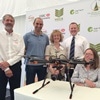
The in-field crop monitoring system demonstration by Dr Ji Zhou, Phenomics Project Leader, was very popular as it featured the CropQuant robot.
CropQuant provides continuous monitoring in-field of the micro-climate, providing unique insights into crop performance. It monitors the crop growth and its growing environment using a suite of sensors and an imaging ‘eye’ that can extend up to three metres. This allows visualisation of the crop canopy as it grows.

The data is processed using machine-learning based algorithms to create a very detailed picture of the way that a particular variety of wheat grows in the field, allowing comparison between different genotypes and a better understanding of how performance can be enhanced. It is well known that there is often a big gap between the potential yield of wheat and that actually attained.
The data obtained from CropQuant will allow analysis of the multiple factors involved to provide better models for forecasting and also decision making about application of fertiliser or the best timing for harvest. Dr Ji Zhou explains that the environmental factors that determine crop growth – soil moisture, humidity, temperature (ambient and soil) and light level – can now be measured easily with cheap sensors built into the robot, which then feed into the growth predictive model.
The event was very successful; Dr Belinda Clarke commented: “It was a good evening last night at Earlham – they were really thoughtful about how they organised the event and there were a number of farmers there, which was excellent.”


Post Overview
Agri-TechE Related Posts
Using AI to fix fractured value chains: a path best tackled facing forward
Engineered wheat contains double the iron
Start-Ups showcase exciting agri-tech opportunities at REAP
Agri-tech set to revitalise essential industry sector
Digging into the detail of the Strategic Potato Farm