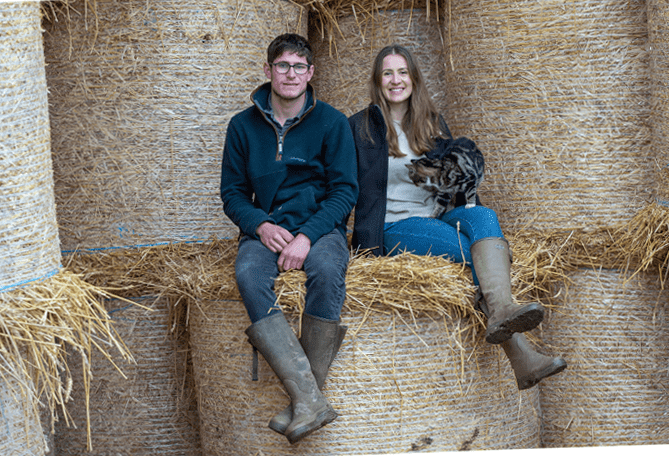
Could a land-use framework support a ‘just transition’ to Net Zero?
 Holdsworth Associates
UK’s Net Zero economy has grown by 10% in the past year, and the UK is positioning itself to become a global hub for transitional finance*. This ambition could also be used to fund a move to regenerative agriculture, changing the mindset that sustainable food production comes at a cost to society, observes Rachel Holdsworth.
Increasingly banks and investors are offering preferential finance to companies that have reduced their climate risks and have high ratings on voluntary disclosure platforms. To achieve this, companies need to further reduce their carbon footprints – and the solutions could come from agriculture.
Farmers are in a unique position as not only can they reduce their emissions, but they can also actively remove carbon from the atmosphere into habitats – through improving soil, regenerative agriculture, and planting hedgerows and trees.
However, agriculture is often considered a separate entity to the wider business community. This means that farmers are not part of the conversation when green finance is being discussed.
Changing the mindset
Farmer Doug Wanstall has trialled a range of restorative systems on his farm in Kent and is also co-founder of Beyond Zero (beyondzero.ag), an organisation that is helping farmers and landowners transition to regenerative systems. He says: “We’ve always believed that the same land can deliver not just food, but also wider environmental benefits. We need to think about land differently and how it can solve multiple problems.
“We drastically underestimate how much opportunity there is in soil. With interventions they become deeper and more fertile. Our projects are getting some amazing numbers, year after year. Some farmers have increased their soil organic matter by about half a percent per year.”
Doug’s own farm, Bank Farm, in Kent is used as a model farm to show what is possible. He has experimented with growing sterile variants of Paulownia, a fast-growing tree from South-East Asia that produces hardwood. The UK currently imports 80% of its timber and Paulownia can grow to the size of a 40-year-old oak in just ten years – and can then regenerate.
Independent verification creating trust
Demand for high integrity carbon projects is increasing, driven by the need for businesses to be more transparent with their stakeholders.
Melanie Blackmore, co-founder of Carbonology (carbonologyhub.com), specialists in carbon standards verification, explains: “Sustainability is becoming integral to company performance. Increasingly we are seeing banks and investment institutes asking for evidence that a company has a credible carbon reduction plan.
“In some cases, they give preferential terms for loans, but in other cases they will refuse finance as the company is considered a high climate risk.
“Independently verified carbon reporting can also improve ranking on voluntary disclosure platforms such as EcoVadis and CDP, indexes increasingly being used by investors for valuations.”
Farmer-led initiative
Beyond Zero has taken a science-based approach to develop its framework, which aims to both build resilience in farm businesses and deliver high quality carbon projects for offsetting that are trusted by investors and the markets. It has about 15 approved projects, covering 300,000 hectares and a further 90 in the pipeline.
Doug continues: “The first obligation for all businesses is to have a credible carbon reduction plan and reduce their own emissions,” he says. “For many it won’t be possible to get completely carbon neutral so they will need to buy credits to offset their residual emissions.”
Each project is monitored through an intensive soil sampling protocol and remote satellite imaging. There is still much debate about the accuracy of testing and the techniques to use, but Doug says the key is to be consistent with the technology and process.
Beyond Zero has worked with Cranfield University to develop its soil analysis protocol. Its UK Carbon Code, used to verify projects, is gaining traction with farm clusters.
For each farm project, Beyond Zero creates baselines to work out the emissions and opportunities for carbon removal, with the aim to get the farm business to beyond zero as quickly as possible.
Once this has been achieved and the project audited, and approved, it is registered with the UK Carbon Code Registry. The project can then issue credits annually based on the net balance between their emissions and carbon removals – one credit for each one tonne of CO2 removed from the atmosphere above net zero.
Doug estimates that the current projects are generating about 450,000 credits a year.
“Once beyond net zero a farm can sell the additional carbon credits created from this positive action to large corporations.
“This could form a long-term supply and offtake arrangement that delivers constantly, improving how land is managed and delivering the co-benefits that follow a regenerative transition.”
Bank Farm will be opening on 1st May 2025 as part of an event with Carbonology and Nature Broking, a company that matches corporates with sustainability projects. Find out more at: naturebroking.com/events/bank-farm-may
* eciu.net/media/press-releases/2025/uk-net-zero-economy-grows-10-in-a-year-finds-new-report
- *I have permission from the copyright holder to publish this content and images.
Related Posts
In Conversation With: Henry Grover, Videographer of Ponda’s latest short film
ATW 2025: How can Agriculture Decarbonise the Supply Chain?
ATW 2024: Exploring the route to net zero; what role regenerative agriculture?
We reveal the Top Eight Innovations in the REAP 2025 Start-up Showcase
Data-driven environmental monitoring highlights significant variations in bird biodiversity